

Adrian Van Young on Growing Up in the Metal Scene and Finding His Way to Crime Fiction
Life and writing, with a jagged edge.
The night when I learned that I wasn’t a tough guy, I was in my early twenties, at a Motörhead show.
This was in New York City, 2006. All my headbanger buddies were with me that night—except for Luke, missing in action. Allegedly, he’d been pregaming and got bounced from his cab for an open container, forcing him to walk dozens of blocks to the venue more than half in the bag, inexcusably late. Once inside he rushed the stage, 6’4”, elbows out, hollering, “Killlllled byyyyyy deeaaaath!”
The guy who I saw him slam into ahead of me, soaking him in expensive beer, was a close-cropped and furious wedge of a man, like the Easy Rider-era Dennis Hopper of my nightmares. With Luke long gone, he turned, saw me. Motörhead, I remember, was playing so loud a strange, dreamlike pantomime took place between us: he came in close, quaking with rage and gesturing at his sodden vest while I performed what I thought must be a universal gesture: Bummer, man, but not my fault.
“What’s that, motherfucker?! What’s that?!” the man shouted.
He reached to grab hold of my shoulders for leverage, and rammed his head into my nose. Mine is not a small nose and it hurt, good and awful. “Is it bleeding?” I moaned, pinching the bridge. As it turned out, it wasn’t bleeding. It luckily wasn’t broken, either. But I’d just been head-butted, a tough guy rite of passage, so why did it somehow still feel like I’d failed?
As my buddies surrounded me, giving me pats, Luke returned from his mission of chaos down front. “Walk away,” he said, helpfully, “just walk away, bro.”
Though no part of me planned to do anything else, the head-butting biker seemed no longer bothered. With his hands jammed down into his vest, he was already back to enjoying the band.
*
For a bearded tattooed guy who mostly wears black and listens to artists with names like Witch Vomit, Magrudergrind, and Eyehategod, I’m less of a badass than I might appear—at least in the traditional sense of that word.
Sure, I’m street-smart, so there’s that. And while I wouldn’t say I’m a pushover really, I sometimes do tend to be conflict-avoidant. Still, in most situations, I handle myself—as confident and without fear as any straight, white man in our modern world from a very young age understands he can be. Yet ask my friends, my wife, my mom, none of them would describe me as outwardly tough.
I’m too open-hearted and friendly for that.
In emails, I use the word “lovely” a lot—“How lovely to hear from,” “Have a lovely day.” Retract your fist, please, and accept I’m a hugger. I smile too much in conversation, my mouth grimacing as the smile grows fatigued. With a professor dad and a therapist mom, I grew up in a lovely, historic enclave of San Diego, an indoors goth weirdo surrounded by beach. Somewhere out there today exist VHS tapes of me singing show-tunes in a baggy Van Gogh shirt belted into khaki shorts. I adore cheesy romcoms. I am not a good liar. But I am a good texter, too quick to respond.
Still to say heavy music is something I like would be a crushing understatement. If I’m wearing headphones or my family is distant, it’s what I put on when I stroll out the door, my Subaru Outback’s windows rattling, my headphones bleeding shrieks like a spirit possession as I bob down the streets of New Orleans or Paris, the two cities that I call home. And we’re not just talking Sabbath here. Or Motorhead (my poor, poor nose.) We’re talking cookie-monster-vocals, blast-beat-pummeled, feedback-driven-psychosis extreme heavy music. We’re talking music that could kill you if it didn’t make me, at least, feel so alive.
*
As a kid, I came up in the hardcore punk scene in San Diego in the 90s.
Though the name of that city sounds hardly synonymous with a rebel disdain for traditional values, the scene then was actually pretty legit. The Locust, Cattle Decapitation, Durga, and Hot Snakes are just few of several SD heavy bands my friends and I showed up to watch on the weekends at certain foundational all-ages venues—like the Che Café collective on the UCSD campus, a vegan, social justice hub, or Locust House which was (surprise) the immense party house of the guys in The Locust, a grindcore brigade of well-dressed UFOs.
Being part of the San Diego scene—which often overlapped with metal—ensured I was exposed from a fairly young age not just to a cohort of scrappy creatives allied with the causes of justice and equity (as punk tends to be in a best-case scenario). But also to what I would understand later as life’s seedier, tougher, shadow side—what folks in the “norm” world refer to as crime.
Both sides benefitted me as a young person. More so even as a writer.
*
At the real risk of channeling Roy from Blade Runner, as a young punk kid I saw some things.
I’ve been wasted on fortified blackberry wine with some homeless crust lords in an overpass squat. I’ve chilled with a crew of junky hipsters in their heroin den above a shitty Chinese restaurant, fittingly, with a cartoon dragon swooping down from the side of the glowing gold sign. The gnarliest of it came at shows: I’ve seen people smashed over the head with beer bottles, trounced bloody and bruised in the heart of the pit, knives brandished in parking lots, dudes pissing off rooftops, zombies half-dead on heroin passed out in bathrooms. I’ve been wingman for plenty of jittery drugs deals and even bought some drugs myself.
*
Not that metal or punk have been strangers to crime.
Shock-punk impresario GG Allin (aka the “Charles Manson of rock”) habitually assaulted fans both on and off stage—a troubling amount of young women among them.
Varg Vikernes of the Norwegian black band, Mayhem, was arrested in 1994 for the stabbing murder of Mayhem’s guitarist, Euronymous, which came at the height of a national crime wave fueled by black metal scenesters across Scandinavia and itself boasting grave desecrations, church burnings (I drew on this history in writing Rough Beast.)
“Dimebag” Darrell Abbot of New Orleans’ Pantera was murdered in 2004 when a ravenous fan shot him on stage.
*
Now solidly in my middle age, I still go to shows, but with different priorities.
Arrive early, leave early. Nurse only one beer. Always bring cash for merch so you don’t have to buy it (like you’d pack an umbrella to ward off the rain.) Plus, I’ve gained some perspective on how I was able to move through the shadier side of punk rock without ever becoming an addict myself, getting stabbed in the dark, ending up a roof pisser.
Through not being a tough guy, but being myself, an observant and affable fly-on-the-wall, I was able to curry some risky encounters into detail-rich fuel for the stories I write.
I suppose that I wasn’t unlike Sammy Singerman, the narrator of my new crime novel, Rough Beast, about a New Orleans black metal band on the skids whose front man is murdered their last night on tour. While Sammy is initially arrested for the crime, upon his release he becomes a detective, trolling New Orleans’ underworld of heavy music, drugs, and murder to unmask the killer and get some revenge. Sammy flows through the darkness and squalor like I did, observing punk-rock’s shadow side from afar.
As I researched Rough Beast on the ground in New Orleans in the metal and punk venues lining St. Claude and the gas-lantern flickering streets of the Quarter (the most fun research, I can promise!), I was always that dude in the back of the club with his Notes app aglow, drinking everything in. Genuflecting like knights before battle, I wrote of a doom band about to start their set.
More than bros, I wrote. Way more—of two scruffy young bucks at the base of the stage.
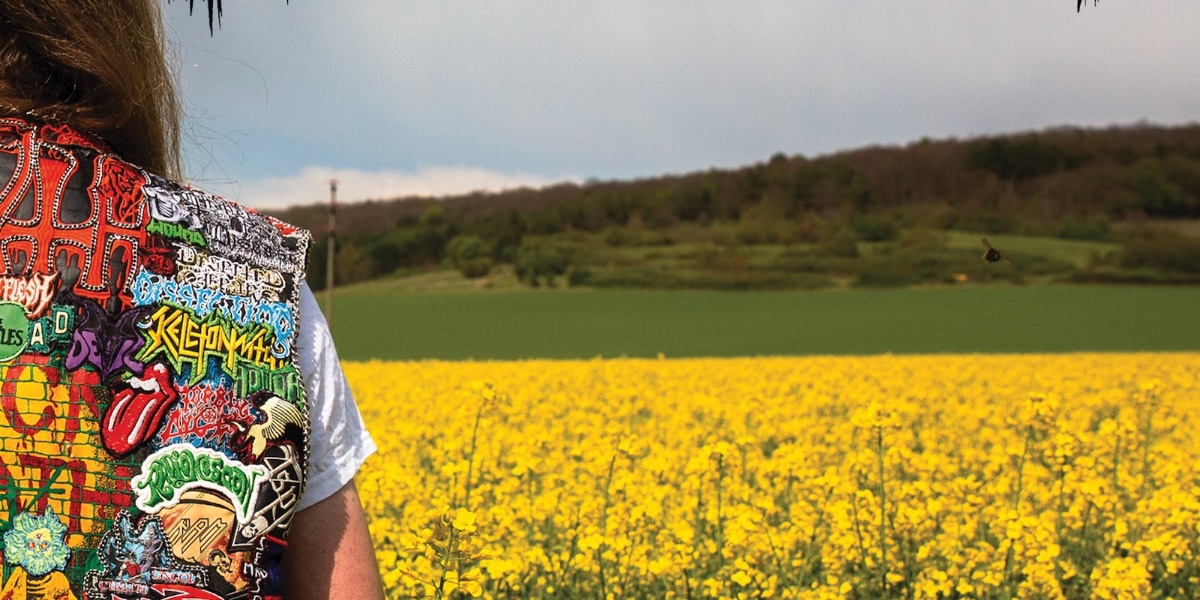
Metal elder, I wrote of the scraggly white-beard in the bleached denim vest half-covered in patches (what metallers call a “battle jacket”), slumped over his PBR pint at the bar, watching the room with a tight-cornered smile.
*
That damaging night of the Motörhead show, I ended up taking Luke’s advice, putting distance between my head-butter and me.
I ended up somewhere beside the back bar, where I watched the band, and the guy at a distance. Though on some basic level I was terrified of him, I couldn’t deny I was fixated, too—in the way we’re all drawn toward the things that can hurt us.
I watched him sort of roll his shoulders, as though to assure himself all was okay—and I watched him still flinging the beer from his vest with a both-handed fussiness verging on mania. I watched him get back in the groove of the band, his shaved bullet-head bucking awkwardly forward, his sinewy arms straining tense as bridge cables. I watched him throw up devil’s horns.
You could say he never saw me coming. He never saw me there at all.


Adrian Van Young
Adrian Van Young is the author of four books of fiction--most recently, a novel, Rough Beast. His short fiction, essays and criticism have been published in Conjunctions, Guernica, BOMB, Granta, and McSweeney's, among many others. He lives in New Orleans with his family, where he teaches intermittently, but is mostly a professional freelance editor. Read more at: adrianvanyoung.com.