

Anna Rasche on the Hope diamond and the trope of cursed jewels in literature
The author of The Cursed Diamond explores the allure of magical jewelry
Each year approximately six million people visit the Hall of Minerals in the Smithsonian Museum of Natural History to jostle for a glimpse of the infamous Hope Diamond. Many are afraid to get too close. This singular stone has passed through the hands of adventurers and royalty, heiresses and actresses. And according to legend it brought almost all of them to a bad end.
Today, the Hope epitomizes the “cursed gem.” An object as alluring as it is dangerous; all the wealth of a kingdom, condensed into something that could be forgotten in a coat pocket. But it is hardly alone. Evil jewelry lurks in our earliest mythologies, embeds itself in the pages of history books, and stands at the center of some of our most celebrated works of modern literature.
An early example is the cursed Necklace of Harmonia, wrought by a cuckolded Hephaestus, Greek god of the forge, as a passive-aggressive wedding gift for the daughter born of his wife’s infidelity. Nonnus describes the necklace as a golden tangle of snakes and eagles, encrusted with gems. The tragedies of Oedipus and that of Acteon, who was torn apart by his own hunting dogs, can be traced to this sinister family heirloom.
In India, the Sanskrit texts of the Bhagavata Purana tell of the Syamantaka, a jewel, perhaps a ruby, gifted by the god Surya to the mortal King Satrajit.
The Purana states: “It was the peculiar virtue of that gem, that if worn with all purity it would yield gold and prosperity of the kingdom but if worn by a man of bad character it would bring on his death.”
Indeed, as soon as the stone was in mortal hands it set off a chain of violent deaths. The impure men who possessed it were mauled by a lion, murdered in their sleep, and decapitated. Historians Anita Anand and William Dalrymple hypothesize that the legend of the Syamantaka is the original “curse” legend, one so often attached to important Indian gems.
In the seventeenth century the French gem merchant Jean-Baptiste Tavernier traveled to India, unbothered by any tales of curses. He returned to the court of Louis XIV with spectacular diamonds from the fabled mines of Golconda. One of them would eventually be recut into the Hope diamond. Though Tavernier wrote hundreds of pages about his travels, he never told how he acquired the blue diamond (good business for a gem merchant).
In the absence of a true account, a rumor took hold. It was said that Tavernier prised it from the eye of an idol, invoking a terrible curse. Word spread that he, like Acteon, was eaten by dogs.
What is known for certain is that this blue diamond was stolen during the French Revolution, smuggled into England, and recut to hide its royal French provenance. It reappeared decades later and significantly lighter, in the collection of banker Henry Phillip Hope. Today, most gemologists agree that the missing carats became dust on the cutter’s wheel.
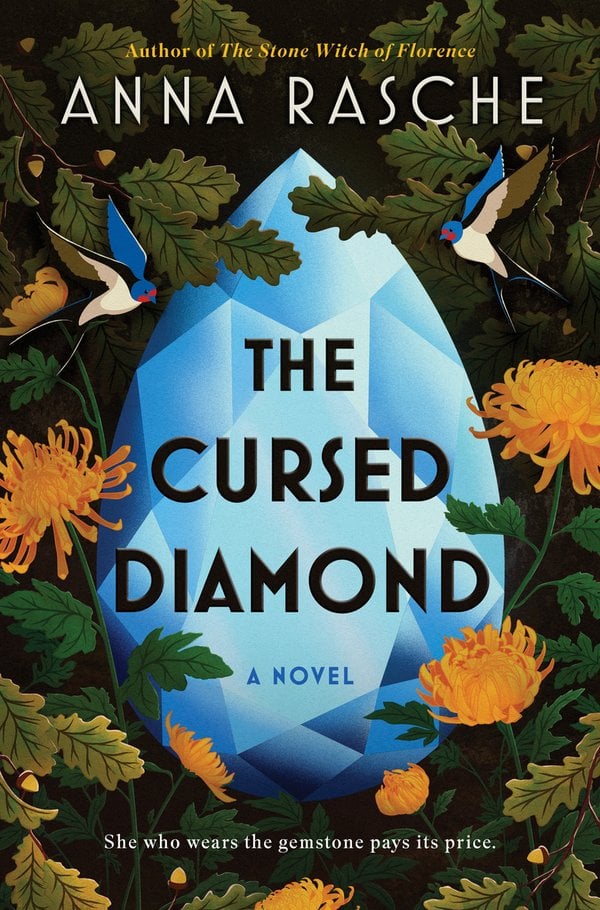
But for a long time it was believed another stone was cut, a blue brilliant of about ten carats. It was said to be owned by the mad Duke of Brunswick, a voracious collector of gems who died exiled from his ancestral seat. The duke’s effects were sold at auction and the blue diamond disappeared. The Brunswick Blue is the mysterious stone, a maybe-sister of the Hope, that inspired the fictional gem called the Midnight in my novel, The Cursed Diamond.
The Hope reemerged in England in the1830s, amid a Gothic Revival where cursed jewels fit right into the zeitgeist. Anne of Geierstein by Sir Walter Scott, published 1829, tells of Lady Hermione, who turned to ash when her precious opal was touched by holy water. (It was Scott’s fiction that launched the still-enduring superstition of opals as unlucky stones). Murky origins aside, the Hope was displayed as a national treasure at London’s Great Exposition of 1851, alongside another Indian diamond with a sinister history.
The Koh-I-Noor, the “mountain of light,” was once a principal treasure of the Mughal Empire. It came into British possession in 1849 after a particularly heartless agent of the British East India Company extorted it from the last Maharaja of the Sikh Empire, the ten-year-old Duleep Singh. The ship that carried the stone to England was plagued by tempests and cholera.
When it was finally presented to Queen Victoria, she accepted it with reluctance, believing it cursed. Luckily for her, an addendum was soon added: the curse only applied to men. To this day the Koh-I-Noor remains in the Crown Jewels of the United Kingdom, a source of contention with India.
Inspired by the Koh-I-Noor, Wilkie Collins invented The Moonstone—the fictional yellow diamond at the center of his 1868 bestselling novel. In this ur-detective novel, a young Englishwoman lands in trouble after inheriting a gem stolen from a Hindu idol by her unsavory soldier uncle. The Moonstone’s success fixed the typical arc of a cursed jewel in the western imagination: illicit origins, greed-induced folly, and bitter ends for those who coveted what was never theirs.
In 1901 Lord Francis Hope sold his family’s blue diamond to cover debts he’d racked up partying his way around the globe with then-wife, American actress May Yohé (Yohé would die in impoverished obscurity, blaming the Hope Diamond for her troubles). For the next eight years the gem passed quietly between dealers and buyers, landing with famed jeweler Pierre Cartier.
Soon, newspapers were cataloguing the misfortunes of the Hope’s previous owners: kingdoms lost, carriages overturned, ships wrecked, heads removed. It is a dark and un-fact-checked history, allegedly encouraged by Cartier to add intrigue and close a sale with American gold heiress Evalyn Walsh McClean and her husband.
After the McCleans purchased the diamond, their lives were marred by tragedy: madness, addiction, political scandal, and accidental deaths. Even so, Evalyn wore the Hope until her death. “Bad luck objects, for me, are lucky,” she said.
The trope of the cursed jewel, a treasure that brings great joy and great sorrow, continues to captivate and inspire works of fiction. It lives in Tolkien’s One Ring. It goes on and on as the Heart of the Ocean in Titanic and burns bright as the Sea of Flames in All the Light We Cannot See. Now, in The Cursed Diamond, it manifests as an icy blue stone called the Midnight, my own humble addition to this enduring lore.
***

Anna Rasche
Anna Rasche is a historian and gemologist who has previously worked in the jewelry collection at the Metropolitan Museum of Art and as a curatorial fellow at the Cooper Hewitt, Smithsonian Design Museum. Rasche's debut is based on original research she conducted on the uses of gemstones in medieval medicine at the Cooper Hewitt Museum and on site in Italy. She lives in Brooklyn with her husband and infant daughter.