Appalachian Jump Scare
Michael Amos Cody on crime, terror, and the Appalachian sublime.
I remember a summer night when I was in my late teens. I’d been at my cousin Joey’s house atop the hill behind my own house. My guess is I’d been helping Joey mow his yard so he would be free for whatever adventure we’d planned for the next day. However it was, I found myself following the rattling mower down the path between our houses.
Night had fallen, and the landscape around me—the hillside field our path bisected, the two-lane strip of U.S. Highway 25-70 below me, the hills that rose on the opposite side of it, the age-rounded Appalachian ridges beyond—was lit by moon and stars and scattered security lights mounted on creosote poles in front yards or above basketball goals attached to the sides of barns.
Lost in the beauty in front of me—beauty that fell away into the valley where my house stood and then rose from there to the near horizon—and the words and music that always filled my head, I was unaware that Joey followed close behind me in the dark, his footsteps masked by the rattle of my old push mower. When I reached the bottom of the hill and crossed the double dirt-track driveway, Joey hunkered down behind the Ford LTD my mom and I shared.
I rolled the mower into the weathered wooden shed we called “the garage,” threaded a chain through well-worn holes in the wide door and adjacent wall, and secured it with a padlock. This work was done by feel and a faint radiance from the night sky, the only visible lights at the garage being our security light some fifty yards away on the other side of a big pine tree and the warm lamp-glow of living room windows where my mom and dad and grandmother sat watching TV.
As I recrossed the driveway by the rear of the LTD, Joey showed impressive restraint, I must admit. He didn’t pop up and shout, “Boo!” He didn’t reach out to grab me by the arm or ankle or jump out and tackle me. He simply released the breath he’d been holding, released it with maybe a hint of growl in his chest.
I crumpled to my knees. Then, within moments, we were laughing our asses off.
This little vignette, although innocent and fondly remembered, demonstrates some sublime qualities available to the writer of crime thrillers set in mountainous rural areas, in villages and small towns nestled against or tucked into the folds of mountains, and, for me particularly, in “my own little postage stamp of native soil” that is “Bloody Madison” County, located in western North Carolina’s slice of southern Appalachia.
In crime stories set in rural communities and small towns, the cliché one interviewee or another seems almost scripted to repeat is some variation of “Around here, people never used to lock their doors.” More often than not, the implied new impulse to lock doors isn’t to protect against unknown strangers or the arrival of some wickedness from a faraway city or country; the sad realization that longtime neighbors or best friends (even cousins) can’t be fully known results in a kind of cinematic jump scare. Terror originates suddenly and from close proximity. If it’s true what most crime stories claim, that people suffer and die at the hands of somebody they know, then in such communities as my fictional Runion, in “Bloody Madison” County, NC, jump scares are built into the social fabric, as whole families and adjacent kin can live along the same valley road or along the same mountain ridge.
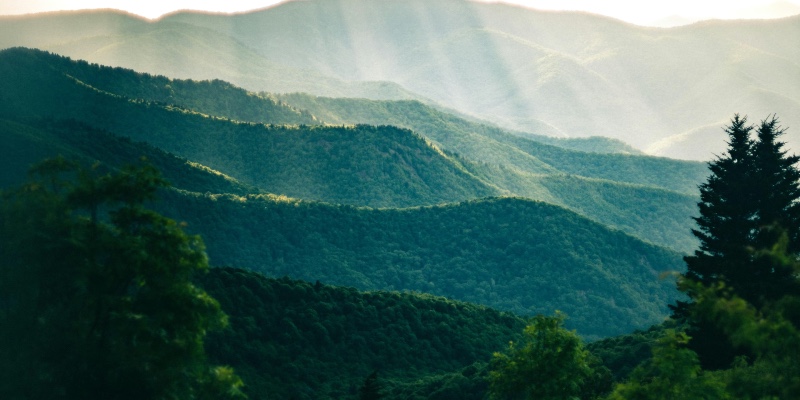
Likewise, landscape itself—particularly, I think, mountain landscapes—can be laid with explosive shocks to the system of a protagonist or community. Appalachia’s striking natural beauty can provide cover for wide-ranging crimes to create an example of the sublime described by eighteenth-century Irish philosopher Edmund Burke as a blend of beauty and terror. The mountain terrain is both lovely and dangerous, lushly inspiring and imaginably terrifying, at once a place of solitude and a place of isolation, a place of scenic winding roads and hiking trails, off the beaten paths of which stands a potentially disorienting and deadly wilderness.
A family might rightly be proud of its dream home or its ancestral home nestled in some verdant cove above the French Broad somewhere north of Asheville, where they feel protected by the luxuriant green hills that stand guard on three sides. But pride and supposed familiarity can become blind spots. The forest that surrounds them is home to playful squirrels and photogenic deer, almost certainly, but somebody—perhaps somebody our idyllic family knows—could be perched two hundred feet up the hillside and looking down into the yard, learning or confirming the family’s habits, their comings and goings. I think of Cormac McCarthy’s Lester Ballard from Child of God (1973) watching John Greer’s property (formerly Ballard’s own homeplace): “He’d watch from his . . . promontory, see Greer come from the house for wood or go to the barn or to the chicken house. After he’d gone in again Ballard would wander about aimlessly in the woods talking to himself. He laid queer plans.”
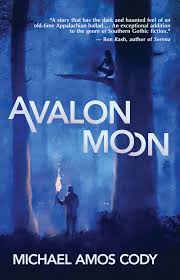
The summer night my cousin pranked me provided a memory that still makes me smile a half century later. But characters like Lester Ballard—several of whom I’ve known in real life—still make me shudder with the realization that somebody else might have been watching me make my rattling and oblivious way down the hill from Joey’s house to mine. In my new novel Avalon Moon, I’ve tried to make myself shudder, to capture a sense of the Appalachian sublime through landscapes and characters both rich and strange. A rocky promontory high on a mountainside, a fading river island community, an abandoned shack in a dark mountain valley become scenes of both love and terror. Characters quirked by their desires assume the objects of those desires to be familiar and safe. Some will survive their assumptions. Others won’t.
***

Michael Amos Cody
Michael Amos Cody was born in the South Carolina Lowcountry and raised in the North Carolina highlands. He spent his twenties writing songs in Nashville and his thirties in school. He's the author of the novel Gabriel's Songbook (Pisgah Press) and short fiction that has appeared in Yemassee, Tampa Review, Still: The Journal, and elsewhere. His short story collection, A Twilight Reel (Pisgah Press) won the Short Story / Anthology category of the Feathered Quill Book Awards 2022. Cody lives with his wife Leesa in Jonesborough, Tennessee, and teaches in the Department of Literature and Language at East Tennessee State University.