Tori Eldridge on Capturing the Culture of Hawaii's Cowboys in Her New Novel
The author of Hawai‘i Rage explores the Pacific islands' history of paniolo
After writing my first Ranger Makalani Pahukula mystery, Kaua‘i Storm, I couldn’t wait to explore our rich paniolo culture with Hawai‘i Rage. I mean, come on…cowboys in Hawai’i? How sexy is that!
When people think of my homeland, cattle-ranching does not usually come to mind. They are more likely to envision warm waters and mai tais on the beach or the natural beauty of our ‘āina—our land. Although visitors can book a horseback riding adventure, unless the stable is on a cattle ranch or run by paniolo, they might assume it’s a typical vacation activity and attribute no more significance than that.
Few malihini—the Hawaiian word for visitor or foreigner—realize that the Hawaiian Kingdom had cowboys before the United States. Surprising, but true. Although the Spanish began ranching in North America in the early sixteenth century, the first Anglo-owned ranch wasn’t established in Texas until 1828. The Spanish-Mexican vaqueros taught Hawaiians to ride in 1832, seventeen years before Texas became a state.
Choosing the setting for my paniolo (Hawaiian cowboy) story was easy. It had to be Waimea—also known as Kamuela—where King Kamehameha III first brought over the Spanish-Mexican vaqueros from Alta California. It is from these Españolos that the word “paniolo” was derived.
But how did horses and cattle reach the Hawaiian Islands in the first place? Like most everything else, they were brought from far away.
The first longhorn cattle—six cows and one bull—were gifted to King Kamehameha I by British Captain George Vancouver in 1793. A year later, Vancouver returned to Hawai‘i with a dozen more and encouraged Kamehameha to engage in the dairy and beef industries. But after putting a kapu on killing the longhorns, they multiplied out of control.
The first four horses that arrived in 1803 were wild mustangs from Spain. But at this time, the Hawaiians did not know how to ride or cope with the feral cattle that would come down from the mountains to harass the maka‘āinana (commoners) and destroy their fields.
It wasn’t until 1815 that King Kamehameha I met with his friend John Palmer Parker, who had returned from the War of 1812 with a musket, and asked him to come to Hawai‘i Island and hunt the feral bulls. Parker married Kamehameha’s granddaughter Chiefess Kipikane and was given property in North Kohala and granted permission to keep the cattle he caught.
He began his commercial operation in 1835 by selling products from wild cattle to a Honolulu merchant named William French. Parker purchased his first two acres of grazing land in 1847 and officially established Parker Ranch, which now operates under a charitable trust with more than 130,000 acres, raising cattle that number anywhere between 10,000 to 35,000 head.
But why is all of this so fascinating to me? Although I can trace my own ancestors back to North Kohala ten years before the first longhorns arrived, none of them were paniolo as far as I know.
My childhood horseback riding experiences were limited to summer camps, vacation trail rides, and few months of weekend lessons on O’ahu. Although I wanted to ride as well as my horse-enthusiast father, the ability never took hold. I have since met incredible equestrians who might have changed that for me if I had trained with them in my youth.
Or perhaps, I was simply destined to focus on dance and martial arts. I never had the athletic space or time in my life to learn to ride well. And yet, watching a rider and horse move as one still gives me a thrill.
The astounding success of Yellowstone tells me I’m not the only fan.
Paniolo in Hawai’i are some of the best cowboys and cowgirls in the world. Our own Ikua Purdy won the 1908 Wyoming Rodeo World Roping Championship, which he entered with two other Paniolo Hall of Fame cowboys Archie Kaʻaua—who placed third—and Jack Low.
I was privileged to spend quality time with Henry “Uncle Bud” Gibson—a living paniolo legend and the owner of the New Town and Country stables on O’ahu—while researching Hawai’i Rage. He’s the calabash uncle of my Punahou School classmate Kim Greeley, a gifted equestrian in her own right and the daughter of Jaclyn Yaeger Greeley, who was one of the top Hawai‘i rodeo competitors of her day.
Through their stories and consultations, Uncle Bud and Kim increased the authenticity of my paniolo scenes and filled me with a deep appreciation and respect for cow horses, like the champions Uncle Bud has trained over the decades.
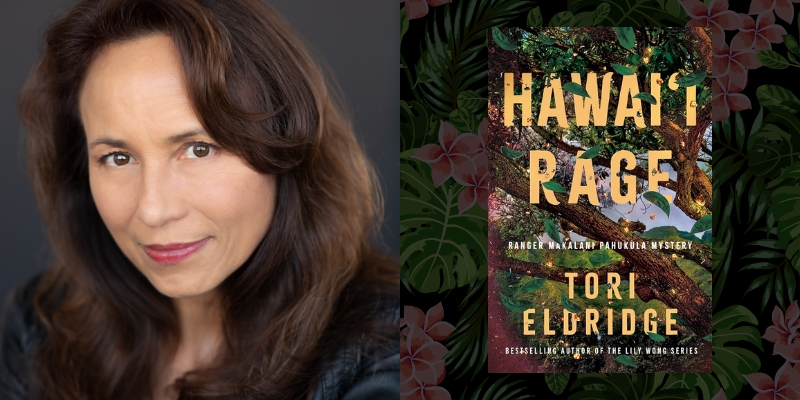
Hawai’i Rage is my tribute to our remarkable paniolo. In this Hawaiian cowboy mystery, a suspicious death on a Kohala Mountain ranch draws ranger Makalani Pahukula into a tangled family tree. When more dangerous accidents happen, Makalani follows the clues into the dark history of Hiapo Ranch.
***


Tori Eldridge
Tori Eldridge is the author of Kaua‘i Storm, Hawai‘i Rage, and the acclaimed Lily Wong ninja thriller series. Born in Honolulu—of Hawaiian, Chinese, and Norwegian descent—Tori graduated from Punahou School with classmate Barack Obama before performing as an actress, singer, and dancer on Broadway, television, and film, and earning a fifth-degree black belt in To-Shin Do ninja martial arts. Her literary works have garnered Anthony, Lefty, and Macavity Award nominations and the 2021 Crimson Scribe for Best Book of the Year. Tori lives in Portland, Oregon, with her husband, where she helps care for her precious mo‘opuna (grandchildren). Learn more about Tori and her books at ToriEldridge.com.