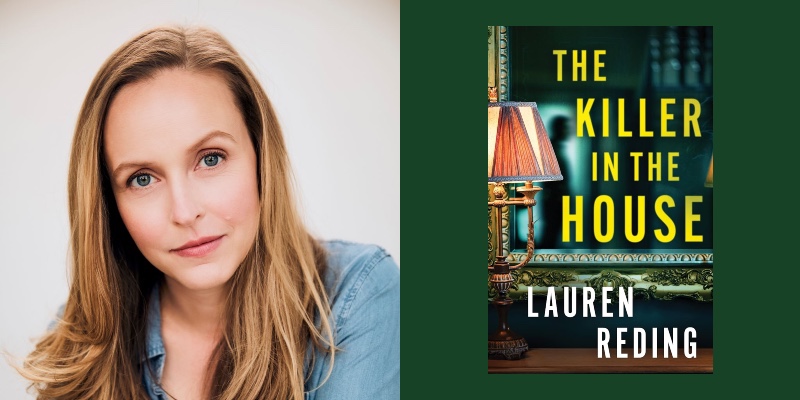
Megan Tusing on the Art of Audiobook Narration
Author Lauren Reding talks with the narrator of her debut thriller's audiobook.
When I’m writing, I do sometimes hear voices in my head: I imagine what characters would sound like delivering different lines of dialogue, and I “listen” to my prose to make sure it’s working properly. I have a lot of control over these private voices, and in the writing and revising phases of a book, I make them sound exactly as I want.
Cut to the exhilarating and vulnerable experience of hearing someone else, a professional audiobook reader, read my debut thriller, The Killer in the House aloud for public consumption. I was, frankly, quite nervous to listen to the audiobook because I saw it as an opportunity to fixate on writing choices I could no longer change now that the book was out in the world, but what I realized was that The Killer in the House was no longer just my project. The voice actors, Megan Tusing, Caroline Hewitt, Luke Daniels, and Marni Penning, had brought their interpretive know-how to the book, and I found myself thinking, “That’s not how I imagined it sounding it all, but they’re absolutely nailing it!”
In a quest to learn more about the skill and talent behind audiobook narration, I sat down with Megan Tusing, actor, award-winning audiobook narrator, producer, coach, and the main narrator for The Killer in the House audiobook. Here’s our conversation (edited slightly for length).
Lauren Reding: Tell me about how you came to audiobook narration.
Megan Tusing: I’ve been an actor in New York City since 2006. I went to school in Virginia at James Madison University, where I met my lovely vocal professor at the time, Andi Arndt, who has become a prolific audiobook narrator. After I graduated, Andi and I stayed in touch and she was like, “You should give this a try.” And I ignored her for a few years, because I thought I didn’t possibly have the energy to start a whole new creative endeavor, but luckily she was persistent, because it completely changed my life. She went above and beyond in ushering me into this career, and then when the door was open, I just sprinted forward, stuck out my hand to anybody who would talk to me, started going to conferences, and then through those connections, I got my first audition, and then that leads to your first project, and then if you hustle the right way, work just keeps coming. So it took a little time to build, but I’m ten years in now, and over 450 books recorded.
LR: Wow!
MT: And it’s the best job in the world.
LR: What do you like about it?
MT: I like that I get to not only be an actor but I get to also be a CEO. When I moved to the city, I didn’t become a waitress as my survival job because I was so worried that people who were hungry would make me cry, so I thought working in an office would be a better idea. People still make you cry in an office, but I just had a better skill set for handling and organizing office type things, and I liked it! So the thing I like about this job is that I get to have this perfect swirl of left brain and right brain. I love that I get to act every day. I get to play characters that feel closer to my personality versus when I was doing stage and TV and film. When I was in my twenties I looked like I was in my teens, so I was getting cast in roles that were much younger than me—I still had fun, don’t get me wrong, it was great! But there is something satisfying about getting to play a character who’s my actual age and bring my own life experience to color that.
LR: This whole world is completely opaque to me. I got to listen to your audition for The Killer in the House, and we picked you, and then the production team told me when it was all done. So I don’t have any insight into what happens to actually produce an audiobook.
MT: A casting director will send me an email letting me know the description of the character they’re interested in me playing and giving me a synopsis of the book. I just do my best at portraying what I think the text is trying to say, and then off it goes. And then, usually, I’ll hear from the casting director within a week or so. I need at least a week to prepare your book, meaning I need to read the full script so I don’t give the bad guy away too soon, especially with thrillers. I just had one where the bad guy talks in the very first chapter, but if I do their character voice, you’re immediately going to know who it is, so I have to be creative with things like that.
And then once I have that and I have any pronunciations I might need (for example, “Ann-ah” versus “Ah-na”) then I get in the booth and I record the book. I can do about two “finished” hours of audiobook a day. That takes me between five and six hours of real studio butt-in-seat time. I send my files off to the publisher, and they have a whole quality control team that catches any discrepancies, and they send it back to me. I have to say all those sentences again. I send it back to them. They plug everything in. They put their fancy, glossy audio coat on it, and then it’s ready for retail!
With a multi-cast, though, like what we had for The Killer in the House, the producer who casts me will put us all on an email chain to get us to talk to each other to make sure that we all say “Ann-ah” or “Ah-na.” And it was also important that I understood what Caroline Hewitt, who played Mariah, sounded like so I could mimic it to the best of my ability. Of course, we’re different people, we’re going to sound different, but if we have the same kind of energy about it, it will match.
LR: How do you take care of your voice when you’re doing that many hours in the booth?
MT: [takes a drink of water] I hydrate! I have to pace myself. I actually ran into some vocal issues last fall because I pushed too hard. As a freelancer, you only get paid when you work, right? And I had deadlines and things to do, and the easiest way to hurt your voice is not listening to your body. So I have learned the hard way. I take a break every hour; I take an hour lunch break. I don’t talk on my lunch break because it’s my vocal battery recharging. Like this call is considered part of my vocal battery for the day, so this will be an hour I wouldn’t put in my recording schedule because that’s how you push too hard.
Warmups are really important. We do those tongue twisters like, “Peter Piper picked a peck of pickled peppers.” I have to chant some words at a monotone like, “Many velvet vines move through mellow meadows” [laughs]. And then I hum. It’s to wake up what singers call your “mask,” like where you get a sinus infection, there’s a lot of resonance in this section, and if you wake that up, you notice a difference.
But I have found that really, really helps and having this kind of ritual before getting in the booth gets my brain ready to sit down and really focus, because reading for that long feels like a really long meditation.
LR: In the sense that you have to summon your stamina?
MT: Meaning like when you’re answering an email, sometimes your brain will wander to what you’re going to have for dinner. After you’ve narrated for a while, your brain will start to do that, too. Words are still coming out of my mouth, and I have to have a moment where I’m like, “Wait, you’re not completely present with the text; we’ve got to come back.” So that’s what I mean by meditation, how your thoughts drift, and you have to continue to bring yourself back. Narrating a book takes a lot of energy because I have to be in the story. If I’m phoning it in, the listener can hear that, but, you know, if the story’s really engaging, it’s not hard to do.
LR: How do you decide how you’re going to voice a particular character?
MT: It’s similar to how I would do it on stage in that I think about the character’s motivation, their insecurities. What’s their background? Where did they grow up? That’s a big one, their social, economic status, that effects everything. I’m a Navy brat that lived in West Virginia and is now in New York City. I had a little bit of an accent that I had to get rid when I moved because I had to be “accent neutral.” There’s no such thing as a neutral accent, but I couldn’t have any of that [slips into southern accent] twang goin’ on or it would affect my castability. So learning that about a character would inform a lot of how I would voice them. If there’s a barreling police officer who’s going to come in take charge versus the one who’s just ready to retire and put his feet up, they’re going to have a different cadence or pace.
LR: How do you decide what’s going to be a good project for you?
MT: Took awhile. When you first start out, you’re probably going to say yes to everything, but as I started to build my career, I recognized there were certain genres I was just pulled to more. And I think giving yourself permission to change as you evolve is really important. I loved the work I did in my early career, but as I was growing into a different artist, I wanted to tell different kinds of stories. I have a pretty specific “no” list, now. Most of it’s based on my values, things like unnecessary grotesque violence or racial slurs, homophobia, things like that. But there’s always an exception because sometimes if it’s a really important aspect of a story and doesn’t cause something within me to be like “nope!” then sometimes it’s worth doing.
So there’s been a little bit of curving the kind of work that I do. I like to take on a project that I feel A: compensates me fairly. (I think that’s very important to talk about. Yes, I love my job, but I also want to be paid a living wage.) And B: I also like to look at what’s in line with the portfolio that I’m trying to build.
LR: What techniques or strategies are important for narrating a thriller that might be different from other genres?
MT: The big thing in mystery/thriller is tension and suspense, right? If you like that genre it’s because you like to be surprised and guess which direction it’s going to go, and I don’t want to give that away. Funnily enough, romance and mystery/thriller are very similar in that they both are formulaic to a certain extent, and with mystery/thriller, you’re always going to have a happy ending because you get to know who the killer is. There was a book I did that had a scene that could have been considered a meet-cute in a romance, but as a thriller, it was really creepy! It was this guy knew who this woman was, but she didn’t know who he was. He was pretending they were just bumping into each other, and, as a romance, it’s very much, You’ve Got Mail vibes, but in a mystery/thriller, it’s like “Oh, he’s gonna murder her later!” So the tone of how you would read that scene is different. When you’re doing romance, for example, you’re trying to build the sexual tension or the attraction or the curiosity, and there’s this lightness and bubbliness, and excitement, but with mystery/thriller, there’s a fear, so the thing that’s getting the body excited is different.
LR: I teach college writing, and when it comes to any career, the students always want to know what surprising skill they might not realize they need until they get into it. Are there any surprise skills that you need as an audiobook narrator?
MT: Networking. We spend hours alone in a booth seeing no one else. We’re introverts, most of us, so having the skill of putting yourself out there, that’s one of the biggest things. Nowadays, you gotta not just be an artist, you also have to know how to be savvy on a social media platform. If you can create some sort of presence on social media and gather steam that way, you can sell more books. But most of my work is through publishers, so I’m not going to find a casting director, necessarily, on Instagram. I’m going to talk to them at a conference, through email, or through an audition class, and that’s the relationship building. It’s so competitive, and it’s this finesse that you need to develop of not being overly in somebody’s face, respecting that they’re a human being, but still showing up like you need to and asking for work, and that’s one of the hardest things to do well.
It’s this weird pull of needing to stay present in what you’re doing but always needing to move on to the next thing. It’s a delicate balance of having multiple stories and to-do lists in my head and juggling them well.
LR: I really admire what you’re doing, and listening to you talk about it deepens my appreciation for audiobook narrators and for what you bring to the story.
MT: The thing is that you, as an author, are the original creator of the work, and as an audiobook narrator, I’m then creating what I hope is sort of like a really good cover song. I’m trying to interpret what message you’re trying to get across with your work.
LR: Not to dismiss cover songs, but you’re doing more than that. There are huge groups of readers who are only going to access The Killer in the House through the audiobook, including some of my dear friends and family, so that’s something I’m really grateful for.
MT: Which is why it’s so important to have narrator approval in your contract [laughing]! And if you review an audiobook you love, tag the publisher and that narrator because the narrator is a freelancer and if a book starts getting attention, it might get them their next job.
***
Megan Tusing has three recent audiobook releases: No Prisoners by Alice Blake, The Good Sister by Bonnie Traymore, and Objects in Lakes by Rachel Ramas. She’s excited about the release of The Crying Killer by Jess Lourey, and a still-secret project to be announced in October! See everything she’s up to on Audible or by following her on Instagram.
Lauren Reding is the author of The Killer in the House. She teaches writing at Towson University.

Lauren Reding
Lauren Reding is the author of The Killer in the House. She teaches writing at Towson University.