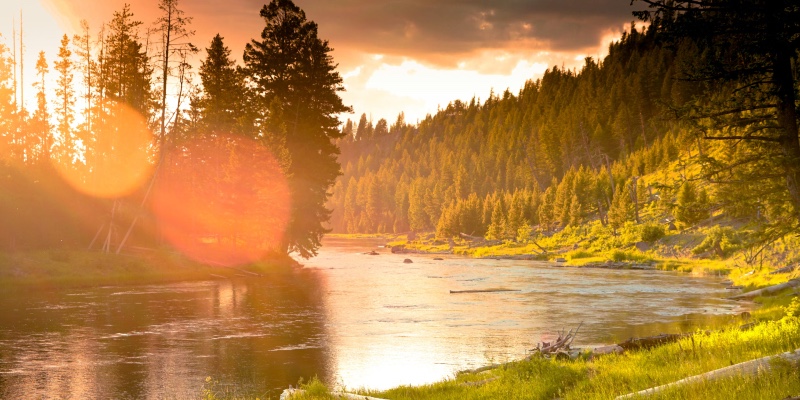
How Teaching Wilderness Science in Yellowstone Inspired a Fantasy Novel in Victorian London
Thomas Kent West on bears, botany, and the magic of science.
It was around sundown when, after putting my eighth graders in their tents for quiet time, the grizzly bear came charging into camp.
This was not a totally unusual occurrence in Yellowstone—after a few years of teaching science in the neighboring Grand Teton and guiding trips in both parks, I’d had a few run-ins with our furrier, toothier cousins—but this was the first time it had ever happened where I was supposed to be in charge…(of a bunch of eighth graders—at night—with a grizzly bear charging into camp, etc.)
Luckily I had a co-instructor, who we’ll call Beth. Beth was quiet, artistic, and about a hundred pounds if you put a thumb on the scale. Meanwhile, I was over six feet, a stone’s throw from 250, and was generally called upon when a booming “teacher voice” was needed. But when the grizzly bear came galloping into camp, I froze. Years of preparation reduced, in the moment, to a vague fumbling for a can of bearspray kept somewhere on my person.
Beth, meanwhile, leapt out of her chair and began screaming the strangest expletives I have ever heard. She ran towards the bear, angling to put herself in between it and our students. All of this happened in a few precious seconds. By the time I came to my senses and joined her, uncapping the bearspray, the bear was already gone. It had heard Beth’s strange string of expletives and had apparently decided this particular meal was not worth the trouble. We stood, panting, and watched it crash back through the brush from whence it came.
You might be wondering: what does this have to do with a fantasy-mystery set in Victorian London, of all places, where the magic is based on plants?
And to that I say: Beth taught me that, like with plants, incredible power can come in unexpectedly small packages.
*
It might be surprising to some that a person who’s written a near-600 page book about botanical magic was never much of a “plant guy.” At the University of Michigan I studied Environmental Science with a focus on Geology, pursuing what I believed to be a sensible career in mining exploration. I quickly discovered that this was not a sensible career, mostly because I am not very good at the practice of science. I love learning about science. I love the stories that it tells. This led me to teaching, and my passion for the outdoors led to teaching in wilderness settings, which led me to Teton Science School and into the company of many brilliant teachers who were “plant people.” I marvelled at how they moved through the woods; how they knew the names of things and their uses; how they could tell the story of evolution through patterns of leaves and map the invisible relations between species; how the latin names of plants sounded like spells. They rolled wild sagebrush (Artemisia tridentata, the thrice-fanged Artemis) between their hands for the calming scent. They chewed on lemon-balm to ward off dehydration. On long trips through the mountains they boiled pine-needle tea for vitamin C. It seemed to me that the world of plants was a world of secrets, a hidden realm of power that was so often trampled underfoot, one that was becoming rarer and more arcane as machines of metal cleared the plains to grow corn and soybeans.
And beyond the medicines and poisons of the hidden plant world there was the spiritual component, the way that plants seemed to stretch their roots into the hearts of people, into their religions and traditions. Hidden in the hills on the eastward side of the valley was a pair of ancient gnarled pines that formed a natural arch and framed the shark-teeth tips of the Tetons, called the Wedding Trees by the locals. Scraps of ribbons commemorating weddings hung from their branches, and boxes hidden among the roots held ashes of the dead. It amazed me that centuries after the druids had died out, people in these wild hollers seemed to reinvent paganism all on their own. Like something deep in their blood knew the tune of old songs even if the words had been forgotten.
And then there were the things we taught our students—of aspen trees, with their interconnected groves that constitute a single organism, some of them the largest, oldest living things on earth. Of lichen, those symbiotic creatures of algae and bacteria that splashed every surface with orange and emerald, who, over centuries, silently ate and digested stone. Of krummolz, warped trees on the peaks of mountains that, despite being hundreds of years old, stood only to my thigh, bent-backed and gnarled like crones.
All of these things bled into the book that eventually became City of Iron and Ivy. Aspen trees, with their eye-like knots, photosynthetic bark, and quaking branches became the bioluminescent elderwood trees, whose leaves whisper with the voices of the dead. The bent-backed krummolz, warped with age, became hedge witches that offered young girls love potions with terrible prices. And the fractal patterns of lichen—and those on lightning-felled trees—became the protagonist Elswyth’s facial scar, a Lichtenberg figure that reflects the way plants grow, or how electricity burns through wood.
Although it took years for the actual story to sprout, the magic I call floromancy began in a wild hot spring in Jackson Hole, Wyoming, where my mind wandered and I wondered what it might be like to grow whatever plant I liked from my skin, or seep any poison or medicine I wanted to from my fingertips.
Elswyth—and her alternate Victorian London where City of Iron and Ivy is set—came much later, when I decided that I wanted to write a story about the real-life magic of plants. I chose to set it there, in that time and place, because I saw it as an era inherently in conflict with itself. While British scholars scoured the globe to catalog species of plants and their uses, London bloomed with floral fascination and ladies sent messages hidden in the language of flowers, pteridomania (a Victorian obsession with collecting ferns) also pushed these beloved species to near extinction. And elsewhere—within Britain and without—the rush to exploit new (to European perspectives) species of plants wreaked havoc on fragile ecosystems and the civilizations that had long been stewards of them.
It was a remarkably rich time in the history of botany, and a remarkably complicated one, and I knew that a story about the power of plants was better set there than in the American West. But despite this, the roots of Elswyth’s London will forever remain in the wild places of Wyoming, in the somewhat-sacred groves of aspen trees and the ancient petrified forests of Yellowstone, in the algae the color of blood that grows in summer snows. And the monsters therein—far more dire than even grizzly bears—were nevertheless inspired by personal run-ins with these beasts in one of the few truly wild places left on earth. If I wrote this book for any reason at all, it is to share the ineffable feeling of being connected to these wild things, of catching a glimpse of their secret power, and to remind people that—even if these plants do not grow from our skin—they are nonetheless and inextractable part of us. A part that must be cherished, understood, and protected, lest it be lost forever.
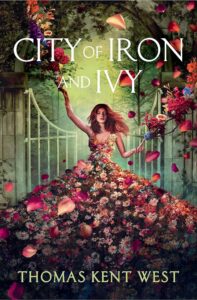

Thomas Kent West
Thomas Kent West is an American author who creates stories filled with intricate magic, imperfect heroes, and richly imagined worlds. His experience as a biology teacher and wilderness guide in Grand Teton National Park inspired him to write a book set in a fantastical place but based on real-world botany. That novel became City of Iron and Ivy, which received the Book Pipeline Grand Prize in Science Fiction and Fantasy. You can read more of his work, receive bonus scenes and short stories, and sign up for his newsletter at thomaskentwest.com.