
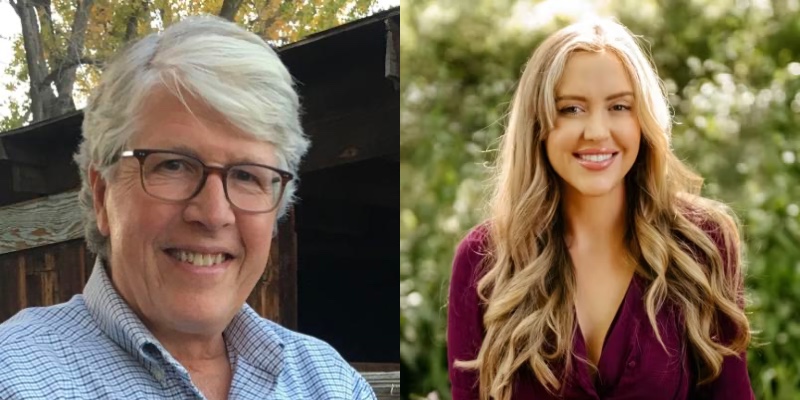
Douglas Preston and Aletheia Preston on Inventing a New Character
The Prestons take you behind the scenes and into the backstory of their new chief of forensics.
Dear CrimeReaders Friend,
For our guest posting about our new thriller, Paradox, we decided to do offer you something a little different. One of our favorite characters in Paradox is Detective Bart Romanski, Chief of Forensics at the Colorado Bureau of Investigation. Paradox opens with Romanski at a crime scene in the Colorado mountains, in which a man has been most awfully murdered—by being embalmed alive. So what we offer to you now is Romanski’s origin story of sorts, narrated by Romanski’s former chief, a rather unpleasant man named Detective Chad Dawson.
With warm regards,
Douglas Preston and Aletheia Preston
Romanski
The building was a crap-shack, a deed-restricted townhome in Five Points tucked between the abandoned Motel Regis and a cracked-asphalt vacant lot. There were a lot of nice neighborhoods in Denver, but Five Points wasn’t one of them. Good things didn’t happen in Five Points.
I had this on my mind as I climbed the freezing stairwell, while I called dispatch to run a background check on the victim. I stepped through the apartment door. Our stiff was sitting at his desk, his faceless head flopped forward, his fingerless hands resting on either side. Black spots and streaks peppered the wall. He hadn’t been dead long—the landlord heard the explosion and called us.
And right then, I saw the newest addition to our homicide team, Detective Bart Romanski, leaning in close to the body, sniffing. Romanski had recently been transferred into my department, over my objections. Fact is, I just didn’t like the guy. I’m convinced he was some kind of diversity hire—small and scrawny, looking like the ‘before’ pic of a gym transformation. But I was overruled by the director. So here was Romanski, hovering eagerly over the stiff with his feet splayed like a penguin—a real fuckin’ beta.
“Romanski? May I ask what you are doing?” I said. I didn’t use his Detective title, that had to be earned.
“Ah, the smell of burnt caramel. The device was likely made using potassium chlorate, an extremely volatile compound that explodes when it comes into contact with sugar.” He grinned. “Here’s a crime scene for the textbooks.”
The rest of my CSIs filed in.
“Listen here, Romanski,” I said, “I expect you to wait for me before beginning to process a homicide. There’s a way we do things in the Colorado Bureau of Investigation.”
Romanski’s smile faded. “But Chief, this isn’t a homicide.”
“Romanski, I realize you’re new, but take a good look at the scene. Pretty obvious the guy was blown up by a letter bomb. Note the missing fingers, the condition of the face, the peppering of shrapnel on the walls.” I turned to my guys, who were now listening. “Right?”
They nodded in agreement.
“Are you willing to hear a little story as to why I disagree?” Romanski asked.
This guy was really getting on my nerves, but I was down to letting this jamoke embarrass himself in front of the other CSIs.
“Go ahead.”
Romanski began. “When I was ten, my favorite Uncle, Randy, who lived down the street from us in Denver, went kind of ga-ga. Dementia. I used to go over and visit. One day I found him sitting cross-legged in the dead ashes of the fireplace, reading a book. He said to me, ‘You’ll need this,’ and handed it to me. It was entitled The Man Who Spoke for the Dead, and it was about Sir Bernard Spilsbury, the British pathologist who invented forensic science. I read the book cover to cover and it changed my life.”
My frown deepened. “And the point?” I asked.
“I’m getting there. Spilsbury invented the ‘murder bag,’ a forensic kit that he used to process a crime scene. So I created my own. To test it out, I got my friend Brenda to volunteer. During lunch she pretended to be a dead body and laid down on the floor in Mr. Sullivan’s classroom with her eyes closed. I told her it wasn’t realistic enough, and Brenda suggested that I swipe some packets of ketchup from the cafeteria and smear them on her. Naturally, I complied… in the name of science. I was in the middle of ‘investigating,’ when Mr. Sullivan entered and caught sight of me bending over Brenda, her blouse slathered with ketchup, plucking fibers off her with a pair of tweezers. All hell broke loose. The police were called, and my Spilsbury bag was confiscated by the principal. And that, Chief, was my start in a career in forensic pathology. What I learned from Spilsbury was that, above all, the forensic detective has to relearn how to see. That is why I can tell you that Ivan Gruner was not murdered, but killed by his own idiocy.”
“Oh yeah?” I asked, “and what do you see?” I stifled the impulse to add Sherlock to that sentence.
Romanski shook his head. “You are correct, Chief, about the letter bomb. There are metal fragments embedded in the wall, Mr. Gruner’s remaining craniofacial structures, and his hands, suggest the explosive device was loaded with shrapnel and concealed within an envelope. And indeed, you can see he was opening the mail when it happened. There’s a stack of unopened mail on his left, opened mail to his right.”
“Just like I said: one of the letters blew up in his face.”
“Exactly. Except it wasn’t a homicide.”
“You think he was making a letter bomb?”
“No.” He gestured. “Look in the trash can. In there is a photo, torn in half, of Mr. Gruner with an unknown female, the eyes of the woman shredded as if they were stabbed with a knife. And you will see, blown over there on the floor, a new padded mailer addressed to a female, looking like it was about to be filled, sealed, and mailed. Near it is a sheet of stamps with some detached. And next to the desk is a fragment of a similar envelope, dirty and singed, which looks like it might have gone through the mail and been involved in the explosion. You can see a bit of red-ink stamping on it, illegible.” Romanski straightened and looked me dead in the eye. “It is my conclusion that Mr. Gruner sent a letter-bomb to this ex of his, which was returned, probably for inadequate postage. He then negligently exploded his own letter bomb in an effort to open and repackage it, causing his death.”
“Jesus Christ, Romanski, never in my life have I heard such a stream of deductive bullshit,” I said, losing my temper.
Romanski leaned in. “The reason I told you that story, Chief Dawson, is to show you that I eat, breath, and sleep forensics. And that’s why I aspire, someday, to have your job. After you retire, of course… Chief.”
He gave me a most insolent look, turned and walked off.
I stood there, too scrambled to get a retort together, livid at the guy’s audacity.
Suddenly, dispatch hissed through on my radio. “Chief Dawson, background came back on Ivan Gruner. Got something interesting: recent priors for domestic violence against his ex-girlfriend. There’s an active protective order.”
Across the room, Romanski was already talking to one of the techs like he owned the place.
I stared at the radio. My fist tightened around it. I imagined it was around Romanski’s neck instead.
***
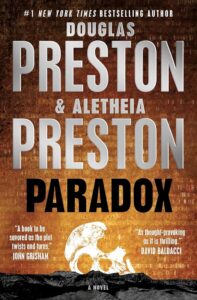

Douglas Preston and Aletheia Preston
DOUGLAS PRESTON has published over forty books of both nonfiction and fiction, of which more than thirty have been New York Times bestsellers, a half-dozen reaching the #1 position. He is the co-author, with Lincoln Child, of the Pendergast series of thrillers. He also writes nonfiction pieces for the New Yorker. He worked as an editor at the American Museum of Natural History in New York and taught nonfiction writing at Princeton University. He is president emeritus of the Authors Guild and serves on the Advisory Board of the School for Advanced Research in Santa Fe. ALETHEIA PRESTON is a reformed lawyer originally from Santa Fe, New Mexico. After working as a prosecutor in San Francisco, she moved into private practice as a trial attorney before embarking on a journey as a writer. She is a lover of thriller and science fiction novels and has been an avid reader and writer in both genres since she was a little girl. An admitted adrenaline junkie, Aletheia spends much of her free time outdoors finding ways to risk her life, from skiing and mountaineering to paragliding and winter camping. She is also a PADI certified deepwater and wreck scuba diver. Fluent in Italian and Spanish, she spent much of her childhood in Florence, Italy. She and her cat Mochi live in Bozeman, Montana.