Camille Perri and Alafair Burke on Dog Park Culture, Friendship, and Mystery
In conversation with the author of 'Social Animals'
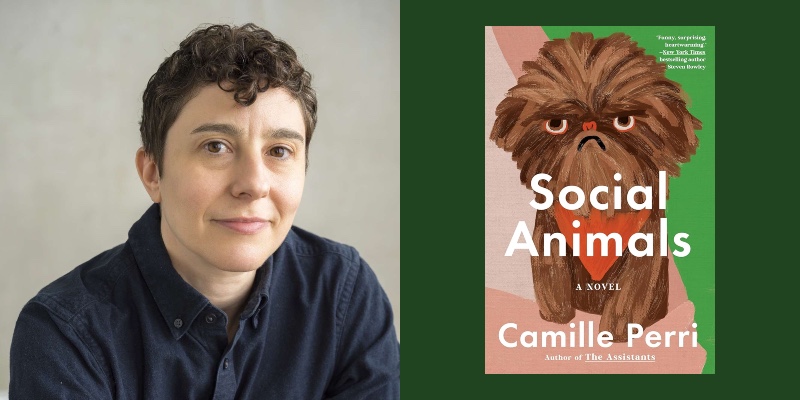
Camille Perri is the author of The Assistants and When Katie Met Cassidy. She has worked as a books editor for Cosmopolitan and Esquire. She has also been a ghostwriter of young adult novels and a reference librarian. She splits her time between New York City and the Hudson Valley with her wife and their Brussels Griffon named Pip. Her new novel, Social Animals, is now available from G.P. Putnam’s Sons.
Alafair Burke is the Edgar-nominated, New York Times best-selling author of fourteen novels of suspense, including The Note, The Ex, The Wife, The Better Sister, and Find Me, and coauthor of the best-selling Under Suspicion series. A former prosecutor, she is now a professor of criminal law. She recently served as president of the Mystery Writers of America and was the first woman of color to be elected to that position. She lives in New York.
Alafair Burke: I’m going to start with a completely novel, unexpected question: Where did the idea for Social Animals come from?
Camille Perri: The idea for Social Animals started with the characters Val and Alex. I had created them for a screenplay I was crafting, which was sort of a buddy comedy about these two very different women who come together to solve a crime. When I decided that script wasn’t working, I abandoned it but plucked out Val and Alex to use them in a novel instead. This was an earlier version of the novel that would eventually become Social Animals, which featured Val and Alex—but I still didn’t think it was working quite the way I wanted it to. It wasn’t until I got my dog, Pip, and brought her to the local dog park that it occurred to me to center the novel around a dog park and the interesting personalities that convene there. This was when I created the character of June. Her story would be the one to bring Val and Alex together.
Alafair Burke: I really enjoyed reading this novel. I love a book about friendship, and of course I love dogs. Tell us a little bit about Val, Alex, and June and their canine pals.
Camille Perri: Val is a former con artist from Queens, NY, who had a rough and tumble upbringing, now working as a PI. She is hired by June’s husband Silas because he suspects June of having an affair with someone from the dog park she regulars. Val is not a dog person but needs a dog for the duration of this job, which is how she acquires Cash, a badly behaved Brussels Griffon.
When Alex enters the novel, she does so with some secrets, which will be revealed over time. All the reader knows of Alex, at first, is that she battles anxiety and depression, and appears at the Hamilton dog park in search of June. Her goal is to get close to June, with the ulterior motive of targeting June’s husband Silas. Alex doesn’t have a dog at first, but soon adopts a beagle named Bruce. Unlike Val’s Cash, Bruce is well-behaved, loyal, and immediately begins to change Alex’s life for the better.
June, who is married to Silas, is a regular at the Hamilton dog park along with her happy-go-lucky, if a little dopey, golden retriever, Willow. June is sweet and good-natured but deep down feels isolated and extremely lonely. For this reason, she is intrigued by the two new mysterious women at the park—Val and Alex. June is starving for companionship and Val and Alex both appear (at least on the surface) to be potential genuine new friends.
Alafair Burke: Do you consider yourself to resemble one of the characters the most?
Camille Perri: There is a little of me in all three women, but Val is probably closest to my heart. Her voice came the most naturally to me and, though this novel is a three-character ensemble, with Val, Alex, and June each with their own point-of-view and personal arc, I do consider Val the anchor character.
Alafair Burke: What drew you to a dog park as a setting from which this friendship grows?
Camille Perri: Dog parks are fascinating places. They’re enclosed spaces where strangers interact who wouldn’t otherwise be socializing with one another. You get all different kinds of people from various backgrounds with only their dogs drawing them together. You also tend to get a core group of regulars who come to the park at the same time every day, which leads to inevitable drama. Cliques form, arguments ensue, love affairs happen—you name it. It’s fertile ground for fiction. Within the first few days of bringing my dog to the dog park for the first time I began taking notes
Alafair Burke: Val is cajoled by a high-value client into adopting a dog—whom she dubs “Cash”—as a way to gain access to the target of her investigation. You’ve called this book jacket an homage to the love you have for your own pet, Pip. How much does your own dog, Pip, resemble Cash, and how did your own experience with Pip influence this novel?
Camille Perri: Cash and my dog Pip are the same breed. They’re both Brussels Griffons and I used a lot of my personal life experience with Pip to create Cash’s character. Like Val, I did not want a dog before I got one. Val succumbed to pet ownership for her job; I did it because my wife is very convincing. There are a few aspects of the Brussels Griffon breed that make them a bit high maintenance, but also extremely entertaining. They are intelligent, highly self-important, spirited little dogs, who aren’t always so eager to please, and tend to look grumpy. They are not the easiest dog for a first-time dog owner. I knew what I was getting into when I welcomed a Griff into my home, but Val did not. I squeezed as much humor out of that as I could.
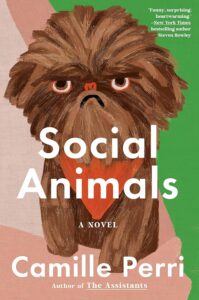
As for the book’s cover, it is a Brussels Griffon, but it’s a long-haired Griff, whereas Pip and Cash are both short-haired. The frowny face, though, remains the same.
Alafair Burke: With three friends, you have a group of three, but you also have three friendships of two. What is it about the three-friend dynamic that is such fertile ground?
Camille Perri: I love a triangle in fiction. The odd numbered three-person friendship presents great potential for conflict because of the inherent inequality that’s baked in. All three friends can’t always be together. Experiences, conversations, and—most importantly—secrets are often shared among just two of the three. In contrast, if a friend group was made up of four, two equal “teams” of two might form. This isn’t possible in a triangle. Someone is always going to feel like the odd man out in a given situation, and as you well know, this is exactly what a storyteller wants when it comes to building opposition into a plot arc.
Alafair Burke: The title of this novel is so perfect as you explore your characters’ struggles with loneliness. I am reading so many books right now and seeing it in television too—this universal feeling of isolation. Why do you think that’s such a shared experience right now, and do you think fiction can help somehow?
Camille Perri: I think the loneliness epidemic is very real. Some of it stems from the prevalence of using social media in the place of in-person social interaction, and some of it is a leftover from the Covid years, but regardless of the causes, we know the solution is to get outside and connect with other humans. Unfortunately, this is easier said than done. It takes real effort. On the bright side, I do think fiction can help, and that books make people feel less alone. Isn’t it a blessing that the introverts of the world have novels to read? I include myself in this group! My greatest hope is that my book might bring someone who’s feeling lonely or isolated a little comfort and company. As someone who battles social anxiety, nothing would bring me more happiness than to know others like me are picking up Social Animals and finding something of themselves reflected back in a joyful light.
Alafair Burke: Like your previous novels, Social Animals blends comedy and satire to explore wealth and privilege disparities. What draws you back to those themes, and why do you lean into humor as you broach a pretty serious topic?
Camille Perri: It’s true that all my novels touch upon themes of wealth and privilege. I can’t say for sure why, but money fascinates me. I guess having grown up without a lot of it plays some part. Of course, social inequality is no joke, but I do tend to approach class disparity in fiction with a humorous bent. For me, the humor is in the lack of self-awareness that can come with privilege. For example, Social Animals largely takes place in an affluent suburban community, at the kind of dog park where the animals have their own wardrobe and eat organic, home-cooked food. There is something horrifyingly funny about this, no? It wouldn’t go unnoticed by someone with a hardscrabble background like Val. I enjoy having characters with varying levels of privilege bumping up against one another in my books. It makes for a better story.
***

Alafair Burke
Alafair Burke is the Edgar-nominated, New York Times best-selling author of fourteen novels of suspense, including The Note, The Ex, The Wife, The Better Sister, and Find Me, and coauthor of the best-selling Under Suspicion series. A former prosecutor, she is now a professor of criminal law. She recently served as president of the Mystery Writers of America and was the first woman of color to be elected to that position. She lives in New York.