
The American Archeologists Who Created a WWII Intelligence Network in Greece
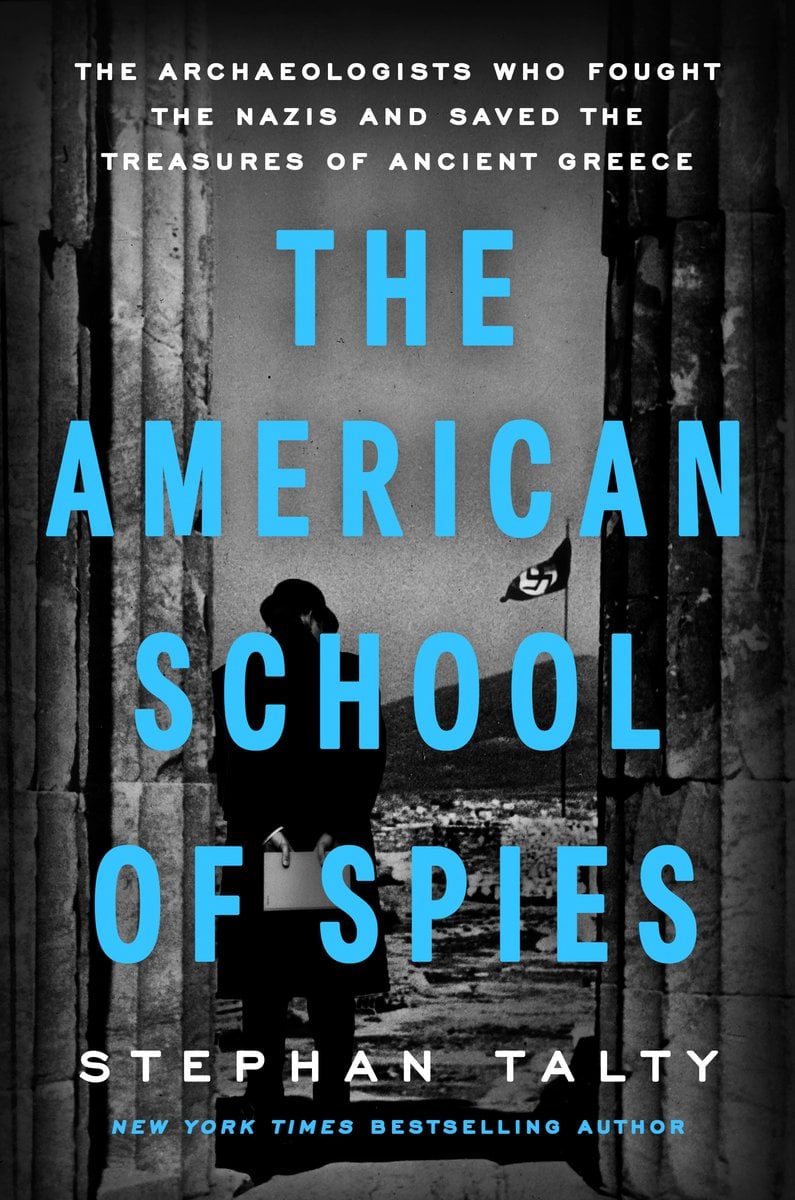
An excerpt from The American School of Spies by Stephen Talty
Rodney Young arrived in Cairo in May 1943 and moved into a hand-some three‑story stone villa near the Greek legation. A staffer showed the spymaster to his room, which he found to be completely empty, not a stick of furniture in sight. He set down his bags and, the next morning, began to create an intelligence network out of thin air.
The city was less frenetic than it had been the year before when Erwin Rommel’s advance sparked the embassies and spy agencies to burn their files, sending a rain of smoldering confetti on the city; back then, one could hold out one’s hand and collect a handful of smoking fragments. The panic had passed, but the febrile mood remained; at the Cairo Royal Military Academy, Captain Gamal Ab-del Nasser was plotting his revolt against the British, and the spy agencies were turning their attention from the desert war to Europe.
“Cairo was a halfway house, a place to catch your breath before the next plunge,” wrote the spy and writer Patrick Leigh Fermor, who’d worked as an operative in Greece, “but you never forgot the war was watching.”
The OSS was arriving in force; the Greek Desk was only a small cog in the agency’s sprawling mission, and its operatives were joined by those specializing in Egypt, Turkey, Yugoslavia, and elsewhere. They joined Abwehr agents trawling Cairo’s bars, listening for snip-pets of gossip about D‑Day or FDR’s health, as did the Russians and the Brits and the French.
The Americans frequented the cafés and dance clubs; it was later said the OSS’s initials stood for “Oh So So-cial.” The best place was on the banks of the Nile at Shepheard’s Hotel, the “Grand Old Lady of Cairo,” where generals dressed in khaki ordered gin slings at the Long Bar and shouted over the sound of the orchestra, which played big‑band swing late into the night.
Intelligence officers made the nightly rounds from dinner at Fleurant’s, the St. James, or Le Petit Coin de France, followed by dancing at the Scarabée Club or the Kit Kat Club, both of which were housed in barges moored by the riverbank. The Kit Kat Club was notorious; “officers were warned to be particularly discreet in front of the Hungarian dancing girls,” and eventually the OSS had to ban its spies, including Rodney Young, from going there, causing a drought in available intel.
So it was back to the Shepheard, whose Swiss manager, Charles Baehler, maintained a policy of strict neutrality in the competition between nations. “A man can learn more in an hour [there],” said one American operative, “than a week in the field—provided he keeps his mouth shut.”
The Greek Desk utilized the city’s wares and hiding places. Virginia Grace, the amphora expert turned operative, snuck into a Giza tomb and buried some incriminating papers there, along with the records of the Harvard Pyramids Expedition. Jack Caskey, the somewhat timid agent who’d grown up speaking Greek, hunted for gold; agents would need it to buy food and weapons inside Greece. He located two-hundred and twenty-five pounds of the stuff on the black market and snapped it up.
As for Rodney, there were a hundred things on his to‑do list. He scoured the city for “theatricals”: clothes and battered suitcases that agents could take into Greece and not stand out from the locals. He had on hand a large stock of used shirts, pants, and suits, whether shipped from Washington or gathered by his local contacts he never revealed.
Rodney discovered they were “of the Sears Roebuck variety and recognizable as such two blocks away.” His operatives would look like suburban Americans on the way to the bowling alley or drive‑in movie. What were his suppliers thinking? The wrong shirt or an overwide lapel could get an agent arrested. Rodney brainstormed and came up with a solution: the refugees coming out of Greece would be given the Sears, Roebuck styles in exchange for their own outfits, which would be fumigated and mended, then worn by agents going back into Greece.
Cables had to be translated, refugees interviewed, agents recruited. Rodney demanded his people speak Greek and preferred men who’d served as soldiers or operatives, sometimes nicking them from the British. The diplomatic pouch from Izmir brought daily reports from Dorothy and Caskey. Rodney analyzed them and drew up plans for action.
In a secluded upper‑class suburb of Cairo, he founded a spy school in a ridiculously opulent palace called Ras el Kanayas that was owned by the brother‑in‑law of Egypt’s King Farouk. (It was actually the brother‑in‑law’s third‑best palace.) There he scrounged together a training staff; without much support from the OSS, he had to find his own instructors. His radio expert was a Greek American he’d befriended on the journey to Cairo; his cryptography teacher was James Oliver, an American epigraphist.
Young finalized his first batch of agents, had them vetted for their politics, and assigned them to a specific mission inside Greece. The first, Settler, consisted of two Greek operatives who would head to Athens, secure a boat, acquire materials to be used in fake documents, and provide Young with intel on police activity and no‑go areas in Athens.
At the same time, Rodney began the arduous process of putting together an amateur merchant marine. He would need vessels of some sort to get men and matériel into the country; he would need bases in North Africa and Turkey and Cyprus to stage, load, and service the vessels; he would need stamps and papers to get them in and out of Greek ports with arms, agents, and contraband under the noses of the Germans.
Originally, Rodney had been promised submarines to smuggle in his operatives, but the Navy had other priorities; they would have only a few spots open for his men. After researching the ports, Rodney arrived at a solution: caïques. The traditional fishing vessels of the Aegean, they were made of pine, painted white, and usually had sails.
Rodney began buying as many as he could lay his hands on and hunting up outboard engines to put on the sterns; he couldn’t have operatives stranded a few hundred yards from the coast because of an offshore wind. He added “dealer in nautical spare parts” to his list of side jobs.
“Pete, on a rumor that there is a vast junk heap at Camp Huckstep, is going out there to pick over the junk for boat engine parts,” he wrote in a memo.”If we can get an adequate supply of old parts to use as spares…we can go on.” Rodney even inquired into the possibility of turning old tank engines into outboards in order to get engines quicker.
Even with these new power plants, the boats were vulnerable. The fastest caïques could manage eight knots, the slowest German patrol boats twelve knots. They weren’t going to outrun anyone; the agents had to rely on deception and wit.
Stamps proved to be surprisingly tricky. Greek Desk vessels going in or out of the ports were required to carry the official documents a real fishing boat would possess. Seemingly everything required a stamp, a pass, a paper, or a permit; to get caught without one or with a fake one meant the caïque would be confiscated and the agents either shot or sent to a concentration camp.
Rodney patched together a library of German official documents—seamen’s passes, meteorological bulletins, a German Admiralty chart of the North Aegean, a fishing boat’s logbook—some of them taken off refugees interviewed by Dorothy. Rodney recruited a team of counterfeiters and gave the documents to them for copying.
But the stamp collection remained woefully inadequate and often outdated. Greek and German officials were changing all the time because of transfers or promotions; the signatures on the papers had to change along with them. The Brits were ahead on documents: they’d instituted a system whereby all refugees coming out of Greece surrendered their identity cards on arrival at a foreign port.
The ID cards were then sent to a central office, cataloged, and studied: the officials’ names, their signatures, and the stamps were painstakingly recorded and copied. It was an ingenious system, and Rodney used every ounce of his considerable force of personality to get access to it.
His days stretched past the hot Cairo dusks. It was a jerry‑built force he was assembling. Some of the Greek agents carried ancient blunderbusses, not modern rifles; they wanted to know if Rodney could find ammunition. “Look, we are running a five‑ring circus here,” he wrote to his colleagues on July 20. “Next week I have to go to Beirut to pack people into a submarine, examining previously their underwear for laundry marks.” He hadn’t been trained for this; he was making it up as he went along.
The OSS bureaucracy was often a disappointment. When Rodney asked his superiors for help with the stamps, he was met with excuses and delays. “Damn it all to hell,” he raged to Caskey after many weeks of waiting for results, “WHY did I even believe that Washington could do or would do what they promised?” This would become a major theme in the Greek Desk correspondence.
The Brits bedeviled Rodney, too. Rodney’s resentment toward them eventually coalesced around one figure: Noël “Hadzis” Rees, who was the head of MI6 in Izmir, Turkey. Described as “an impeccable Englishman in gray flannels and Royal Harwich Yacht Club blazer,” he came from a long line of British aristocrats who’d lived in Turkey for generations, “racing yachts in the bay and horses at the hippodrome.” Rees rubbed elbows with the Greek crown prince and supported his claim to rule Greece; he drove a Rolls‑Royce to the British consulate.
Rodney didn’t resent the display of wealth, nor was he impressed by it. It was Rees’ subterfuges and power grabs that he and the other Americans found insufferable. And Rees’s sheer rudeness. “I would not take these rages of [Rees’s] too seriously,” Rodney counseled Jack Caskey, who ran the OSS base in Izmir. “The more often and the more violently he has them, the more likely he is to burst a blood vessel and die.” What began as an intelligence rivalry would soon bloom into something more.
Rodney finally persuaded the British to share their library of stamps, but what to put them on? “The stock of the proper kind of paper are almost unobtainable in many cases here in the Middle East,” he wrote a Navy lieutenant in a top secret letter.
We have requests from Greece for harbor master stamps, health stamps and German control stamps. We also have a log and control book for a caique which worked under German requisition. It would be most useful if we could have facsimile books made up on this model and a collection of the stamps which would have been used in it. Brand new books would not be too useful and would be conspicuous, so if we had our books with say half a year of imaginary voyages filled…with paper stamps and signatures.
Dorothy was doing yeoman’s work in Izmir, but she could speak to only so many refugees a day. A potential informant might be walking through another port on another day and his information lost. The Desk sent out a wide blast for intel on “safe routes, police regulations, forbidden zones, curfew hours etc. This information should be available from majors, doctors and naval officers coming through your parts.”
And when “local cloak and dagger people” advised the Greek Desk that their boats should fly their own banner so neither the Germans nor the andartes fired on them, Rodney’s team drew up a rakish pirate banner—a black pennant relieved by a single red five‑pointed star—to flutter on the prows of the vessels. Rodney’s amateur navy now had its own flag.
Rodney gave instructions to his agents for the men who would be going in. He wanted a grading system to evaluate their intel:
Alpha: I saw this with my own eyes.
Beta: A trusted source saw this with his own eyes.
Gamma: My sources and I didn’t see it, but believe it to be true.
Delta: Doubtful but worth mentioning.
“Do not only give the numbers of units,” he told his agents. “Give descriptions of insignia on collars, shoulders, sleeves, etc.—also numbers and badges painted on transport, tanks.” By collating the information from agents across the country, he would get a holistic picture of German troop movements and strength. From that, war policy and future maneuvers could be deduced.
Over the months, Greek Desk lingo rose up organically. Agents and operatives were “bodies,” as in “the caique arrived today with three bodies.” Radios were “stations.” A German believer was “a hot Nazi,” to be avoided at all costs. An unusable banknote was a “dingo,” a scheduled transmission a “listening date.” A successful communication was “worked”; an unsuccessful one was “not worked.”
***

Stephen Talty
Stephan Talty is the New York Times bestselling author of The Black Hand, The Good Assassin, Agent Garbo, and A Captain’s Duty, and most recently Koresh and The American School of Spies. His books have been made into two films, the Oscar-winning Captain Phillips and Only the Brave. He’s written for publications including The New York Times Magazine, GQ, and Playboy.