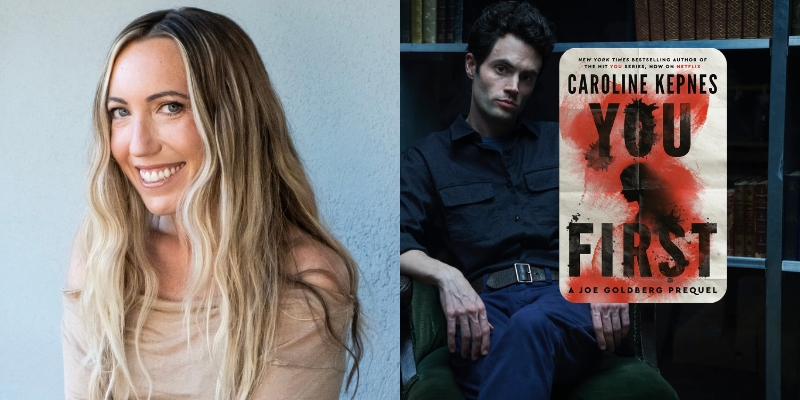
Caroline Kepnes on Post-9/11 Fiction, Grief, and Returning to Joe Goldberg's Origin Story
The author of You First in conversation with John B. Valeri
“The problem with books is that they end….”
–Joe Goldberg, You
It’s the inevitable arc of stories: beginnings beget conclusions. And yet, when done right, they live on in time, providing readers with a place to return to again and again, over and over.
This alchemy is something Caroline Kepnes captured in You (2015), which introduced twenty-something literati Joe Goldberg, single in the city and looking for love—and whose charisma and cunning (d)evolved into acts of stalking and serial murder. An instant New York Times bestseller, the book (which Stephen King called “Hypnotic and scary”) launched a franchise that now includes five novels and a five-season television series, ensuring Joe Goldberg’s immortality for generations to come.
But the inimitable Kepnes—formerly an entertainment journalist and TV writer (7th Heaven, The Secret Life of the American Teenager), whose bookish revery and pop culture savvy positively imbues her work—could never quite escape the feeling that Joe had been holding out on her, keeping secrets about his past.
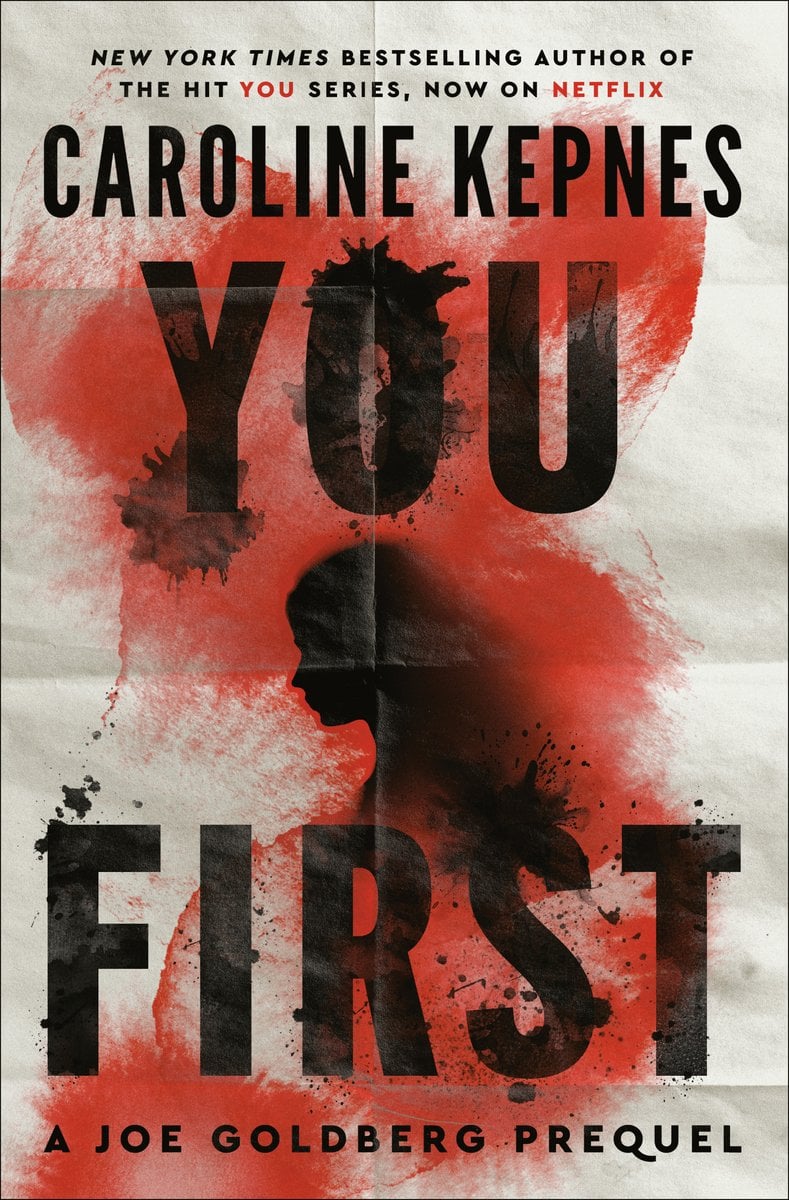
This summer, she revisits his formative years in You First (June 9, 2026; Random House), a prequel novel which finds the seventeen-year-old coming of age in post-9/11 New York City, on the cusp of manhood amid extreme claustrophobia and confinement—and vulnerable to the competing needs of his complex nature.
And then it happens. A random encounter with a beautiful woman at Mr. Mooney’s bookshop (where Joe is a prisoner to his work, sometimes literally) results in a Craigslist Missed Connection (“NYC Bookstore Babe”). And Joe is so ready to connect.
But Vail Gunderson is twenty-four and works on Sex and the City, possessing a worldliness in love and lust that eludes Joe. So he stretches the truth, providing an age and backstory that’s far more fiction than fact. As one lie leads to another, Joe—torn between loyalties—finds himself on the brink of a combustible toxicity that threatens to blow up everything, and everyone, around him.
Now, Caroline Kepnes reflects on going back to beginnings to unravel Joe Goldberg’s origin story in You First….
*
John B. Valeri: You First is a prequel to the Joe Goldberg saga, which has been immortalized on page and screen. What compelled you to mine his formative years for this new book–and how much of his origin story already lived within your head vs. what emerged during the writing process?
Caroline Kepnes: Joe is, for the most part, very good at keeping his secrets. I’ve always felt that his internal monologue is both a revelation and a cover, like there’s something he won’t even talk about with himself. I imagine him keeping a secret from me, and it’s always been in the back of my mind. What won’t you tell me, Joe?! What is so painful and humiliating that he had to erase it from his own memory?
I wanted to let us all see Joe before the wheels fell off, when that inherent internal chaos had a little more innocence to it. His neediness in this book is what astounded me with every draft, the anxiety, the insecurity. I reference Choose Your Own Adventure books because the process made me so aware of his decision-making process, how he honed his skills of rationalization on what he perceives to be a battlefield of love.
I didn’t expect to have so much fun with him, and I learned so much by having him binge Sex & the City. I was like wow….He really was naïve, and with each draft, that naïveté became a crucial part of the story. It really did feel like this series of events where he was increasingly crushed and cornered and realizing that he’s pretty good at solving problems, if he is willing to bend the rules, which he is, which only makes him feel more isolated.
I also savored the warped proud mom-ish moments where I’m like, wow…that is how you work it with Craigslist.
JBV: The narrative is very much steeped in time and place (post-9/11 NYC), with culture and climate saturating the story. How did you (re)immerse yourself in that world—and in what ways do you see us as being products of our environment?
CK: There are some marriages of time and place that fascinate me, and post-9/11 NYC is one of them. I lived in the West Village at that time, and the atmosphere was uniquely gut wrenching, everyone adjusting to living in this new version of New York. Emotions, of course, run high when you’re young, and from the get-go with the You series, I thought of Joe as someone who was activated by 9/11 in his own private way. I wanted you to feel like you’re living in this distinctive moment in time, so I went back to the evidence of my experience. I dug my old journals, the ones I sat with in coffee shops before smart phones.
The “free writing” was helpful because it was like oh that’s right….Here are the things I would’ve texted friends if there was texting. My journals were both helpful and cringe-painful, as are most journals, right?
I also looked at all my old pictures, the ones from disposable cameras. Writing Joe is always fun because I get to watch things like Serendipity through his eyes. Of course, he sees that movie and comes away with this conviction that he deserves that too, that he is Cusack without a Piven. Joe attempts to get some control, some justice. It’s not just that he wants a girlfriend. He wants someone to love him so he can be like See, Mom I am fucking lovable. The drive to be loved is at the heart of every book, his desire for his obsessive dedication to be reciprocated, twinned, etc.
I chose to start with him post-9/11 because of what we learned in book one about his personal 9/11 experience. That’s what makes him special to me. Until 9/11 he was handling himself, but once this shame was introduced, it destroyed his tolerance for anything remotely conjuring shame. His loneliness is exacerbated by his humiliation over missing out on the biggest day in the world.
So, he is in so much new territory, learning how to carry his secret, feeling like he has way more weight on him than all the other New Yorkers and we see the beginning of this split, how one secret you can never tell paves the way for more deadly secrets. And a decision he makes in the end is a way to get some control back, even if he doesn’t realize it. It’s like getting a tattoo, only, you know, a little more extreme.
JBV: There are three characters of particular influence on Joe in this book: Mr. Mooney (the boss), Vail (the girlfriend), and Dick (“the friend”). What does each represent in his life—and how do their differing personalities and opinions create conflict in his pursuit of love?
CK: They say that parenting gives you purpose, and with this holy triumvirate I was exploring the other side of that. What does childhood give to children who don’t have super-involved parents?
Joe wants Vail to be mother with a capital M. When she confuses him or makes him feel scared, he runs to his father figure Mr. Mooney, and he is in this rebellious stage where half the time he’s going to Mooney because he just wants another reason to prove his “father” wrong. Dick becomes the big brother that Joe never had, but again, Joe wants too much from this friendship, gives too much in the wrong way. In every dynamic, Joe wants to be the center of someone’s life, which is not how things work in this world.
I read this quote from Angelina Jolie recently where she says her mother told her that if you ask one person for advice, you need advice. If you ask more people, you need attention. So often people seek attention when they’re stressed out about something. Vail is the mother figure who will never be enough. In this way, Joe is acting like he’s the only young one, expecting a form of love from Vail that she’s not in a place to deliver.
Mr. Mooney is the father figure. Joe is in classic teen rebellion mode, and yet Mr. Mooney is the most consistent figure in his life. And Dick is just so damn solid. He is misogynistic and toxic.
What’s tempting for Joe is that there is safety in being toxic. Other people get hurt, particularly women, but not you. In this book, at this time in Joe’s life, advice seeking is a form of self-soothing/ procrastination and avoidance. Instead of being honest with Vail, he’s lying to her. He wouldn’t put it this way but essentially, he is doing recon and consulting other male experts for help, but more so to avoid intimacy. A classic surefire way to guarantee that things blow up in your face.
It was exciting to let Joe try and please and appease these people. To me, this is the emotional foundation of his avoidance as an adult. He is trying on personalities, too insecure to be honest with those closest to him, which is why he becomes incapable of closeness.
JBV: Much of this book is internalized thought, which drives external action. How did/do you endeavor to access Joe’s headspace—and what was your approach to balancing the cerebral with the physical to achieve sustained suspense throughout?
CK: It is always the trickiest thing with You novels. He is so so sooo fun to write, and I get going and don’t want to stop. That’s where so much of the writing that makes the book click comes in the third draft, in the microsurgery you do when you have the whole story locked down. I lead with Joe’s emotions, and I seek the moments where things dovetail. The Choose Your Own Adventure moments where he realizes that his choices are maybe not “normal.” Throughout the book he’s patting himself on the back for getting craftier, for becoming better at sneaking around and getting away with it.
I wanted the reader to be with Joe on this slippery slope. Was it inevitable that he becomes a murderer? Is it in his DNA? What is the nature nurture balance? My hope is that you read this, and come away with a stronger sense of yourself, the moments in your life where you really got to know yourself, were maybe a little scared, a little surprised by what you learned about yourself.
JBV: You First is dedicated in remembrance of your mother. Did you find that writing through your grief proved to be cathartic, a challenging, or a combination of both? In retrospect, how do you think that experience affected the emotional undertones of the story?
CK: It’s a full circle of parental grief. I wrote You in 2013 a few months after my father passed away. I was filling the void with this new voice and treating myself. Writing You let me go to happy places in my mind. It was back to my old stomping grounds in New York, back to being fresh out of college, a literary playground that felt like home to me.
So, then years later, my mother was my closest, most constant reader. It broke my heart to see her struggle with health issues. It is not lost on me that I wanted to, quite literally, go back in time once again. It’s like of course I set this story in New York 2002; when I lost my dad, I wanted to revisit the charm and the chaos of NYC. And when I was starting to lose my mom, I wanted the same thing. New York City, baby. Literally.
Writing You First helped me get through things, same way that writing You helped me. The hope is that something translates, that these books do the same for readers. A few sick laughs, getting lost in a story, swept up in a character that pushes different buttons at random…these things are, I hope, a helpful little escape for anyone going through it.
JBV: The series is very much a celebration of books. Tell us about how reading has shaped the trajectory of your personal and professional lives. In what ways do Joe’s experiences allow you to honor the importance of stories in our development?
CK: Oh books! Hands down one of the most amazing things about being an author is the friends you make along the way. The first ARC I got as a debut author was Fashion Victim. I read this thing I laughed so fucking hard and then I was like okay, author Amina Akhtar, let us be friends. And we are!
I’ve always been a bookworm. And I’m lucky that my parents supported this obsession. Ramona Quimby was my first literary role model. Are You There God? It’s Me, Margaret made young me want to be a writer. American Psycho made me double down on that dream. Reading is just so damn good for you because if you’re reading, you’re focused. It’s like being up at bat in a baseball game. You are intently doing this one thing. And my whole life, reading has helped me get out of my anxious brain.
But in 2012, after I lost my father, I lost my ability to focus. I didn’t think I’d read again, in all seriousness, my heart and mind felt ruined. Emily, Alone by Stewart O’Nan is the book that got me back. He is a genius. You read that novel; you are in Emily’s soul. It’s disorienting and intense. That’s the goal for me with reading and writing, to be in someone else’s headspace. I wanted to see if I could go into the mind of a murderer. Making Joe a reader was the way for me to ensure that we had common ground, that I would have things to talk about with this person whether I liked it or not. The dark side of the “we contain multitudes” notion.
And oh God as a child I was obsessed with learning to read. Reading seemed like a superpower, like if you could read you could make the world your own. I remember those first moments with Hop on Pop vividly. And it’s the joy of writing the You series that books I love to find their way into the pages. I love it when readers tell me that they learned of a book from one of my books.
JBV: In addition to authoring the You books, you worked in the writers’ room as part of the television show. How did you find the collaborative experience to compare to the relative isolation of writing a novel? Also, in what ways did the small screen version of Joe and his world work its way into the subsequent books (assuming it did)?
CK: I stepped into Greg and Sera’s season one You room and saw the romantic comedy beats spelled out on the wall and just about lost my mind. It was like oh yes…they get it! I mean I knew this from our talks, but seeing things and being a part of things is another level, and it was great to be back in that kind of space. I hadn’t been in a writers’ room since I was on staff at Secret Life of the American Teenager.
As an author, you get so used to working alone, and the little things about daily life and coping are just so different. At home, when I get stuck, I go out and bum around or watch TV or take a shower or something and I remember being in the You room like…oh right. This is a job. I can’t go buy a pack of cigarettes and roam around; we are staying in this room together!
The crazy thing about adapting a story like this too, is you reap what you sow. As they were casting season one and it’s one great get after another I’m like…well maybe Joe doesn’t kill anyone, you guys?! Maybe Peach and Benji are alive forever! A reader recently just asked me about You Love Me.
In that book Joe manipulates people and circumstances to avoid direct hands-on murder and preserve his self-image as a good guy. I didn’t write You for TV, so to see talented amazing actors take on roles….It does make you like wait…why does everyone have to die?! And they do so that Joe can live.
JBV: Joe Goldberg has become such a part of the pop culture lexicon that audiences can’t seem to get enough of him. It’s not a bad problem to have, obviously–but how do you balance your own creative ambitions with readers’/viewers’ expectations?
CK: That appetite is a beautiful thing. It’s very Spaceballs the movie…the placemats. For a pop culture junkie like me it is joy. Joe Goldberg was my healing toy in 2013, and now he means so much to so many people. As the show blew up, as the years have gone on, I’ve grown increasingly grateful for my own extreme, addictive little ways. I am obsessive by nature, and writing is something I need to do, something I like to do. I like writing more than I like having written. It’s the good kind of addiction. I am simply more at ease when I am building characters and worlds in good old Microsoft Word.
It will always be insane to be in the grocery store and overhear someone crack a joke about Joe Goldberg, to realize that what started as this offbeat crazy little healing experiment on my sofa in my apartment became a part of the pop culture lexicon. And I am eternally grateful for all involved in every step. It’s serious to me as a former entertainment journalist. I have always been passionate about “this…stuff” (Miranda Priestly!). I love how an adaption of a book can make me realize things about the way things looked in my headspace as a reader, as a writer. And to be a part of that, to have you fans around the world so passionate and zealous is a dream. Thank you for that!
And then it’s back to work, which is the sort of prequel dream, the one where the other dreams come from, if you will. When you are a writer, whether you’re published or not yet published, your dream comes true every day in the act of writing. Writing releases you from ambition. Emotions and anxiety and nerves and doubts and highs and lows…these are pretty snazzy writing tools when you’re in flow.
***

John B. Valeri
John B. Valeri is a book reviewer, author, and host of the web series “Central Booking.” He has contributed to The Big Thrill, CrimeReads, Crimespree Magazine, Criminal Element, Mystery Scene Magazine, The New York Journal of Books, The Strand Magazine, and Suspense Magazine. Visit him online and watch past episodes of “Central Booking” at JohnBValeri.com.