


Clive Cussler and the Art of the Thriller
Graham Brown on the NUMA Files, saving the world, and earning a reader's surprise.
At their deepest levels, fiction writers are nefarious characters. They’re leading you down a path that will keep you up at night worrying for the fate of your favorite characters, and possibly the world as we know it.
They are, in fact, liars, manipulators, twisters of the truth, hiders of the ball, and experts in the procurement of red herrings. If they are any good at their craft, they are somewhat like magicians, getting you to pay attention to one thing, then making something else appear or disappear through sleight of hand. They revel in conceiving ideas that will make you squirm, wonder, or feel the creeping shadow of suspense. They love, more than anything, to surprise you while making you realize they were telling you this would happen all along.
And of course, you wouldn’t want it any other way.
I’m a thriller writer, not a crime writer. The two blend in certain ways, but in general the thriller relies on pacing and upcoming danger or impending doom. The crime story often includes these elements, especially with a criminal still on the loose, but it usually relies primarily on dealing with an event that has already occurred.
For a thriller, pacing is important, but twists in the story are even more important. A fast-paced thriller written in a completely linear style will bore you within a hundred pages. There must be curveballs, twists, and surprises, or you might as well just skip to the end to see if the world survives. The deeply foreshadowed event or revelation is one of the best moments in reading a novel or watching a movie.
Two huge spoilers ahead – do not read if you’ve never seen The Sixth Sense or read Raise the Titanic.
When considering great twists and last-minute revelations, I cannot help but think of The Sixth Sense. Watching that movie for the first time, I was completely enthralled. When they finally revealed that the character Bruce Willis plays is actually a ghost and has been dead all along, I was stunned. I instantly recalled all the moments and clues M. Night Shyamalan had shown us along the way: his wife not speaking a word to him at dinner and then running out, or Bruce Willis not speaking up when the little boy’s mom is being accused of child abuse, even though he’s sitting right there and he’s a psychiatrist. Those moments seemed odd at the time, but suddenly they made sense. There’s even a line of dialogue where Haley Joel Osment looks at Bruce Willis and says, “The ghosts don’t know they’re dead.”
Brilliant.
I often use movie examples when talking about writing because they’re more universal. Unfortunately for us writers, more people watch movies than read books.
One of my favorite literary examples comes from Clive Cussler’s Raise the Titanic. In the prologue of the novel, a chapter about the sinking of the great ship, we see a character who appears quite mad. He forces a member of the crew to take him deep into the ship’s hold even as the Titanic is taking on water. Once there, he opens the back doors of an old truck to see… nothing. He exclaims oddly, “Thank God for Southby.” And then locks himself inside.
The crewman, baffled by this but very much wanting to survive, rushes to escape the sinking ship. He lives, never forgetting this moment of madness or what the man said, wondering about it all through the remainder of his life.
As the novel unfolds, we find the modern-day world locked in the Cold War. A weapon has been developed that will allow a kind of Iron Dome to be created to protect the United States from ballistic missiles. Clive was always ahead of his time. To power this system, America needs a unique and very rare radioactive element called byzanium.
A desperate search for this element begins—a race between the world’s superpowers of the time, the U.S. and Russia. It’s learned that the world’s known supply of byzanium was placed aboard the Titanic before she set sail and sank. The decision to find the ship and, more audaciously, to raise it from the depths is made. (The Titanic hadn’t been located yet when the book was written, but Clive’s guess at her location and depth was surprisingly close to the ship’s actual resting place.)
A great effort proceeds. Sabotage, murder, and other crimes are committed as spies and operatives tangle in the shadow world of the Cold War. The ship is finally raised, almost destroyed by a hurricane, and then almost stolen by the Russians. NUMA prevails, with some help from the U.S. Navy. The Titanic is brought to New York where she finally docks seventy-six years after she was supposed to finish her maiden voyage.
And… nothing of the radioactive element is found anywhere inside her.
In the epilogue of the story, Dirk Pitt, the hero of the series, remembers what the old survivor said about the madman who locked himself in the truck and intentionally drowned. Thank God for Southby.
He travels to Southby, a tiny town in the U.K., where he discovers a grave marked with a name from the madman’s old journal. With the help of the local constabulary, they dig into it and discover the radioactive material was buried there all along.
It’s a great twist—fantastically memorable and hinted at during several points in the book, just enough to make you wonder what’s going on and truly appreciate the fantastic ending.
Having worked with Clive on the NUMA Files, I learned so much about writing, and even more about life, but one of the great lessons he taught me was to always keep your readers guessing—but never cheat them with a trick they can’t see coming.
In my own series and in all the books of the NUMA Files, I’ve done my best to keep up that tradition.
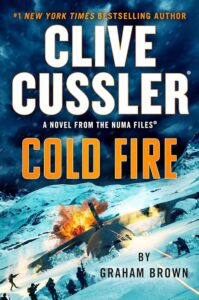
I think you’ll find good examples of this in most of my novels, but particularly in Devil’s Gate, Nighthawk, Desolation Code, and especially in the novel that comes out this June, Cold Fire.
Devil’s Gate is a classic sea-based adventure, with a powerful villain using advanced technology to threaten the wealthy countries of the West.
Nighthawk centers on the search for a missing spacecraft that crash-lands with a cargo of antimatter cryogenically stored on board. It’s a ticking-time-bomb story where the world is in great danger, and the heroes’ ingenuity and ability to think their way through problems matter far more than their physical strength or any weapons or gadgets they carry.
Desolation Code has a large element of science fiction to it. The novel revolves around a powerful artificial intelligence system named TAU. Its creator wants to merge it with human biological partners—some willing, others definitely unwilling. Just who TAU merges with, how it’s accomplished are plot points delivered through surprising twists that are hinted at throughout the novel.
In the newest entry of the series, COLD FIRE, we’ve created a cat-and-mouse, spy-vs.-spy espionage thriller.
A high-tech aircraft capable of controlling an entire battlefield and shooting down hundreds of missiles and drones in a matter of minutes goes missing and crashes into the sea. Or did it?
Perhaps it’s on the Arctic ice where a Chinese icebreaker has mysteriously parked itself. Or maybe it went to a remote location in Russia along its last known heading?
In a throwback to the great power struggles seen in Raise the Titanic, we have Kurt Austin, Joe Zavala, and the rest of NUMA’s intrepid band going up against Chinese agents and a Russian general willing to take almost any risk to secure the plane. But with all three nations risking war to find the aircraft, the sense that someone is leading them down a dangerous path to conflict grows with every page.
Just who is behind the aircraft’s disappearance and why, is something you’ll have to read the novel to discover. If I’ve done it right, the revelation will both surprise and intrigue you. In the meantime, I hope you’ll enjoy the lies, the manipulations, and the red herrings I’ve laid out along the way.
But in at least ONE way you can actually trust the authors— we’ll always do our best to make sure you’re never quite comfortable until all is finally revealed and resolved to the most satisfying degree possible.
***

Graham Brown
Graham Brown is the author of Black Rain, Black Sun, Clive Cussler Condor's Fury, and Clive Cussler's Dark Vector, and the coauthor with Cussler of Devil's Gate, The Storm, Zero Hour, Ghost Ship, The Pharaoh's Secret, Nighthawk, The Rising Sea, Sea of Greed, Journey of the Pharaohs, and Fast Ice. He is a pilot and an attorney.