
Con Lehane On Writing a Red Scare Noir Against a Backdrop of Rising Oppression
Lehane's latest novel wasn't meant to be an allegory.
But if the shoe fits...
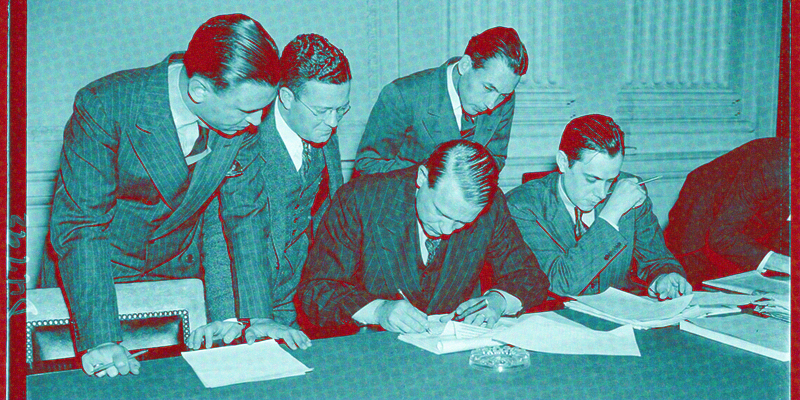
In my travels to a few author events since my book, The Red Scare Murders, came out in mid-December, questioners have often asked if my story—set against the backdrop of witch hunts, inquisitions, guilt-by-association, accusation by innuendo, and governmental attempts at thought control in 1950 and to demonize Communists and other progressives—was meant to be an allegory reflecting on our own times of governmental attempts to control information, stifle dissent, weaken the independence of the courts, academic institutions, the press, and governmental agencies designed to protect the nation’s citizens from fraud, exploitation, and so on.
The simple answer is that this was not my intention. But the parallels between the time of the red-scare witch hunts following World War II and and today’s ascendancy of autocratic government, diminution of civil rights, scapegoating of immigrants, documented and undocumented, and attempts at thought control by the Make America Great Again government are undeniable.
I’d never had to talk publicly about the political implications of one of my books. I remember Stephen King in On Writing suggesting when you’d finished maybe a second draft you might think about the implications or theme or meaning of the book. You would try to discover the book’s theme, even though you hadn’t intentionally put it there. But he didn’t make a big deal out of it. Maybe you came up with something. Maybe you weren’t able to articulate that idea even if you knew something was there that held the book together. What I discovered in The Red Scare Murders after the fact of writing it was a lot of betrayal weighed against the importance of maintaining your own integrity.
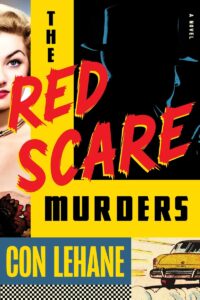
The book, as you might guess from the title, is set against the backdrop of the anti-Communist hysteria of the 1950s. My protagonist, Mick Mulligan-Private Eye, having been blacklisted in Hollywood for refusing to name names of possible Communists he’d known, has been hired to try to prove the innocence of a man on death row. An organizing campaign is underway for a city wide strike to win union recognition for the city’s cab drivers. A cab company boss has been murdered. The man convicted of his murder and awaiting death in the electric chair is a union organizer, an African American, and a Communist. Mulligan has two weeks to prove he isn’t the killer.
At one point in the story, Mulligan asks himself, concerning the plight of another Communist union organizer, why the man was about to be jailed for his beliefs, which included, according to the indictment, conspiring to advocate, teach, and organize the violent overthrow of the U.S. government. We know now—and Mulligan, and arguably the prosecutors, knew then—the Communists had neither the intention nor the ability to overthrow the U.S. government. So, asks Mulligan, if this wasn’t the reason, what was?
What the Communists did have—along with many other progressives—was a political philosophy that encouraged them to build strong unions and oppose the stranglehold the ruling oligarchy had on the nation. The Reds’ ultimate aim was socialism. But this was far on the horizon. The efforts to lock up the Communists, as far as Mulligan could see, was not to protect America from the evils of Communism but to maintain the rule of the elites—the rich and the powerful corporations that controlled the major institutions of society. Capitalism, Americans were to believe, was as American as motherhood and cherry pie. A threat to capitalism was a threat to the the American way of life. If protecting capitalism meant wiping out some of the nation’s basic tenets—freedom of speech, freedom of assembly, the right to a fair trial, and such things—so be it.
The impetus for the book, however, was not ideological. A few unrelated ideas that I’d carried around for a number of years came together to form the spark or origin-idea for what became The Red Scare Murders. The first involved a girl I knew when I was young. She was barely out of high school and had moved to the small city where I lived, some distance from where she’d gone to high school, where she got her first job as a junior secretary in an office of a local factory. After a few months, she became romantically involved with her boss, who wooed her in the way a wealthy man, older and more experienced, can seduce a young, naive girl from an impoverished background who’s just starting out in life. It happened that a friend of mine worked in the plant where this young woman worked in the office and told me the man she was dating had a wife and a couple of kids. I told her what I’d been told. I guess she asked her boss who denied the accusation. She decided to believe him. Some time later—at least a couple of years—she discovered what I’d told her was true. That ended that.
The second piece was also based on my own experience. I drove a cab when I was young—beginning when I was eighteen—off and on for four years or so. I worked nights from 7:00 p.m. to 7:00 a.m, learned how to play blackjack and shoot craps and, most relevant here, took part in a taxi strike. This is a long story of its own that I won’t go into. But I inadvertently became a scab. The non-union company I worked for bought a rival cab company while its drivers were on strike for recognition of their union. For a month or so, the strike continued while we, the unwitting, were still driving. When the strike settled—with a contract—we all became part of the union and I worked another couple of years off and on as a Teamster union driver.
Another inspiration for the story was more an idea than an actual happening. I read a lot of U.S. labor and left-wing history when I first began working for labor unions. And I was particularly intrigued by a time at the end of World War II during the Red Scare witch hunts when major struggles took place in a few unions in New York City between the Left and the Mob for control. What struck me in particular was that the U.S. government by-and-large sided with the gangsters in the these struggles, willing to let organized crime run amuck in the labor movement rather than let unions—led by communists and socialists—become a threat to capitalism.
My book is a novel about imaginary people in a particular place at a particular time fighting their way through imaginary dire circumstances. As a writer I’m not a political proselytizer and my book is not a political treatise. But as I look at the story I wrote now that it’s finished, the book does seem to contain something of a cautionary tale.
I didn’t start out with the idea that betrayal would be a major theme. But there it was. One glaring betrayal in the book is that of a society’s institutions abandoning their ideals when the pressure to conform to the beliefs of the ruling class became too great. These included the institutions we’d expect better of: the government, the courts, higher education and K-12 school systems, the mainstream press, sadly the labor movement. Sadder still is the story of workers betrayal of other workers, of a friend’s betrayal of a friend, a husband’s betrayal of a wife, a wife’s betrayal of a husband. Mick Mulligan’s challenge is to not become a victim of the most significant betrayal—the betrayal of oneself. When push came to shove would he be true to his own integrity?
So far in our day and age only half the country has buckled at the knee and is willing to let a would-be oligarch trample on the Constitution, the rule of law, the right to hold an opinion in opposition to the orthodoxy. The scary part for me is that this acquiescence could grow as the pressure to conform increases, as it did during the red scare.
***

Con Lehane
Con Lehane is a mystery writer, living outside Washington, DC. Murder off the Page is the third in his series featuring Raymond Ambler, curator of the 42nd Street Library’s (fictional) crime fiction collection. He's also the author of the novels featuring New York City bartender Brian McNulty. Over the years, he (Lehane, that is) has been a college professor, union organizer, labor journalist, and has tended bar at two-dozen or so drinking establishments. He teaches fiction writing and mystery writing at The Writer’s Center in Bethesda, Maryland.