Kylie Lee Baker on 'Japanese Gothic', Historical Fiction, and Writing Horror with an Emotional Core
The author of ''Japanese Gothic' in conversation with Morgan Leigh Davies
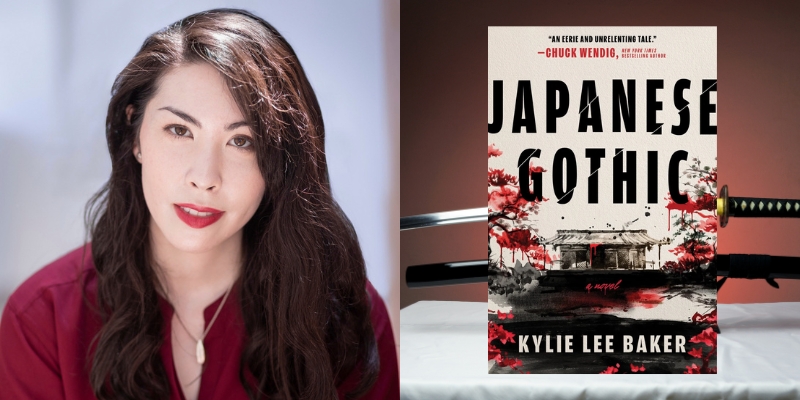
In Kylie Lee Baker’s new novel, Japanese Gothic, nothing is as it seems. Lee Turner, a college student at NYU, claims to be visiting his father’s new home in Japan on a leave of absence from school, while in fact he’s fled the country after violently murdering his roommate. But he can’t quite remember why he killed him, and definitely doesn’t know where he hid the body.
Even stranger, his father’s old house in the countryside seems to be filled with a haunted presence. That presence turns out to be Sen, the daughter of one of the last samurai, living in 1877. Though her family is in hiding from imperial forces, Sen’s father insists that soon, the samurai will rise again. He trains Sen to follow in his footsteps, convincing her of the nobility of their cause. Soon enough, Lee and Sen discover that a sliding paper door is all that separates them, and the intersection of their lives creates chaos on both sides of the novel.
Japanese Gothic isn’t as bloody or as pointedly political as Baker’s last novel, Bat Eater and Other Names for Cora Zeng, which follows a Chinese American woman who realizes that a serial killer is murdering Asian American women while working as a crime scene cleaner in New York City during the COVID-19 lockdown. In that novel, Baker, who has both Chinese and Japanese heritage, used horror to critique the anti-Asian racism that surged alongside the pandemic.
Japanese Gothic takes a more sideways approach to its political ideas, but those ideas are potent. In this novel, the family is not a source of safety or consolation but a site of violence and unease. As the book progresses, Baker shows more and more of Sen’s family life, painting an increasingly damning portrait of her father, who physically and emotionally abuses his wife and children and lives in a state of delusion about the future of the samurai.
“I will always be a samurai,” he grandly tells his more realistic wife. “If you don’t accept that, leave. But leave my children, because they will always be samurai too.” Later, when his wife criticizes him for not providing for the family, he instructs Sen to cut off two her mother’s fingers. She complies.
As dramatic as these scenes may be, Sen is hardly alone in her plight: as Baker puts it, “My portrayal of the one American family in this book is also pretty negative.” Lee’s mother disappeared mysteriously when he was a young boy, while the family was on vacation in Cambodia, and he is obsessed with finding out what really happened to her. He believes Sen is the key to connecting him to his mother’s spirit, since she is, in his timeline, already dead.
His father, meanwhile, has dated a series of Japanese women in the years since his wife’s death, all the while pointedly failing to notice Lee’s addiction to sedatives and avoiding discussion of his late wife. Lee’s very presence seems to make his father uncomfortable: he “had a way of wincing at Lee like he was a sharp ray of sunlight. That was why his father never looked at him for very long.”
Baker has not only created two vivid and unusual protagonists, but also a mood of unease and mystery that puts both her characters and her reader on edge throughout Japanese Gothic. What exactly happened to Lee’s roommate, and why can’t Lee remember it? How will Sen’s and her family meet their inevitable ends? Why are Lee and Sen connected, and what will the connection between them reveal?
As Baker explains, she works to carefully include just enough questions and possibilities to keep the reader guessing, but not to overwhelm them: “The reader’s going to expect to find out by the end why Lee [murdered his roommate]—or, if he didn’t do it, who did. I love having those fishing hooks to pull readers along: you know this is going to be revealed by the end, and you’re probably forming theories about it, and there aren’t really that many options.”
In our conversation, held over Zoom, we discussed writing Japanese characters against stereotype, the complexities of samurai culture, the possibilities of the horror genre, and more.
(This conversation has been edited and condensed for clarity.)
*
Morgan Leigh Davies: How did you balance writing historical fiction and characters living in the contemporary world in this book? Especially since they wind up interacting with each other.
Kylie Lee Baker: Historical settings have so much built-in ambiance. Particularly with samurai, people have so many preconceived notions. It feels more dramatic to me than many contemporary settings. For this book in particular, it was a lot of fun to bounce between two worlds. It was very heavily inspired by Chuck Wendig’s The Book of Accidents, which doesn’t go to a historical setting as much as to alternate universes, but I loved the way that everything tied together by the end.
It became a challenge for me to find commonalities with two very different people across two very different time periods. The guiding thread that helped me balance it is, What are these characters trying to achieve together?
I have written historical fantasy in the past. I think of it as, I get to cheat a little bit, quite honestly, because I’ve never written anything that’s straight historical. There’s a bit of a bit more of an expectation that everything is as accurate as it can be. With my writing, when it comes to historical settings, I always do my best to write accurately to the point that someone who is familiar with that time period would not be distracted or put off by it. If I make any changes, they’re reasonable changes.
But because it’s always speculative, I never feel like I have to be perfectly accurate down to the type of soap they use to wash their hands. At the end of the day, there are ghosts running around: none of this is real.
MLD: I was really interested in the author’s note at the end where you talk about Western readers having preconceived notions about Japanese history and samurai culture in particular. As you say, in Western culture there is so much fetishization of this country and time period, but there is also the idea that any non-Western culture is backwards. How much you were thinking about those issues when you were writing?
KLB: First and foremost, I really wanted to tell Sen’s story, regardless of how it would be perceived.
Writing about samurai is so hard culturally as a Japanese American. I’m definitely not immune to the hype around samurai. Blue Eye Samurai is one of my favorite shows ever. There’s something so cool and feminist about a woman in particular wielding a katana. I won’t pretend that that doesn’t make me excited, even with my family history. I’m not descended from samurai. I’m descended from the Japanese people they colonized. Even knowing that, it is still, on some level, as an Asian American, a very empowering image that I do like to lean into.
And at the same time, it’s challenging because I come from two different cultures. There are the non-Japanese Americans who very often have a simplified version of what they think Japan is, and as you’re saying a very fetishized version, who are held to a higher standard in some ways, or conversely you have the original Shōgun, where Japanese people don’t know anything, they’re just murdering everyone because they don’t know what we know in the West.
But then also as a Japanese American, I have this experience of a lot of resentment coming from other Asians and other Asian American people who still, for good reason, are very resentful of Japan and its past, which a lot of the time is something that I get caught in the crossfires of, despite the fact that my family was in America before Japan colonized Korea.
It’s a very complicated identity for me and it’s so hard to portray the nuances in a book, but at the same time I don’t know that that was ever really my goal, because I don’t think it’s possible to show everything I just described, such a multifaceted experience, within one character, one family.
Though I would say perhaps subconsciously as I was writing this, I wanted to talk about the concept of the samurai ideal but also criticize it, because as cool as it is to me personally, I feel like it is important to me in the current cultural context with the background that I have to not glorify the samurai completely—to show that they weren’t heroes and they weren’t all horrible, evil, genocidal maniacs. They were people, like anyone else. Because identity is complicated.
MLD: One of the things that I most appreciated about that historical piece was that Sen’s father is abusive, and she winds up in this bizarre situation where she’s interacting with twenty-first-century people, but it didn’t feel to me like she was behaving based on twenty-first-century ideology. You do a really good job of showing how her approach to the world has been shaped by this abusive environment.
How did you write that relationship in a way where the reader can see that this is really dysfunctional, but also show that her priorities are not necessarily our priorities?
KLB: In some ways, it wasn’t as hard as you might think to write, because at her core, all that Sen really wants is love from her father. She was very easy character to write in that sense. It’s clear that her mother doesn’t like her. Her brothers are just, you know, kid brothers. So the only hope she has of being accepted by anyone is her father. Wanting love from your parent is such a universal theme that really transcends any culture or time period.
I know I just told you that Shōgun is a bad portrayal of Japan—I’m thinking about the first Shōgun, the older one compared to the one that came out in 2024. I loved that, and I turned to that a lot when I was thinking about the tone of the story, the way of speaking, and the sense of loyalty to people around you in ways that don’t always make sense from a Western perspective.
In the show, they talk about how life and death really aren’t that different, how death is not the end of the world. I’m not saying people walked around like, Oh, I don’t care if I die today, but they would accept their death for reasons that might not always make sense to someone coming at it from an American perspective. So that show is definitely a big source of inspiration for this book.
Compared to the first one, the new Shōgun does such a good job of making it a show about Japanese politics as opposed to, White man comes to Japan and fixes all their savage behaviors. The white man was really not the star of the show in the new Shōgun.
MLD: Without getting into too many spoilers, you depict family violence in both these time periods in ways that are in some senses very different, but in others really similar. How did you think about how those ideas would bounce off of each other in these two different time periods?
KLB: I think it’s such a universal, cross-cultural thing, this idea of preserving the image of your family rather than doing the hard work to address the problems within your family. That’s a huge thing within many Asian cultures. A lot of the time, they don’t believe in therapy, they don’t believe in mental illness. This is obviously not every single family, but it is a common cultural phenomenon in many East Asian cultures that you do things as they have always been done in your family.
You have a certain type of hierarchical relationship with your children. You don’t address a lot of problems that are more commonly addressed in Western culture.
I think that can also be a generational thing in America, particularly not being willing to address mental illness, not wanting to think there’s anything quote-unquote “wrong” with your kids—caring more about how you are perceived than the reality. I think that’s another one of those things that transcends time and culture, unfortunately.
MLD: There are multiple scenes in the book where Sen adopts her father’s method of engaging with her family. One line in particular really stuck out to me, where she’s behaving in this really intimidating, frightening way around her mom, and she realizes, “All she’d had to do was act like her father, and her mother had listened.” She’s obviously a victim, but people in those situations do adapt to the world that they’re in and can become bullies as well.
Could you talk about writing that dynamic?
KLB: I think we’ve all seen that children can repeat the actions of their parents, especially in Sen’s case when it’s all that she knows. You see it especially in very sad situations when kids are very isolated, like they’re homeschooled and they just don’t know anything else. That certainly is the case for Sen up until she meets Lee.
What makes the difference is that she finally has met someone with whom she doesn’t have to be a way that she’s not in order to win his approval. That’s just such a novel concept to her. It’s the perfect fit for Lee because he’s such a total weirdo. Nothing that she does phases him. They’re so strangely like two little aliens who’ve finally found each other.
Everyone needs some sort of validation in their life from someone. In both of their cases, they really didn’t have that until they met each other, and that is what enables them to then look at their parents and go, Actually, this is not how I want to live. I don’t want to be this way anymore. I don’t want to repeat this.
MLD: I don’t want to give away the ending of the book, in this and in Bat Eater, I was really struck and impressed by the fact that you don’t shy away from depicting death, or having a lot of dark stuff happen. Obviously, that’s part of the horror genre. What kind of storytelling freedom does the genre open up to you, especially in terms of death and violence? Like you’re saying, death is maybe not the worst thing that can happen to the characters in this book.
KLB: First of all, I’ll say your comment reminded me of one time someone tagged me in a review of one of my books. They said, One thing I love about Kylie’s books is that she’ll kill any character at any moment, so you never know what will happen. I was like, Wait, I don’t know if that’s true. But I understand why people feel that way.
In my adult horror, that definitely does open up a lot more possibilities compared to when I’m writing young adult books, and I don’t want to traumatize teenagers too much. It is nice to have that sort of freedom. In Bat Eater and in Japanese Gothic, I’ve been asked, Why did you kill off this specific character? Why did you have to do that? I’m so sad that you did that.
Maybe this is a very Japanese mindset where I feel like death is just not the worst thing. It’s just par for the course for a lot of horror novels. I think what matters more at the end is what’s left inside the protagonist, assuming that they’re alive.
For me, that is so much more salient, so much more meaningful than anything else in the book, especially because most horror tends to be standalone compared to other genres. Within a hundred pages of this character’s death, everything’s gonna end anyway. But I never try to kill someone just for the sake of it. I’m never into gratuitous blood and gore and death for no reason whatsoever. I really strongly believe that everything in horror has so much meaning.
I think a lot of the horror movies and books that fall flat for me are stories that misunderstand that, that think horror is just about people who love blood and guts, so let’s shower them in blood and guts and kill everyone at the end. There’s no emotional core, no soul to the story.
MLD: The bigger question about horror is interesting because it’s obviously not a new concept that this is a genre that can be used to explore bigger societal ideas. I was thinking about this reading this book because Bat Eater was really explicit in terms of having a political allegory. This book is also really political—less directly about a contemporary issue that is in the news, but about the ideas of family violence we’ve touched on. What do you think the genre opens up for you in terms of addressing some of these different ideas?
KLB: Having access to horrific elements like blood, guts, and gore—for me, that’s a tool that is meant to make the reader uncomfortable. I think that’s so important, especially in a book like Bat Eater, where one of the central theses is that not everyone has the privilege to look away from what makes them uncomfortable. The world isn’t built for you to be comfortable. Not everyone can be. I show that very quickly in the first chapter of that book, to show people what they’re in for.
Japanese Gothic is a little different in the sense that it’s using horror elements as an exclamation point on certain scenes, to really show people how awful the world can be. It’s a way of not pulling my punches, not sanitizing things. A lot of things that happen in horror movies that make people cringe and go, Oh, that’s disgusting—those things happen in real life all the time.
What I like about horror is that you can show how ugly the world can be unapologetically. In a lot of genres, that’s not what readers want or expect, and that’s fair. No one goes into a rom-com expecting a decapitation. That would really ruin the experience. Whereas with horror, you have readers that are willing to be a bit braver, which makes me think that they might be more open-minded to certain things.
That’s why I think horror is such a good vehicle for talking about injustice. I think the heart of horror is having a catharsis against a societal or a personal wrong, or personal trauma. I think that’s the core of the best horror out there.
MLD: Both Sen and Lee repress a lot of their emotions and traumas. When we meet Lee at the beginning of the book, he’s addicted to sedatives, he’s killed someone but doesn’t really remember doing so. But we don’t fully understand the extent to which repression is the point of the story you’re telling until the very end of the novel. How you approach that from a storytelling perspective? Though you keep certain plot elements hidden, you create a feeling of unease throughout the book that I found very striking.
KLB: One thing that might explain my thought process in writing this is that I went down an internet rabbit hole about dissociative identity disorder. None of the characters in this book have that disorder; that’s not what I was writing about. But I found it interesting to learn about, because it demonstrates the lengths that the brain will go to in order to protect you. The whole basis of it is, there’s a lot of amnesia blocking out different traumatic incidents in the past and that results in all these different alters in this very inner world that function as a team to protect the person from things that they can’t handle.
I think that happens in lots of ways that aren’t exactly dissociative identity disorder. The concept of how much the brain can do to suppress trauma was really fascinating to me.
I’m also a big fan of Katrina Ward’s work: every book of hers I’ve read so far has some huge plot twist at the end because the narrators are so unreliable, and I just find that thrilling. With those two things in my mind, I set out to write this very unreliable book. I also think a lot about something Paul Tremblay said about his writing, which is that one way he likes to approach a novel is that everything feels very normal in the beginning except for one thing, and that’s really all that you need. That’s enough to make people feel unsettled.
MLD: Were there any other things that you were drawing on or that inspire you generally? This is a haunted house novel, so it draws on some tropes readers will be familiar with, but it’s very different from a classic haunted house story. There are no ghosts as such, for example.
KLB: This might surprise you, but a big inspiration for this story before any of the specifics was the American version of The Grudge. That was such a formative film [for me]. I watched it when I was way too young to watch it. I thought it was terrifying. It’s essentially, you know, White person goes to Japan, meets scary Japanese ghosts.
As a child, of course, I didn’t think too critically about that. As I got older, I started to consume more media, and there were more and more Grudge sequels, and the American version of The Ring, where similarly, white person is inexplicably in an Asian country for some reason, and then encounters all these scary Asian ghosts. There were more and more movies like that.
I started to not love how all this culture and folklore was just boiled down to: Asian people with long black hair look scary in the dark. When I was a kid and I would watch that movie with my friends, I was the only Asian kid in my class, and so people would be like, Oh, in the dark you’re so scary, you look like the Grudge. I wasn’t offended by it back then, though in hindsight I’m kind of like, Maybe I don’t love that as much as I thought I did when I was a kid.
So I really wanted to write a Japanese haunted house story where the point was not that Japanese people look scary in the dark, and not that Japanese folklore is scary to white people. It definitely can be scary, and I think that’s certainly part of what goes on in this book, but it’s not the entire point. Kind of how in [the 2024] Shōgun, there is a white man going to Japan and doing things, but the point is not that he is saving them. There are so many other things going on there. That’s what I was going for here. The white guy going to Japan is just as awful, if not more awful, and complicated compared to the Japanese characters. Not everything revolves around the white person who goes to Japan. Everyone has their own problems in the book.
It was something I’d wanted to do for a long time, write a Japanese haunted house story that makes me as excited as The Grudge did back then, but has more of the nuance I have come to want as an adult.
***

Morgan Leigh Davies
Morgan Leigh Davies is a writer living in Brooklyn. Her writing has appeared in publications including Bustle, The Sick Times, and Electric Lit. You can find more of her work at mldavies.com.