Cristina LePort on Turning Medical Advances into Page-Turning Suspense
The author of Defrosted explores cryonics, technology, and creating narrative tension
When a heart stops beating, in a hospital, that moment signals an end. In fiction, it can be the beginning.
Medical advances have always fueled storytelling, but in today’s world—where science routinely crosses lines that once felt absolute—they have become one of the most powerful engines of narrative tension. Among these advances, cryonics stands apart. It doesn’t just push boundaries; it challenges the most fundamental one: death itself.
Traditionally, death is a fixed point, a boundary that cannot be crossed. Medicine has steadily eroded that certainty through resuscitation, organ transplantation and life support. Cryonics goes further. It proposes that what we call “death” may not be final, only temporary—an interruption waiting for technology to catch up. Bodies are cooled. Cellular decay is slowed. Time is, in a sense, interrupted.
Cryonics contains all the ingredients of a gripping story: high stakes, cutting-edge technology, moral ambiguity. If death is no longer final, then every decision surrounding it becomes unstable. Is the person gone, or waiting? Can identity be preserved? And the ultimate question: who decides who deserves another chance? These are not abstract philosophical puzzles. They are plot devices with teeth.
Most genres have to manufacture stakes. Medical stories begin with the highest possible ones. Life and death are already on the table. Medicine deals in outcomes that are final, and that finality gives every scene weight.
Now introduce an advance—something new, unproven, powerful—and the stakes sharpen. The question is no longer just “Will the patient survive?” but “Should this even be attempted?” That shift—from survival to judgment—is where suspense deepens. At the edge of the possible. The conflict is no longer just clinical—it is moral and emotional. The science is not decorative—it drives the plot with built-In stakes: life, death, and judgment.
At its core, a thriller is built on urgency, consequence, and uncertainty. Medicine, especially at the cutting edge, delivers all three—naturally. When science moves into territory that was once unthinkable—reviving organs, editing genes, extending life—it doesn’t just expand knowledge. It creates tension. And tension is story.
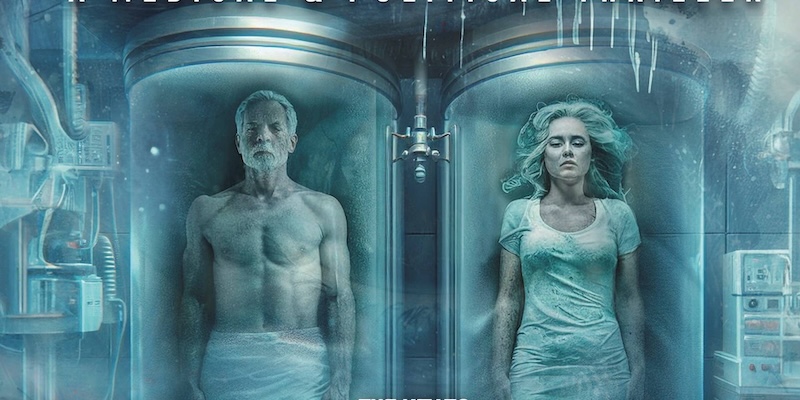
Cryonics exemplifies this perfectly. The process—cooling the body, replacing blood with cryoprotectants, attempting to preserve cellular structure—is grounded in real techniques. But its promise, the idea of future revival, remains unproven. That gap between what we can do and what we hope to achieve is where suspense lives. A story operating in that space doesn’t need to convince the reader of the impossible. It only needs to suggest that the impossible might be closer than we think.
Thrillers depend on urgency. Each chapter must pull the reader forward, creating a sense that something is about to happen—and that it may happen too late. Medical stories are built on that pressure. The body operates on strict timelines—minutes without oxygen, hours before irreversible damage, narrow windows for intervention. These are not narrative devices added for effect; they are intrinsic to Medicine.
Cryonics introduces a paradoxical clock. On one hand, it aims to stop time. On the other, it is a race against it—against cellular damage, funding limits, and the decay of systems meant to preserve life indefinitely. Time is running out and being held still at the same moment. That contradiction is powerful.
Stories need to move forward. Cryonics allows them to leap. A character preserved today may awaken decades later. Secrets can be carried across generations. Consequences can be delayed—only to return with greater force. This temporal flexibility expands the scope of a story without losing its immediacy.
Despite the technology, the data, and the precision, medical stories succeed or fail on one element: the human experience. Cryonics is not ultimately about freezing bodies. It is about refusing to accept loss. It is about hope—stubborn, irrational, and deeply compelling. A parent preserving a child. A partner unwilling to say goodbye. A patient choosing cryopreservation over certain death.
These are emotional decisions intensified by science. Medical advances amplify human behavior. They do not replace it.
In many thrillers, conflict is external: pursuits, conspiracies, visible threats. In medical thrillers, the conflict often unfolds within the body itself. The body is the battlefield. Advances in medicine make that internal struggle visible. They provide tools to intervene, but they also introduce new forms of failure. A treatment may trigger an immune response. A correction may create a new defect. A preservation technique may succeed in form but fail in function.
Cryonics heightens this instability. Even if the body is preserved, what is truly saved? Cells? Memory? Identity? The answers are uncertain—and that uncertainty keeps the narrative moving.
Medical advances make great page-turners because they are already charged with tension. They operate at the edge of knowledge. They demand decisions under pressure. They create outcomes that cannot be undone. What makes medical advances so effective in fiction is their proximity to reality. They are not purely speculative. They are rooted in existing science—biology, chemistry, physiology—and then extend just far enough to create uncertainty and unsettle us. Readers recognize that boundary. They feel the pull of the question: “What if?”
Cryonics intensifies all of this. It transforms death from an endpoint into a question mark. It extends conflict beyond the present and into an uncertain future. Most importantly, it forces characters—and readers—to confront a possibility that is both thrilling and unsettling: that the limits we rely on may not be as fixed as we believe. And when those limits begin to move, the story doesn’t slow down. It accelerates.
***


Cristina LePort
Dr. Cristina LePort, an accomplished cardiologist and author, captivates readers with her medical thrillers that merge her rich medical background with gripping narratives. Born in Bologna, Italy, and now based in Southern California, Cristina's novels, including Dissection and Change of Heart, offer a unique blend of suspense, medical insight, and ethical exploration. Her journey from Italy to the U.S. and transition from medicine to writing highlights her resilience, intellectual curiosity, and dedication to storytelling. Cristina's work stands at the crossroads of medicine and literature, engaging readers with tales that resonate with authenticity and depth. Defrosted is her most recent book.