Death, Delivered with a Wink and a Nod
"Why does the worst case scenario create the best entertainment? And why, as an audience, do we keep coming back for more?"
My inability to handle jump scares is legendary among my friends and family, to the point that my husband and I have a no scare rule in our house in case I inadvertently try to attack him with a frying pan for startling me. While not an uncommon quirk, it may be a strange one for a thriller author.
Like all good rules, this one comes with exceptions (although please do avoid startling me while heavy cooking instruments are in use!). As a teenager, I discovered the unhinged absurdity offered by old B movies, and those instantly became my favorite kind of low-stakes terror and escapism. As I grew up, that love of the horrifying mixed with the humorous brought me to all kinds of new media. My Favorite Murder was and continues to be one of my favorite listens, and Only Murders in the Building became my television obsession. Meryl Streep as Loretta Durkin? Perfection.
So many of these beloved story styles bring us back to the same question again and again: Why does the worst case scenario create the best entertainment? And why, as an audience, do we keep coming back for more? Plot twist: Life is better when death is delivered with a wink and nod.
Into the great (twisty) unknown
Our real lives give us a whole lot to process, which is true as an adult, and perhaps even more deeply felt as a teen. The vast expanse of the unknown feels greater when navigating young adult life (although adults know this never really changes): What are you going to do with your future? What if the decisions you make today impact the entire rest of your life? And most burning of all, will you end up marrying your high school theater castmate Patrick?
You know, the usual existential questions that come with the cusp of IRL adulthood.
As we age, the unknowns remain, and the stakes are very real. But thrillers can, paradoxically, ground us in the absurdity of it all.
To me, these kinds of life-defining questions are answers unto themselves as to why so many young readers love twisty true crime, mysteries and thrillers. In short: There is nothing more terrifying than the unknown. Nothing more terrifying than the anxiety and uncertainty that can come with intense emotions, firsts and growing up. The right story offers a place that’s known, and a safe space to fight through all of the emotions you’re feeling with the neat and tidy closure of literally closing the book … although if you love Alice Feeney stories like me, you know that only the very end will answer your biggest questions!
As we age, the unknowns remain, and the stakes are very real. But thrillers can, paradoxically, ground us in the absurdity of it all.
Murder, but keep the lights on
If we’re going to delve into the darkest corners of the universe and our own minds, I believe in one key element that makes the journey more worthwhile: Fun. (Cue me, glass of wine in hand, laughing uncontrollably while watching Search Party.)
The world can feel bleak and scary, and we want stories that reflect that reality. But we also desperately want to have some fun along the way. We want to feel scared, but we want the self-awareness and confidence to laugh about our fears. To feel the relief that comes when the scare is over, and we’ve made it to the other side.
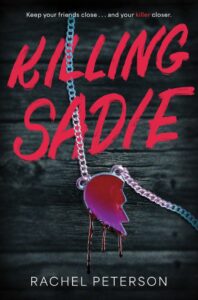
As a writer of young adult thrillers, I take my humor very seriously (pun intended!). My debut novel Killing Sadie is, in many ways, a nod to the kind of high-drama, delicious, campy books and movies that gave me a safe space to get scared as a teen. These kinds of stories offer permission to grab some popcorn and enjoy the ride with your bookish friends. But they can also give teens a safe outlet to feel all the feelings, however big or wild, without judgement.
DM with a younger you
The further away we get from our teenage selves, the more removed we can become from the reality of our experiences. It’s so easy to oversimplify or romanticize our teenage years, or just forget over time what it really felt like to be sixteen and dealing with everything life was throwing our way. In spite of —or maybe because of—our imperfect memories, nostalgia is a heavy aspect of adult life.
We don’t remember every little thing about growing up, yet we still miss the kid we used to be and the experiences we had when everything was still new. Incidentally, the desire to have a conversation with our younger selves probably has a lot to do with adult interest in YA fiction, too.
There is an added level of safety to experiencing teenage life again as adults, especially when it comes to thrillers. We made it through our teenage years, and we love diving into a story that can remind us of what it felt like, while still emerging once again safely into our adult selves. We also want to breathe a sigh of relief when we remember everything that felt like the end of the world in high school was not, actually, the end of the world. What better reminder than fictional murder?
This is (sort of) serious business
The thing that makes self-aware thrillers work is a central kernel of truth. The emotions are real, but the risk is not. We connect with characters when we can access what they’re feeling and relate to it. I love creating circumstances that are wild and theoretically unrealistic, but grounding those circumstances in real emotions that everyone can recognize and understand.
Great stories get us thinking, I might not be able to relate to this character’s circumstances, but I have totally felt that same way. I’m not alone.
That’s why there is such an important place for mysteries, thrillers and camp in the world of YA literature. These kinds of books remind us that whatever we’re going through, we are not the first person to go through it, and there might even be a way to find the humor under all of the tension. As a teen, and frankly, as an adult, there is no more powerful reminder than that.
***

Rachel Peterson
Rachel Peterson graduated from Miami University of Ohio with a degree in English and creative writing. Born and raised in Ohio, she started her career in advertising before spending nearly a decade in New York City as a marketing executive for technology companies. An avid traveler, Rachel now splits her time between Manhattan and the Midwest, where she lives with her husband, Ken; their dog, Olive; and horse, Hope.