
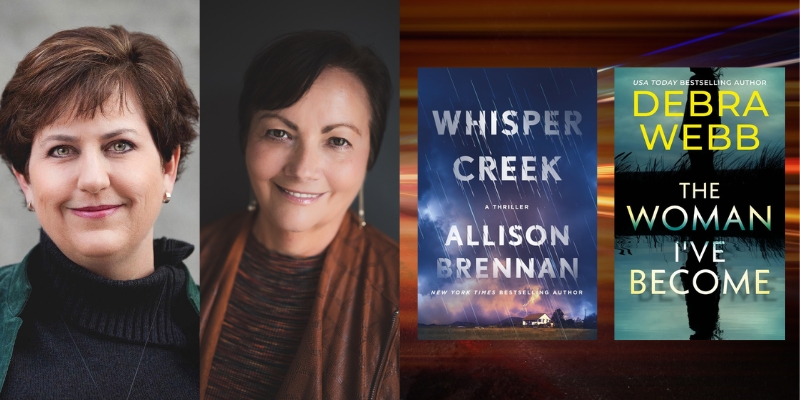
Debra Webb and Allison Brennan on villains, suspense, and writing standalone thrillers
The author of The Woman I've Become chats with the writer behind Whisper Creek
USA Today Bestselling author Debra Webb began her career writing romantic suspense but by the early 2000s had started to lean into darker suspense. A few years later she was fully immersed in the world of thrillers. It was at the very first International Thriller Writers conference in Phoenix, Arizona where she met Allison Brennan.
Flash forward twenty years and Debra’s first standalone thriller, The Woman I’ve Become, is slated for October of this year. Longtime friend and fellow author Allison Brennan was one of the first to read the upcoming release and called it a “page-turning thriller!”
New York Times Bestselling author Allison Brennan also began her career writing romantic suspense for Ballantine Books, but in 2011 launched the Lucy Kincaid FBI thriller series. Now she has two series—the Quinn & Costa FBI thrillers, and the Angelhart Investigations PI series—and writes the occasional stand alone. Whisper Creek is her third standalone thriller, out in June. Allison is thrilled that the amazing Debra Webb is stepping into the standalone world.
*
Allison Brennan: I can’t believe it’s been twenty years. Twenty! Talk about feeling my age.
Debra Webb: No kidding! But I have to say it has been an amazing ride! The best part is we’re both still doing what we love–writing books!
AB: I absolutely loved The Woman I’ve Become. I honestly didn’t realize it was your first standalone! You’ve written a gazillion books. Haha. Why this one? What gave you that itch to write this book with this heroine?
DW: Thank you so much. It was time to do something different. I’ve always written stories with an eye toward what comes next for these characters. I love working with a large cast of characters, providing lots of options for moving forward with the next chapter in one or the other’s life.
AB: You and me both!
DW: But when this story idea first sprouted, it was all about this one woman and the secrets she used like stones to build a life. As the story developed it became about how the story would end. How you battle your demons when they find you and they always do. Really, at its core this one is about survival and how this story would end. In fact, that was the working title, How This Ends.
I’m of the opinion that characters are the heart of our stories, yours and mine. Your newest release, Whisper Creek, is a perfect example of characters being the heart of a very twisted drama! What creative spark brought these characters into such a twisted and dangerous situation. I love, by the way, how you developed two distinct threats!
AB: Story is ultimately about character. Without character, it’s just a cool plot. The people make it a story worth reading.
DW: So true!
AB: I’m sure you know this better than most writers, but writing isn’t easy. No book is “easy” to write. But some books are easier than others, where the story flows chapter by chapter and you, as the author, are whisked away while you write. For me, that book is Whisper Creek. While I had to do a lot of research about farming, northeast Texas, and storms, the story itself practically wrote itself. As for the creative spark, it was basically just “what if”—what if the bad guys are caught in a storm and can’t get away? And while that is an important part of the plot, the story is really about the McKenna family trying to save the farm against both man and Mother Nature.
DW: Your readers are going to love it! Research is so important in what we do. Although we write fiction, it’s crucial that we get things right–or at least believable.
AB: Agreed! Though research is also my favorite form of procrastination, haha.
DW: The storm in your story is such a unique element. It’s difficult to fight Mother Nature lol. Perhaps even harder to outsmart her. Do you have a favorite element you’ve used to thrust your characters into the middle of danger?
AB: Whatever works for the story. In Whisper Creek, I needed a storm in an area that was prone to flooding. I needed my characters to be cut off from the outside world in a realistic way. The last “wilderness thriller” (that’s what my editor calls these books, where setting and weather are an integral part of the story) was set during a snow storm. The next (I’m writing now!) is set in the Bob Marshall Wilderness in Montana. Not during a storm, but it’s a rugged and unforgiving landscape. But I love any type of story where the danger is organic to the plot!
DW: Your “wilderness” thrillers do sound awesome! And yes, it’s always better if the danger is organic. In The Woman I’ve Become, I ushered the characters from the city, Manhattan, to the place where the trouble started so many years before—Westport, Connecticut. It was a homecoming of sorts. Going back to where it all began. Sometimes it’s the going back to that place where the damage was done that builds the tension and fear best. But it also increases the danger in this story because there is the element of isolation at the family lake house.
Primarily it felt right for the characters to face-off in the place where it all started. When a story “feels right” the flow is smoother. As you say no story is “easy” to write but it sure helps when it flows the way you had hoped!
AB: I don’t think “normal” people (i.e. – not writers!) understand when we say it “feels” right, LOL. But that’s exactly how I think as well! We know intuitively when the story is working and when it’s not. Here’s a question I get a lot and I never have a good answer. How do you know when a story will make a good series and when it is really a stand alone? How did you know with The Woman I’ve Become? I usually say, “It’s about the characters” but that doesn’t feel complete enough.
DW: Wow! What a great question and also a difficult one to answer. Again, I believe it’s in part the “feeling” of wanting or needing to continue with the element that makes the series whether it’s the setting or the characters (really, usually the characters). I’ve written lots of series.
One of my favorites is the Faces of Evil series. That one I knew right from the moment the spark came that it would be a series. When Julia and Wendy from The Woman I’ve Become started to speak to me, I knew their story would be a stand alone. I understood that whatever happened, I needed to finish this thing that began between them decades before. It felt, as we’ve discussed, right.
AB: We have to trust our guts. Most of my series I create as a series. Either a police procedural where readers often expect characters to grow over time. For the Quinn & Costa series, I wanted to take my core group but move them around the country so they didn’t investigate in one place. For my Angelhart series, I wanted to focus more on family (a family of P.I.s) so set the book in Phoenix. Again, it just felt right!
Plus, I think with standalones, the characters aren’t usually in a position to have multiple crimes or mysteries in their life. This one “thing” that is happening IS their mystery, if that makes sense.
DW: You are spot ont! Which leads to another point that folks who aren’t writers sometimes don’t understand. When we’re developing a story idea (whether born of a plot element or a character), the synopsis or plan for the story ALWAYS changes because, believe it or not, the characters take the lead.
With every story I’ve written, it starts out as the story I want to tell but about a hundred pages in it becomes the story the characters need to tell. There’s this connection to the characters you’ve created that takes over, don’t you think?
AB: Hundred percent. I have never stuck to a synopsis; I don’t plot. People often don’t believe me, but it’s true. Usually my synopsis is all backstory. I know where the characters are when the story starts and why, but everything after the inciting incident changes as I write. The story feels more organic and natural that way.
But mostly, it’s the only way I can write. After fifty-two books, I don’t really want to mess with that (mostly) works! And yes, I know you have twice as many books as me!
DW: Yes! We are alike in that! My synopsis is basically back story as well. I often wonder if the editor thinks “I don’t remember that from the synopsis.” The characters lead and that’s the best way to tell a story. Once you know those characters you can trust them completely. They know where they need to go!
AB: Yes, exactly! And I find that I have to edit the first hundred pages a lot more than the last three hundred when I’m done with my first draft.
DW: Same here! Getting back to the research, I sometimes wonder if you and I were perhaps cops or PIs in another life. We so love the police procedural aspect of our stories. I catch myself when watching television (series and the news) anticipating what the cops will do next.
AB: I have loved mysteries and cop shows from early childhood. I grew up on Trixie Belden and Nancy Drew and my mom and I would watch Hill Street Blues, she let me stay up late to watch it! I’ve done several ride alongs with local police, participated in the FBI citizens academy, toured Quantico, viewed an autopsy, and more.
Now I have people I can call when I need information (including my daughter, who is a Phoenix PD officer!) I’ve found when I’m writing my standalones, where there is no law enforcement or it’s on the edge of the story, that I have to really think more about what an average person without training would do in these situations.
DW: Those are amazing resources and certainly adds to the realistic feel of writing from the perspective of the police or a private investigator. We share the love of those childhood stories and some of the best cop shows ever! But we’re both also very good at creating villains. Those shoes are a little tougher to step into when writing depraved killers. How do you do your research for those characters?
AB: I have a workshop called “The Villain’s Journey” taken in part from Christopher Vogler’s “The Writer’s Journey.” Basically, the villain is the hero of his own journey. That means he has clear (even if he’s crazy) motivations, goals, and conflicts. Why is he the way he is?
And not all villains are depraved. Some just do bad things. I need to know WHY. Once I know that, I can write them. Also, I remember that (usually) not all villains are a hundred percent evil. There needs to be at least one redeeming characteristic, something that makes them more human to readers. But sometimes the evil villains are the most fun to write! LOL.
What about you?
DW: Every writer should go to your workshop on Villains. It is so true that we have to remember that the villains are people too. And, as you say, not all are depraved. There are levels of evil and each villain must have a reason they are the way they are… one that made them who they are. That background and motivation is as important for the villain as it is for any other character.
And the redeeming characteristic is absolutely essential. The human side of a villain is what draws the reader to him or her even when they don’t want to be drawn. I love how perfectly you defined exactly how to create the perfect villain!
Which brings me to the “bad thing.” The incident, the reason the characters must do what they do. Where does your inspiration for that important story element come from?
AB: I have no idea. I’m not being flip! Usually there are several little ideas that come together that give me that AHA! moment. For the Quinn & Costa series, I wanted a mobile FBI unit loosely based on the real-life Evidence Response Team. I only knew one of the characters when I started, and Kara Quinn wasn’t supposed to be a series character, but took over book one. (Then I had to figure out how to have an LAPD detective on the team permanently!)
For Whisper Creek I knew there was going to be a storm, and I knew that there were bad guys trapped in the storm. I knew the mother of the ranch (a widow), but the four kids all sort of developed as I wrote them. And there was no grandma in the synopsis that I pitched my editor, but she really makes the book.
And I didn’t know that the cat who escaped the barn in the prologue would become such an important part of the story! Have you ever had characters who you didn’t think would be important become pivotal to one of your books?
DW: Like you, I can seldom explain where the trouble comes from in a story as I’m beginning. More often than not I have a character who is in a situation and I build from there: what happened before and what happens after. Occasionally I know, as I did, in part, with my Vera Boyett series. I knew there were human remains in the cave and that the two older sisters had put them there. All the rest came as I wrote the story.
And, yes, those characters, human or animal, who turn into stars are so fun. In The Woman I’ve Become it’s the lakehouse caretaker. She’s so feisty! She evolved into such a great character.
AB: She was absolutely one of my favorites! I’m so glad I got to read an early copy of The Woman I’ve Become.
DW: It really has been such a pleasure talking about writing with you, Allison. Before we go, I’d love to give readers a glimpse into our everyday lives. What’s an average day for you?
AB: My writing life has changed over the years. When my kids were little, I was actually far more productive. I knew I HAD to write when they were in school because once they got home we had sports, homework, theater, and all the stuff that comes with raising a big family. Now, my youngest is twenty-one and I have all the time in the world…so I tend to procrastinate, haha.
But, generally, I wake up around 5 in the morning, go for my morning walk, have coffee and play word games, then sit at my computer from about 7-8 to respond to email, post on social media, etc. Then I have breakfast, and by 9, I start writing. I try to get up to walk and stretch a couple of times, but often forget. By 4 I’m brain dead and call it quits, whether I’ve written 500 words or 5,000 words. I used to write at night, but I don’t have the bandwidth anymore. (Unless I am near the end of a book and am super excited…even now, I’ve been known to write into the wee hours of the morning once or twice a month!)
I also now have a grandson! I babysit him once a week, so that’s my “day off.”
What about you? How do you write and what has changed over the years?
DW: You are amazing! Had to say that! My writing life is similar to yours! And I agree that it was far more structured back when I had school age kiddos. These days I’m up between five and six (sometimes earlier if I’m excited to get started).
I don’t do anything except make coffee before writing. It’s easier for me if I don’t let the world in first. I just dive in and do all the other stuff, social media, emails, etc., later. I write until I reach the point I wanted to reach that day (sometimes a few pages, sometimes a whole chapter). Then I do all the other stuff that life requires.
I also do the fun stuff. You know how I love renovating houses and treasure hunting at junk stores. Nowadays I’m pretty big into gardening, flower and vegetable, and there are the goats and chickens. We moved to a little farm a few years ago. And I have lots of grandkids who I adore! I feel very fortunate to do what I love and to be surrounded by the people I love.
AB: I am totally jealous. That is my dream. I used to have chickens, and I will have my farm and get them back! (And I hope my kids get the hint that I want more grandkids! Ha.) My goal is before I’m sixty to have my farm, but I’ll give my kids a few more years for the babies. What’s next for you after this book?
DW: I am sure your beautiful children will be giving you lots of grandbabies in the future! Ah, what’s next? First, I will write as they say until they pry my cold, dead fingers from the keyboard! I’m working on a new cop series, Flynn & Beckett, for Thomas & Mercer and then comes my next standalone. Before we go, please tell us what’s coming next for you!
AB: I’m with you—I’ll always write. I can’t imagine retiring. I’m definitely looking forward to your new series! As far as what I’m doing…the third book in my Angelhart Investigations series, I’ll Be Watching You, came out in September, and the eighth book in my Quinn & Costa series, One Last Warning, is out in January!
I’m currently writing my next standalone, then I’ll jump into writing the next Quinn & Costa book. I also have a short story coming from Amazon Originals later this year, and a novella in the Quinn & Costa world late next year! I’m busy, but definitely no complaints.
DW: You are amazing, Allison. Be sure and drop by Allison’s website (allisonbrennan.com) for more about her books. I’d love you to drop by mine (debrawebb.com) and check out what’s new and coming soon. Thank you all so much for listening in to our conversation! Cheers!
***

Debra Webb and Allison Brennan
Debra Webb is a USA Today bestselling author of more than 180 novels, including The Woman I've Become. She is the recipient of the prestigious Romantic Times Career Achievement Award for Romantic Suspense, as well as numerous Reviewers' Choice Awards. In 2012, Webb was honored as the first recipient of the esteemed L. A. Banks Warrior Woman Award for her courage, strength, and grace in the face of adversity. After publishing her hundredth novel, she also received the distinguished RWA Centennial Award. The author has sold more than ten million books in numerous languages and countries. Allison Brennan is the New York Times and USA Today bestselling author of over fifty novels, including the Lucy Kincaid and Max Revere series and the recent novel Whisper Creek. She was nominated for Best Paperback Original Thriller by the International Thriller Writers and is a two-time winner of the Daphne du Maurier Award by Kiss of Death.