

Nika Grace on finding remains in deserts and writing a serial killer novel
The author of Serial Killer Wanted unearths fingers, guns, and more on sandy treks
It is a truth universally acknowledged that if you hike across the desert, intently looking at the ground, you will eventually find a dead body.
Let me back up a step to explain why an otherwise mentally healthy thirty-something woman would be hiking across the remote desert for so many thousands of trailless miles. It was because of #VanLife, actually, though this occurred before I understood how to use a hashtag (do I yet understand how to use a hashtag? Don’t answer that.) And, of course, I was never quite affluent enough to purchase a van.
The year was 2010. My husband and I had gotten married, acquired a mortgage, a master’s degree, and a matched set of Real Actual Careers. Reader, I lasted six months.
After that, I decided that business casual blouses and working for the weekends wasn’t for me, and we went on the run. We moved into a Toyota Tacoma truck nearly as old as we were, and worked seasonally to pay for enough ramen to keep rock climbing until we were too old and too square to get up the cliffs anymore.
After a short stint on the ice in Antarctica—a tale for another time—we landed in the Mojave Desert, tracking desert tortoises across the desiccated landscape. When I first got the job, I thought the stories of other tortoise bios finding dead bodies were some kind of urban myth. A form of hazing the new girl that was probably blown out of proportion thanks to mis-identified coyote bones and having too much time to think. Until we found a finger.
A woman’s finger; painted fingernail. No blood. No body.
It was found by a cheerful ex-raft-guide from Flagstaff, one crew over from where I was walking survey lines in the desert just outside of Las Vegas.
The chills that went up my spine followed me all the way home to where I was camping in the—unlockable—camper shell of my Toyota Tacoma, the dusty wind howling around its thin metal shell all night.
Listen, I wanted to make money for road tripping as much as the next girl, but exactly where did that finger come from? And where was the rest of that woman’s body? And why—where—but—didn’t they have police down here?
The questions were more plentiful than the answers. As the years in the Mojave cropped up and the body count rose along them, we never did hear the stories behind any of the human remains we turned in. Not the multiple skulls, not the drifter we found outside of Nipton with his uncashed welfare check in his pocket, not the “suicide” that I still swear was a very thinly-veiled mob hit (details redacted for the safety of the bios who found it). There were so many bodies found by tortoise biologists that eventually Outside Magazine did a feature on the phenomenon, though they didn’t cover half the tales I could have told.
One that stuck with me was three graves, complete with crosses and mounded dirt, armored with river-smoothed stones. We found them near an abandoned compound that used to house a meth lab, and a cult. Since five girls had gone missing in this area the local police in this case actually sent a crew out to exhume the sites. They dug them all the way to bedrock and found nothing, which always tickled my imagination.
I understand setting up crosses for a memorial, perhaps, but why go to the trouble to mound the dirt? Why lug so many stones in such a sweaty climate if you weren’t faking the graves for someone else’s benefit? I couldn’t stop thinking about it, and I never got answers, so I ended up writing a flash fiction story to give myself the resolution that reality was reluctant to allow me.
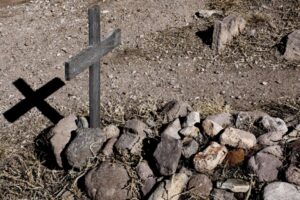 Picture courtesy of Pixabay, Dat 7.
The sluggishness of the authorities when it came to following our GPS coordinates to the corpses gave me a healthy respect for how much easier it was to get away with murder than I had previously thought, at least in the Mojave. The desert always felt like a place real adults had forgotten. What with its abandoned and half-burnt trailers jutting up alongside the sand-drifted highways and the graffiti laced bones of defunct water parks.
That’s why when I decided to write a book about a female serial killer, I set her story in the Phoenix desert. Because I wanted the metaphorical resonance of her rising from the ashes of her past, sure. But mostly because I wanted somewhere to hide the bodies.
I started writing this book in a desert, of course. When I was working a job outside of Barstow fence monitoring. Just me walking miles of fence to look for distressed tortoises not used to having their habitat chopped up by the dividing lines of men. On a day when I’d just written one of the first chapters from my serial killer’s POV, I found two murder weapons.
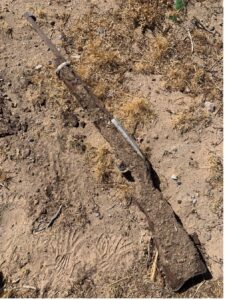
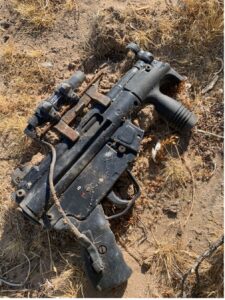 One assault rifle, one hunting rifle. Both rusty from seasons out in the elements, despite being tossed less than ten feet off a major highway. From author’s personal photo collection.
Do I know they were murder weapons? Of course not. When I called the police, they said it was county jurisdiction and hung up on me. The two young county sheriffs who eventually responded had to borrow a set of my latex gloves for tortoise handling just to take the guns into evidence, and never followed up with me about the results of the investigation, if they even did one.
But guns like these cost hundreds to thousands of dollars. Why toss them out the window unless you had to?
I never learned who the guns belonged to, or how they got there. What I did learn was that if you want to get away with murder, you better do it in the desert.
***


Nika Grace
Nika Grace loves writing fight scenes and kissing scenes and is always on the lookout for a story idea wild enough to include both. By day, she works as a writing coach with Sanctuary Editorial, and on the weekends, she and her husband love to disappear into the labyrinth of the canyon country in the American Southwest. Her home base is in Moab, Utah, but her muse lives in New Orleans. She is the author of Serial Killer Wanted.