
Elizabeth Little on Linda Hamilton, Physical Transformation, and Writing Female Action Heroes
The author of 'Good Girls Die Bored' shares how 'Terminator 2' influenced her new novel
It was sometime in 1991—a Saturday morning, if I had to guess—and I was bored. I was at the orthodontist’s office, as I often was in those days, and for reasons that now escape me I had forgotten to bring a book.
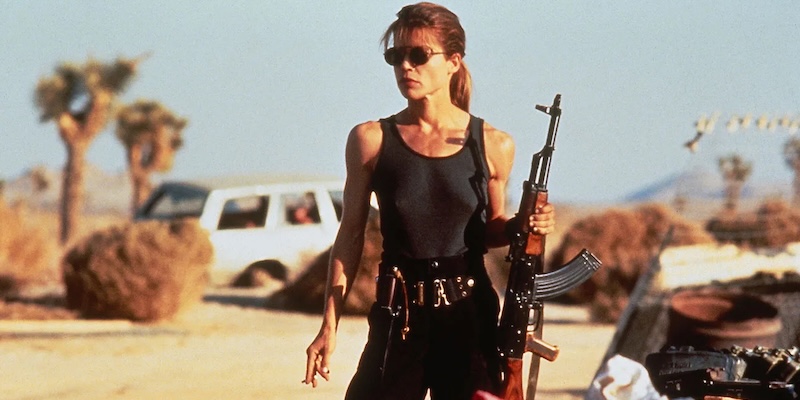
It’s the only reason I saw the article: a People magazine feature on the incredible physical transformation Linda Hamilton underwent in preparation for Terminator 2: Judgment Day. For younger readers, I suspect the actress is basically synonymous with her character’s second, absolutely shredded incarnation, but in the first Terminator film, she was soft and girlish, a quick-witted waitress with a big heart and bigger bangs.
To become the Sarah Connor of the sequel, she had to spend hours each day at the gym, stick to a rigid diet, and employ a small army of trainers, cooks, and nutritionists—and People was there to document every last detail, including her before-and-after measurements.
Waist, bust, hips—and cup size.
I was ten years old. I didn’t know what those numbers meant. But I’d read just enough Judy Blume to be able to work out the significance of moving from a B to a D.
She’s the first female action hero I can remember.
And everyone wanted to talk about her boobs.
*
I don’t believe in writing only what you know, but I’m careful to craft stories that are at least own-experience-adjacent. In particular, I never write a protagonist without first establishing some kind of psychological common ground. For a standard thriller, this is usually straightforward: My protagonists are women, and at some point, they will be in peril. I too am a woman, and as such, upon occasion, I have also been in peril. There you go. That’s my way in.
(OK, so there’s a little bit more to it than that, obviously, but I promised myself years ago that I wouldn’t vivisect my psyche for book promo, so all I’ll say is that you don’t have to squint too hard at my first two novels to see the connective tissue.)
This kind of broad-spectrum, high-baseline relatability is surely a reason so many of us, both writers and readers, are drawn to crime fiction. Women and members of marginalized communities understand on a visceral level what it’s like to walk down a dark street and feel like a target, and crime fiction gives us a chance to explore and even exorcise those feelings in a safe space.
In its most powerful forms, crime fiction can take that shared experience and use it to nurture understanding and empathy, helping take us all a little further into the perspective of characters we might previously have seen as utterly outside our understanding. It’s one of the things I love best about crime fiction.
But you know what? Sometimes that shared hypervigilance really, really sucks.
*
My second novel came out right as Covid hit, and by the time lockdown was over and my son was finally back in school, two years had passed, and I was tired. Tired of being anxious, tired of being scared, tired of bubbling away in a stew of my own catastrophic imaginings.
And I’d had such an easy time of it too, all things considered, which suggested to me that plenty of readers might be feeling the same way, if not more so.
Unfortunately, I wasn’t able to go around from house to house relieving readers of their maladaptive hypervigilance. But I can do whatever I want in the worlds I create. So, I decided that for my next book, I’d experiment with a kind of protagonist that was new to me and would hopefully be a balm to myself and others: a woman who could walk down that dark street and feel like a weapon.
Now, there are plenty of great examples of physically tough female characters in crime fiction, from icons like V.I. Warshawski and Amelia Sachs to new classics like Yasmin Angoe’s Nena Knight. But I wanted to take that toughness even further. I wanted a literal warrior. Not a plucky young upstart or victim forced to adapt on the fly. A trained, battle-hardened fighter who was based in reality, which meant no magic powers, no superhuman strength. Just someone who was so unbelievably hard-headed and determined that she managed to push herself past the limits of what we’re taught to think women are capable of.
Someone more like Sarah Connor—just without all the evil robots.
*
The screenplay for the first Terminator is a masterpiece. I understand that for many of you this might be hard to believe, and believe me, I get it: We live in a post-Avatar world. And don’t get me wrong, James Cameron has his foibles—when Sarah first appears on screen, she’s described as “pretty in a flawed, accessible way.” Gross.
Still, there’s no denying the time Cameron devotes to developing Sarah’s character: We see her at work and at home. She interacts with friends and coworkers. She’s allowed a full human range of emotions. And she’s not just a Mary Sue, either. Over the course of the first film, Sarah trusts the wrong people, makes the wrong choices, and definitely sleeps with a guy she’d been convinced was delusional just a few hours before.
By the time we get to the sequel, however, her personality has been radically diminished, boiled down to a few primal urges in the same way Linda Hamilton’s astounding physical metamorphosis was reduced to a couple of sets of numbers.
Run, fight, kill.
32-26-31.
It’s a thought I kept coming back to as I continued to sketch out my new heroine—Juno Hardwick, a former Marine with front-line experience, a woman as strong physically as she was mentally, someone who could genuinely go toe-to-toe with a trained close-combat fighter. I was fixated on what I thought was action-hero realness. I
read military training manuals, staged fight choreography in my office, loaded up a backpack with books and went for a run. And all along I pictured Linda Hamilton’s arms, her shoulders, the intensity of her gaze as she sucked down a cigarette.
It’s an age-old trap, and I very nearly fell right into it: not being able to see past a woman’s body.
It wasn’t the physical transformation that made Sarah Connor so special. In isolation, the character in the second film is practically one-dimensional, borderline cliché. Even People magazine understood this: You can’t fully appreciate the after if you don’t take into account the before.
If I wanted to craft an action heroine as indelible as Sarah Connor, I had to be sure to capture both sides of her character. The hard and the soft. The weapon and the target. The high-functioning badass on the outside—the hot bowl of emotional spaghetti on the inside.
Juno Hardwick is without a doubt my favorite character I’ve ever written. And it’s not because she’s a badass or a role model, some high-octane fantasy that allows me pretend to be a little cooler when the main thing I do most days is sit in my office chair—although, yeah, sure, she’s all those things, too. She’s my favorite because she helped me realize the measure of an action hero is more than just her dress size.
***

Elizabeth Little
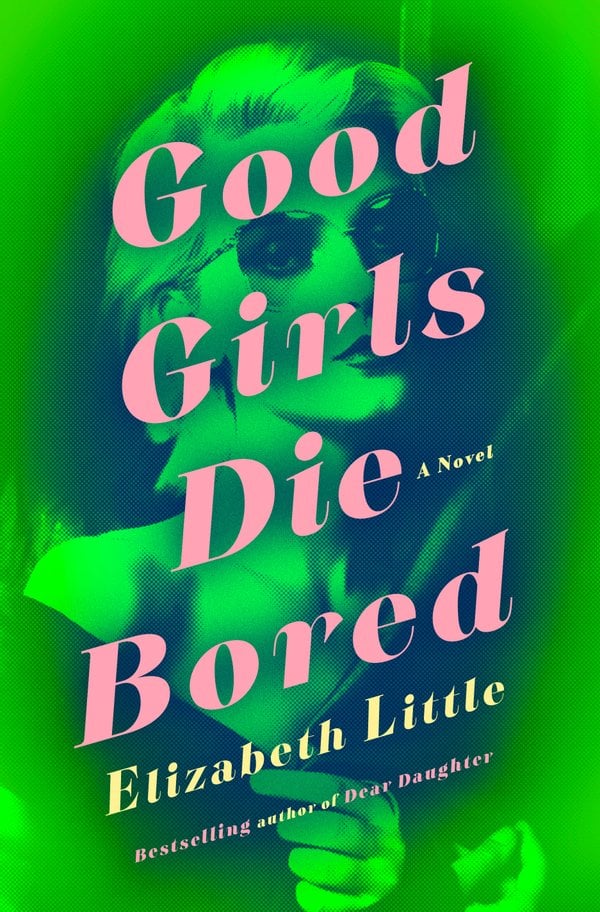
Elizabeth Little is the bestselling author of Dear Daughter, Pretty as a Picture, Good Girls Die Bored, and two works of nonfiction. Her crime fiction has been nominated for the Barry, Macavity, and CWA John Creasey Debut dagger awards, and she received the Strand Critics Award for Best Debut Novel. Pretty as a Picture was a Los Angeles Times and Publishers Weekly bestseller. Her writing has also appeared in The New York Times, The Wall Street Journal, McSweeney’s, and The Los Angeles Review of Books, among other publications. She lives in Los Angeles with her family.