

James Wolff on Why the World of Espionage Is Impossibly Messy
'I have come to the conclusion that this sense of uncertainty and ambiguity lies at the heart of the profession.'
What do spies do? I mean, what do they actually do? Despite having been one for close to fifteen years, I’m not sure I could give a wholly satisfying answer to that question, or at least an answer that was the truth, the whole truth and nothing but the truth. It’s not just the Official Secrets Act stopping me. It’s also that I experienced more than a few days during my career when I wasn’t entirely sure what I was doing, why I was doing it or what difference I was making to anything, and I have come to the conclusion that this sense of uncertainty and ambiguity lies at the heart of the profession.
It might be illuminating to compare spying to policing. Anyone who’s watched The Wire or read Ian Rankin, Ed McBain and Richard Price will no doubt imagine that they have a pretty good idea about what the police do on a day-to-day basis. After all, there’s a reason that police novels are described as procedurals, and that is because they focus on the ‘official, established and methodical steps taken to complete a task’ (which is how my dictionary defines a procedural). A lot of the time, policing follows a playbook, to the extent that if a crime was committed and for some unfathomable reason I was drafted in to help solve it, I’d like to think that I would have at least some idea about what to do. Dust for prints and swab for DNA? Check. Canvas the neighbours, check for CCTV and bring in the suspects for interview? Check.
But spying? If you put to one side the kind of things that never happen, such as car chases, punch-ups or gun fights, what would you be doing on any given day? You might be engaged in a multi-year quest to speak to a person you’re convinced will make a great source only to discover when you finally sit down together that they’d be chaotically unsuited to the role. You might be engaged in surveillance of a target who never comes out of their apartment. You might even be building a picture of a terrorist suspect from their phone calls, internet browsing, bank balance and psychological profile and then staring at the resulting Jackson-Pollock-style mess until you feel able to make a guess about whether or not they are planning an attack. In the 2002 film Minority Report, a specialist ‘pre-crime’ team relies on three clairvoyant mutants to help them identify murders before they have been committed. Spare a thought for the spies, because they’re trying to do exactly the same thing without a single clairvoyant mutant to help them.
Even if you identify your suspects, build a case and persuade the lawyers that a prosecution is in the public interest, the uncertainty and ambiguity – the mess, in other words – doesn’t end there. Late last year charges were dropped against two British nationals who had been arrested on suspicion of spying for China. The reason given for the case being dropped was that the law stipulated that an individual could only be prosecuted for spying on behalf of ‘an enemy state’, and it turned out that the British government was not willing to describe China in those terms. How’s that for messy? The same government calling for the prosecution of alleged Chinese spies is the same government that is unwilling to describe China as a threat?
There’s a scene near the beginning of my new novel, Spies and Other Gods, in which a character describes an unusual training exercise:
‘First day of the course, this is what they do. Someone hands you a screwdriver and says you’ve got twenty minutes. You’re pushed into a pitch-black room. You think: is the screwdriver a weapon? You wave it around, heart racing, can’t see or hear anything… There’s stuff on the floor. Wood, screws. Those little plastic things. It’s a piece of flat-pack furniture. Alright, you think – this is the task: I’ve got to assemble a piece of furniture in the dark.’
It could serve as a metaphor for the act of spying itself. After all, any activity that takes place in the dark inevitably results in confusion, uncertainty and mistakes. In the book, the character ends up with something barely resembling a piece of furniture. ‘Half the slats are missing, it’s got three legs, headboard’s upside down,’ he says, surveying the resulting mess, and although the spies might like you to think otherwise, the same description could be applied just as accurately to more than a few of their own operations as well.
***
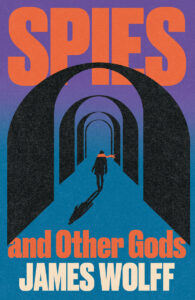

James Wolff
James Wolff is the author of the Discipline Files series, including the three novels Beside the Syrian Sea, How to Betray Your Country, and The Man in the Corduroy Suit. The first book in the series was a Times Thriller of the Month, and the latest installment is the only espionage novel to be longlisted for the 2023 CWA Silver Dagger award. A former British intelligence officer, he grew up in the Middle East and now lives in London.