

Everything You Need to Know About the World of Watchmen, HBO’s New Crime Drama
Yes, it is a crime drama. And it is even stranger than you've heard.
HBO’s latest drama, Watchmen, is nothing if not bold. The first episode opens with a terrifying and gripping depiction of the real life 1921 Tulsa Massacre, where white mobs massacred black residents and destroyed the area known as “Black Wall Street.” The show then leaps forward in time to an alternate 2019 America where the internet doesn’t exist, squids fall from the sky, and both police officers and white supremacist gangs dress like superheroes.
Although Watchmen is billed as a superhero show—and is based on the iconic 1980s comic series of the same name written by Alan Moore—this is not an MCU movie. The characters don’t have actual superpowers (with one exception). Instead, the show uses the concept of vigilantism to look at how power works in the context or race, law, and crime.
The HBO show throws fans right into the world with little by way of explanation. It’s an alternate universe in which the United States looks very different. Everything from the law to technology has changed. Even if you’ve read the acclaimed graphic novel, the TV show is set over thirty years later. So here’s some of the basics you need to know to understand the Watchmen’s world.
**Spoilers for the comic and first two TV episodes below**
___________________________________
Cops and Criminals Alike Wear Masks
___________________________________
Watchmen is set in a reality where superheroes and supervillains exist. In the comic only one hero, Dr. Manhattan, has real superpowers. The rest are simply criminals and vigilantes who fight crimes (or commit them) in elaborate outfits. In the comic—which the TV show holds as canon—superheroes were outlawed in the 1970s. However, in 2019 the police all wear masks and several of them dress in elaborate superhero costumes. So what’s going on?
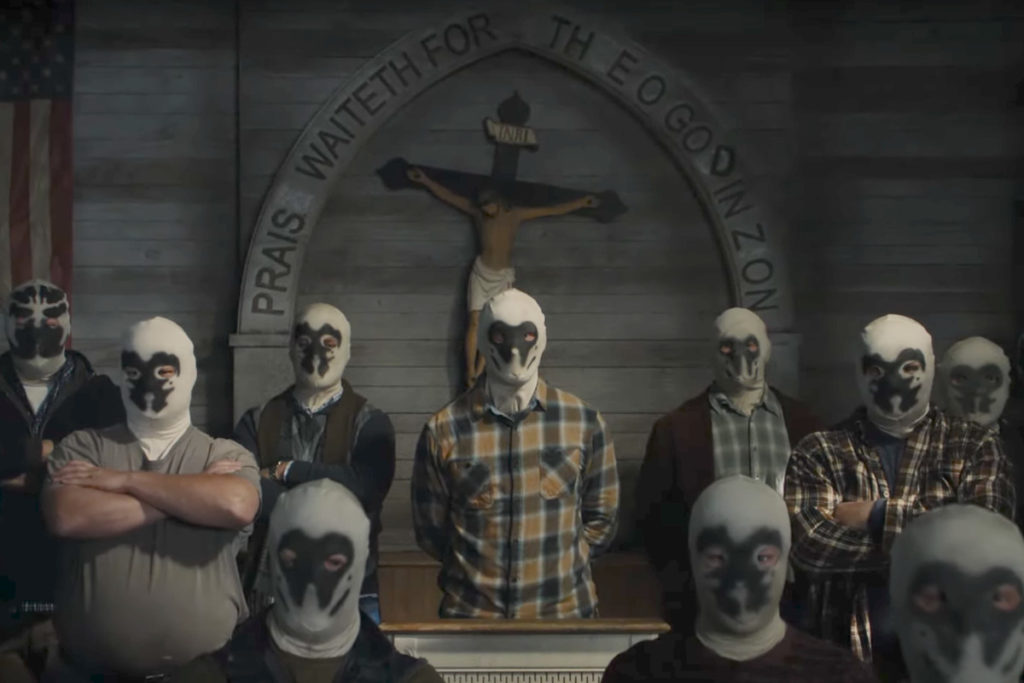
Prior to the start of the show, a group of white supremacist criminals dressed as Rorschach (an anti-hero in the comics) murder police officers on Christmas Eve. This “White Night” attack is depicted in flashbacks in episode two. It leads to the passage of a law that allows police officers to hide their identities. While most officers wear standard issue uniforms and identical yellow masks, there are a set of elite officers who dress in traditional superhero costumes and have identities like Sister Night (Regina King), Red Scare (Andrew Howard), and Looking Glass (Tim Blake Nelson).

___________________________________
Law Enforcement Works Differently
___________________________________
While the police have protected identities, they also are more heavily regulated. In the first episode, a masked black police officer confronts a white driver in a scene that inverts the all-too-frequent occurrence of white police officers harassing and killing black Americans. However, in Watchmen the police officer is not able to use his gun before radioing in to headquarters and getting approval. All police officers have gun locks and guns can only be used in extreme circumstances according to specific regulations.
The detectives in superhero costumes, however, seem to freely break the law without consequence and operate more like traditional comic vigilantes. Whether they have some kind of legal immunity or are simply operating outside of the law isn’t yet clear.
___________________________________
Vietnam Is the 51st State
___________________________________
In the opening episode, Regina King’s character Angela Abar is dressed in Vietnamese clothes and claims to be opening a Vietnamese bakery (actually a front for her superhero identity Sister Night). She briefly mentions that she lived in the US state of Vietnam and this is literal in the show: Vietnam is the 51st state. This is also why the American flag has a different design.
In the comic, there is only one real superhero: Dr. Manhattan. He gained radical powers after an atomic accident and with his god-like powers slowly grows detached from humanity. Nixon uses his superpowers to win the war and Vietnam becomes a state. While the implications of the US having annexed a country halfway across the world as a state haven’t been fully explored yet, presumably we’ll get more details as the show goes on.
___________________________________
Reparations (aka Redfordations) Have Been Given to Black Americans
___________________________________
Several white characters in the show angrily talk about “Refordations,” which are reparations enacted by the “Victims of Racial Violence Act” by president Robert Redford. Yes, the actor. In the second episode, we see a little about how the reparations work as Regina King sends in a DNA sample taken from the wheelchair bound Will Reeves (Louis Gossett Jr.) to see if he qualifies as a descendant of the Tulsa massacre.
___________________________________
America Has Had a Liberal President for Thirty years
___________________________________
In the comics, Nixon abolished term limits. So in the show Robert Redford has been President since 1992, or almost thirty years. This is why in episode two we see some poor white conservatives living in a trailer park called Nixonville that has a giant statue of Nixon (the last conservative president in this timeline).
In an interview with Vulture, Lindelof explained “we were left a clue at the end of the original [comic book], which is that Robert Redford was running for president. We contend that he never, ever would have been able to beat Nixon at the height of Nixon’s popularity, especially post-squid. So Nixon wins in ’88, he beats Redford, and then he dies in office in ’90. Redford gets to run again, against Gerald Ford, and he wins.”
Presumably countless liberal policies have been enacted over the decades that the show will explore. In that interview, Lindelof says that despite being an abashed liberal he thinks liberals get two things wrong: “One is we spend way too much time wagging our fingers. The second is we don’t know when to stop regulating.” This is presumably why the show-within-a-show, American Hero Story, is preceded by almost a full minute of content warnings before it airs.
___________________________________
Squids Fall from the Sky
___________________________________
In the middle of the first Watchmen episode, squid randomly fall from the sky. The characters treat it as no more eventful than a hailstorm. What on earth is going on here? Or perhaps what in the universe, as it’s described as a “trans-dimensional attack.” In the comic, the Cold War is on the brink of going hot and Ozymandias (a.k.a. Adrian Veidt, the smartest man on earth) creates an elaborate and deadly hoax to stop a nuclear war. He teleports a gigantic squid creature of his creation into Manhattan. This convinces the U.S. and U.S.S.R. to work together to prevent the greater threat of gigantic space aliens.
So why are tiny squid falling from the sky thirty some years later? Well… we don’t really know. Presumably either Veidt (played by Jeremy Irons on the show) is dropping squids to keep people on their toes or else some government agency found out the truth of Veidt’s squid stunt and is doing the work themselves.

___________________________________
Technology Evolved Differently
___________________________________
You wouldn’t be able to read this article if you lived in Watchmen’s world because the internet doesn’t exist. Technology evolved differently in Watchmen’s reality, thanks to the presence of superheroes and how they change the Cold War. While the characters don’t have the internet, they do have lots of new superhero-inspired technology. There are paparazzi “moths” flying with robotic wings and the police departments use a futuristic airship that is modeled on the comic character’s Nite Owl’s advanced owl-themed gadgets. (Think of Nite Owl as the Watchmen’s Batman.)
What other changes are there between our reality and Watchmen’s? We’ll just have to wait for more episodes to air to find out.

Lincoln Michel
Lincoln Michel’s most recent novel is Metallic Realms (Atria Books). His previous books include the story collection Upright Beasts (Coffee House Press) and the novel The Body Scout (Orbit), which was named one of the fifty best science fiction of all time by Esquire. His fiction appears in The Paris Review, Strange Horizons, F&SF, Granta, and McSweeney’s. You can find him online at lincolnmichel.com and his newsletter Counter Craft.