
Gary Phillips On Graphic Novels Featuring Robberies
A look at three great heist stories rendered in four-color
On the psypost.org site, there’s an article about a new study published in the online journal PLOS ONE, where it was stated: “Reading a book involves a complex series of mental tasks. A reader must decode words, interpret pictures, and connect new information to what they already know. To do this efficiently, the human brain builds what scientists call a story schema. A story schema is an internal mental framework that helps a person organize characters, timelines, and spatial relationships as a narrative unfolds.” They went to say, “When reading on a digital screen, these sensory anchors are largely absent because the screen remains physically identical while the text simply changes.”
The research was conducted by scientists at the University of Tokyo. They used manga, Japanese-style comic books with a selected group of right-handed students (being left-handed, I wonder if this means I’m too simple-minded for the study? But I digress). While it’s noted the study was funded by a Japanese publisher of such, the researchers maintained this did not affect their conclusions.
Whatever the case, my first-hand research conducted over many decades informs me comics are compelling forms of engagement and entertainment. No wonder then that crime fiction has also found a home in comics for decades. In particular, let’s take a look at the heist story.
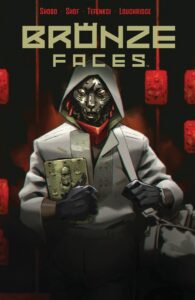
Bronze Faces by Shobo and Shof Coker, illustrated by Alexandre Tefenkgi
One recent revisionist offering is Bronze Faces written by the brothers Shobo and Shof Coker and illustrated by Alexandre Tefenkgi. There are three principals, Timi, Sango and Gbonga (named for Nigerian orishas) who grew up together in Benin City, Nigeria. The trio blossomed under the tutelage of Osaze Asora, a noted sculptor who they called Baba—Timi being his biological son and the other two his de facto daughters. As in the telling of classic gangster flick Point Blank (based on the first Parker novel The Hunter), the narrative employs flashforwards and flashbacks to tell its tale. A technique utilized in other comics as well as television fare Breaking Bad and Lost.
The plot is kicked into motion when years later Baba has passed and the British Museum mounts an exhibition of his work. The three are of the opinion the art is theirs and attempt to buy it back. When that doesn’t work, they steal the goods. In the process, they stumble on a document of colonial plunder, the various locations of Benin Bronzes stolen from Nigeria some 100 years ago. Well, hell, they decide, they’re going to steal them all back. Recruiting a few others with skillsets to help pull off the scores, the gang who has fashioned themselves the Ogiso (ancient rulers), are doggedly pursued by Detective Emily Li of Scotland Yard’s Department of Antiquities and Cultural Heritage.
The action in Bronze Faces is balanced against the at-time tense interpersonal relationships among the characters. As Logan Dalton noted in their review of the first issue on the Graphic Policy site, “Flat colors, inset panels, and rapid fire dialogue give Bronze Faces #1 a solid flow with the entire comic fueled by righteous anger…”
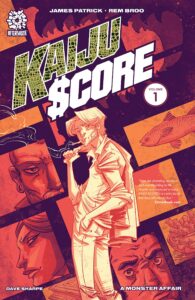
The Kaiju Score by James Patrick, illustrated by Rem Broo
The Kaiju Score by James Patrick, writer and Rem Broo, artist, provides an unusual setting for a robbery. We open on small time, no-last-name thief Marco. He’s thirsting to pull off the big takedown, and has so far failed to do so largely due to his oversight tendencies. But not this time, this time he’s got it all lined up. In a world where kaiju are known entities, one of them, this Godzilla-sized tusked turtle, is projected to make landfall soon. It’s protocol to evacuate the targeted city. This time it’s also where there’s a museum containing the Gustav Art Collection, worth between 30 to 50 million. Marco has insider information the art isn’t moved but secured on site.
As Patrick noted on SYFY Wire about the influence of the Parker novels by Donald Westlake on his story,
“Those are a hell of a read. And from there I think I organically, when it came to execution, was influenced by the work of Elmore Leonard and Quinten Tarantino. Their style always seems to bleed into much of my work. Kaiju Score is a crime and heist book first, the character problems and relationships always being forefront and the monster stuff always the canvas to squeeze as much drama as you can out of it.”
The giant turtle is rather docile. But when an unexpected second kaiju shows, up, which is a more prickly beast, and the double-cross goes down, that oversight flaw of Marco’s threatens to get the crew shot or devoured by an extremely large set of teeth. There’s even a sequel of sorts with Michelle, the safecracker of the crew, assembling her own string to break into a maximum security Russian facility and steal something inside a sleeping kaiju’s stomach.
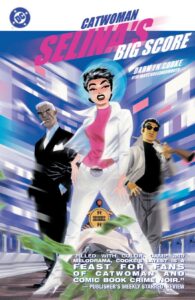
Selena’s Big Score, written and illustrated by Darwyn Cooke
The mention of Parker brings us to writer-artist Darwyn Cooke, who has wrangled a handful of the prose outings of the iconic professional thief into comics form. These included The Hunter, The Outfit and the much condensed and oversized comic The Man with the Getaway Face. The aesthetic mold for these adaptations can be seen in his Selena’s Big Score, produced years before the aforementioned, and taking place at a time in Miz Selena’s, aka Catwoman of Gotham City, carer where she’s presumed dead and in desperate need of a payday. Then insider information as in The Kaiju Score, presents itself—rob a money train of mafia millions while the train is making its run.
It’s a fun and touching fast-paced rendition by Cooke of a vulnerable yet still ruthless Selena Kyle. The walking Easter Egg in this heist tale is a hardnosed professional thief named Stark (for Westlake’s Richard Stark alter-ego pen name for the Parker novels). Cooke realizes him on the page with a lean, rugged build and a face that’s a cross between Lee Marvin and Charles Bronson.
Selena tells us at one point about back then, “…but Stark – Stark was like living granite.” We learn he was not only a young Selena’s teacher in the ways of pulling off a takedown, with Obi-Wan Kenobi Zen-like advice to only trust yourself, but her lover who she double-crossed. But to pull off the money train score, she must go back to him. Recommended highly.
Go on now, go get these heist graphic novels and get your story schema on.
***
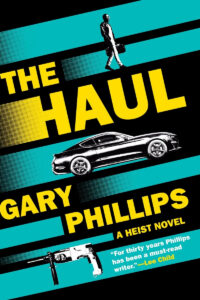

Gary Phillips
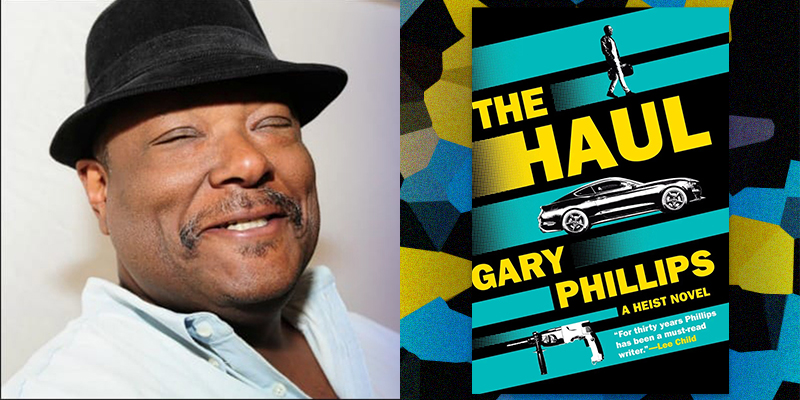
Gary Phillips’ latest novel is The Haul. It’s about semi-retired professional thief O’Conner lured back into the game to mastermind the theft of millions in cash from a billionaire tech bro’s swank survival bunker – hidden under the new arena he built for the NBA team he owns.