
Alysandra Dutton on Writing Historical Noir and Investigating Ancient Roman Crimes
The author of The Stolen Women revisits the traumatic history of the Sabine women
In 753 BCE something happened to the Sabine Women. Romulus, fresh off of founding Rome, could not make marriages for himself and his men, who were considered little more than a gang of particularly nasty bandits. He opted for stealing his brides from neighboring Sabinum during a festival, cementing Rome’s legacy in their wombs.
And when I was fourteen, sitting in the audience of a local high school production of Seven Brides for Seven Brothers, a romantic comedy retelling of the Abduction of the Sabine Women, listening to the cast sing jovially about how those women kissed and cried all over that Roman countryside, a feeling welled in me that I would later associate with the need to clear my desk and get writing: indignation. Or maybe, spite.
Ever since, the Sabine Women have haunted me, much the way true crime stories haunt my generation of American women; their pain felt cautionary, their story morbidly compelling, as they showed up again and again in my drafting notebooks. Sure, the crime was solved. We know who took the Sabine Women, and we know why.
But in time I realized I wasn’t able to let them go because the injustice was ongoing; historians writing seven hundred years after the founding of Rome claimed the women were happy to be kidnapped and in love with their captors, marking perhaps one of the earliest incel arguments that women secretly desire to be overpowered, that rape is not that violating after all. And until the record said otherwise, I couldn’t not write.
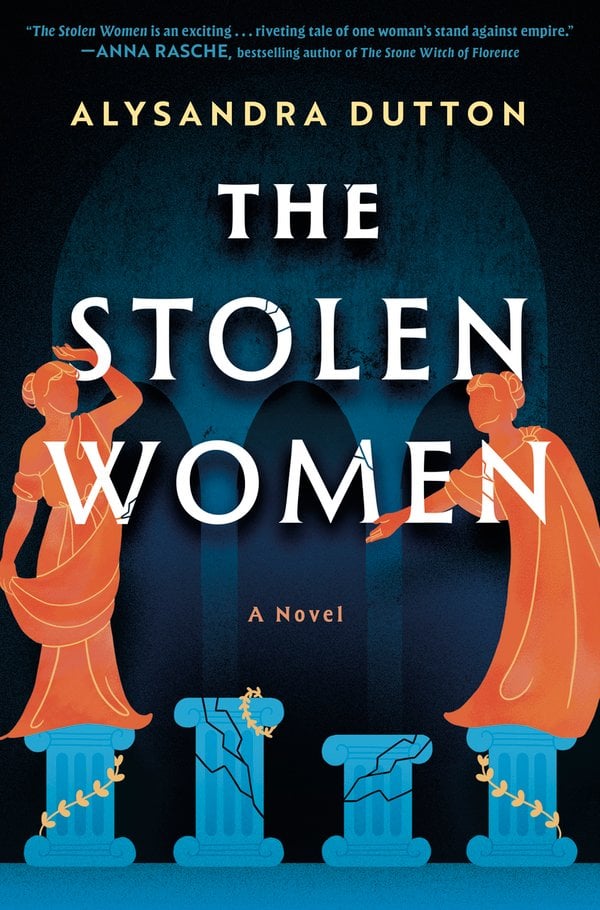
The Stolen Women came together for me, probably not surprisingly, as I discovered an interest in detective literature. I already felt like an investigator, cynical and working against the grain for my victims; it made sense to take years of notes and half-started stories and filter them through classic noir conventions.
My favorite noirs are about fighting—often futilely—against the system. That seemed to me a fitting framework by which to see a young Sabine woman, pitted against Rome. As contemporary readers, we know what’s coming—we know Rome wins.
But in noir, the the tragic end—often as foregone a conclusion as Rome—is an aside. The story is about what drives a person to leave their well-earned cynicism at the door and fight anyway. I wanted to give the Sabine that story.
Soon, Safinia appeared on the page. My classic, hard-boiled detective; at first, all she wants is to be left alone to put food on the table and protect her sisters. But then, the femme fatale, a woman in danger, in tears, draws her into the twisting, atmospherically moody world of a mystery.
The disappearance of an ex-lover, answers that lead to more questions, and a sidekick classical historians will immediately recognize as keeping vital secrets—it was all there. I may as well have given her a pipe to smoke on as slats of light shine through her dusty office (she does, at one point, smoke hemp in the fashion of the ancient world—one of my favorite scenes, and a send-up I couldn’t resist). But what would happen when her investigation led to Rome?
As Safinia descended further into her obsessive pursuit of mysteriously disappeared women, I also began to feel obsessive, my research notes looking more like a murder board every day. By this point, I was living in Rome, as a member of the awards-holder cohort at the British School at Rome. Before this moment, I had written a lot about trauma; my history necessitated it. Writing about violence, about violation, was my way of making sense of my own past.
In Safinia, I found cathartic satisfaction in her quest for answers and subsequent fight for survival. But what began as an intimate story about gendered violence began to take a larger shape during my days at the BSR. Suddenly, I realized I was writing a book not only about violence—but about violence in Rome. And the qualifier mattered.
Any contemporary archeologist will tell you that the study of Rome is also the study of fascism. I’ve written before about how it is impossible to extract fascism from its birthplace, and the reason for this is practical and material: fascism mucked up a lot of crime scenes in its day. Or, I should say, excavations.
Mussolini’s thirst to associate himself with the image of the Roman Empire meant large swaths of history were greedily uncovered, poorly documented, and then left to rot. Far from the conservation practices of archeological excavations today, even the Colosseum Mussolini was determined to see from his balcony, tearing down a historic medieval neighborhood to achieve this, was neglected by the 1970s. It was a known site for drug-users and criminals (and underground cinemas and raves, but that’s a story for another day), crumbling dangerously around its edges.
I note the irony in an essay at the back of The Stolen Women: Mussolini wanted to see the colosseum Emperor Domitian built so that he could feel like a God, too. But Emperor Domitian, my research found, proudly displayed an impossible to verify family tree that tied him to the original kidnapped Sabine Women, eight hundred years before his reign. This was the brag of important men in Rome, their Sabine ancestors promoted from victims to propaganda that proves a family’s interests in the Eternal City.
From here, my tact had to change; a moody, forget-it-Jake-it’s-Chinatown ending had no place in this world. I’d been so consumed by the crime of kidnapping, and the futility of Safinia’s hopes for solving it, that I was missing the crime of history, of rhetoric; not of how you tell the story of an Empire, but of how you justify it.
Ancient historians edged around the Sabine Women, acknowledging the crime but inventing, in the same breath, an ending that renders their kidnapping palatable. Titus Livius—Livy—claims in his histories that the women kept their freedom of choice and chose to stay with their Roman captors; Dionysius of Halicarnassus praises Romulus’ bold foreign policy in his decision to kidnap them in the first place. And Mussolini, in Italy’s fascist era, rips the protective shell off of history and lays it bare and eroded, absent any context that doesn’t spell empire.
In these days of writing and drafting, Safinia’s task looked enormous, insurmountable. But if nothing else, she taught me how to move doggedly, determinedly through history; to trust the way the Earth churns up new answers and new mysteries. They will never have all of you, a historian tells her at a low moment, and he’s right.
The truth has a way of breaking through.
***

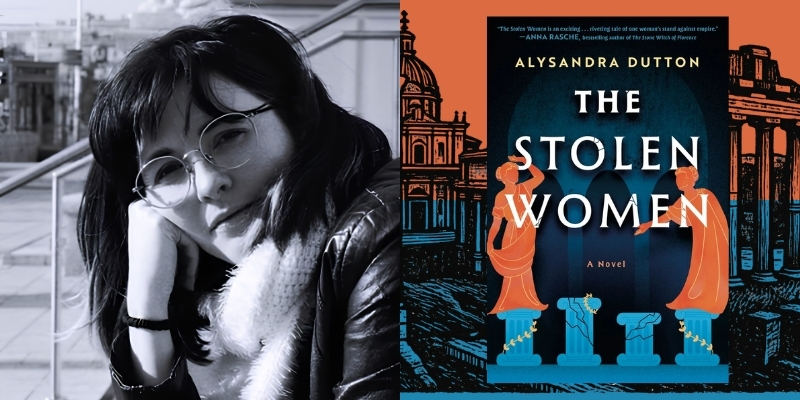
Alysandra Dutton
Alysandra Dutton attended the University of Arkansas for her MFA, where she was awarded a dizzying number of fellowships and prose awards. Her short fiction appeared in Catapult, Electric Literature, and The Sun, and she wrote The Stolen Women with support from The Elizabeth George Foundation. Currently, she lives in Minnesota and is a teaching artist with The Loft Literary Center, where she leads regular historical fiction workshops and neurodivergent writing groups, Interlochen Arts Camp, and the ALS Association.