
Sarah Gailey On Horror, Grief, and the Lies We Tell Ourselves to Escape Our Suffering
People will do anything to avoid addressing loss. That's a problem.
I remember thinking: I can’t bear this. I remember pressing my hand to my chest, pressing hard, making a fist and rubbing my knuckles against my breastbone in an echo of the sternal rub I learned in EMT school—a quick, brisk gesture meant to inflict immediate pain. A sternal rub is used to see if a person is responsive to pain, even if they aren’t responding to the sound of your voice; it is used to see how alive they still are.
I remember hurting my own sternum on purpose with my own knuckles. But it didn’t hurt more than the pain that was already there, on the opposite side of the bone.
I didn’t respond to the stimulus.
This was what grief was, to me, the last time I encountered it. A loss that re-oriented my life, followed by pain that made me wonder how alive I still was. There was no escaping it, either. There was no running fast or hiding in a closet peering through the slats. There was no car to leap into and drive away fast into the night, although I tried that a few times. It came with me everywhere I went—my little passenger, drilling into my breastbone with unyielding determination.
It was awful. But, for a season of my life, it made me fearless. That fearlessness was so strange and freeing. I write, among other things, horror; fear is my business. I make a study of fear. I live inside it. But that grief obliterated my sense of fear. I could not imagine that anything could happen to me to make me feel worse.
And so I did everything. I traveled the world, and I got rid of most of my possessions, and I subjected my body to adventure after adventure.
I felt like I could do anything, because I couldn’t imagine a pain worse than what I was living inside of.
I would never have thought that pain could cleave me from imagination in this way. As a writer of upsetting fiction, it is my job to imagine pain. To befriend it and understand it, and then introduce it to you, the reader, so you can turn it over in your hands and touch it to your tongue. But during this time, I couldn’t imagine pain beyond what I was experiencing. I’m not talking about metaphorical or abstract pain here; this was in my body. This was sensation. It was excruciating. And I couldn’t think around it or think past it or think through it or even begin to articulate it.
It was incredible to me to admit and accept the fact that, as a result of my pain, I couldn’t write.
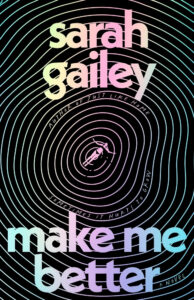
At the time, I was facing down yet another brutal rewrite of my novel Make Me Better. I had already rewritten it so many times—it would end up taking five rewrites in all, each one a particular hell. At this point, my editor and I agreed that another round was necessary. There was still something vital missing from the heart of the book. We discussed it at length, trying to figure out what nutrient was absent. We paced in circles, turning everything upside down and inspecting it. Looking for the gap.
I remember thinking: I can’t bear this. Knowing that I needed to write, and knowing that I could not write, and rubbing my knuckles against my chest. I remember thinking: I would do anything to stop feeling this way.
Grief is one of the few truly universal parts of the human experience; there is no life without loss. But oh, how we try to escape it.
I was telling the truth to myself when I had that thought. I would have done anything to stop feeling that way. I had friends and family around me all the time, for months, to make sure I didn’t do some of the things that would make me stop feeling that way. One of those friends—dear to my heart, never afraid to be in proximity to anguish—was with me when I thought: I would do anything. And I remember looking up at her and knowing that she was saving my life by being there beside me.
I called my editor the next day and told her that I knew what was missing from Make Me Better.
Not grief. Not that unbearable pain I was carrying. But instead, what we will do to free ourselves from it. Grief is one of the few truly universal parts of the human experience; there is no life without loss. But oh, how we try to escape it. We will even go so far as to submit ourselves to shame, a profoundly painful emotion, if it means we can tell ourselves that grief does not need to exist for us. We will swallow that medicine with relief: I was born bad and can never become clean, but I will see my beloved again someday.
That, I realized, was what I’d failed to understand—in my approach to these characters, and to this book, and to life and other people and myself. I had been missing it all along. How hard we will work, and how much pain we will absorb, and how much we will transform ourselves in an effort to escape the suffering that comes with grief and loss.
As I rewrote Make Me Better, it became clear to me that this motive was everywhere in the book, and was everywhere around me. I recalibrated my understanding of the things loved ones had done to themselves and each other and to me. I saw the way they were weaving around a kind of pain that they didn’t think they’d survive.
I could finally see the fear.
I also began to see the vulnerability presented by that fear. There are predators with their noses to the wind, waiting to catch a whiff of existential terror. They find their prey, and bare their teeth, and insist that the right combination of food and exercise and abstinence and purity and worship can inoculate the soul against pain.
I began to ask myself: Who wouldn’t be tempted by that promise? Who wouldn’t be swayed?
Who wouldn’t choose those teeth, given the alternative?
I’ve kept some of the fearlessness that grief gave to me. I survived that experience of suffering. It didn’t kill me the way I sometimes thought it would. But, like the survivor at the end of any horror story, there’s part of me that knows my enemy isn’t vanquished. There will be a sequel. A franchise, if I’m lucky.
I’ve spent a long time reading and watching horror stories, and so often, a character will make a decision that is incomprehensible to the person I think I am (comfortable in my chair, cat dozing twitch-pawed at my feet, warm beverage close to hand). But I know, now, and can never stop knowing, that there is a different version of me—a me who rubs their knuckles against their sternum to check for signs of life, a me who will go anywhere and do anything because no fear is more powerful than the pain of loss.
A me who would choose the teeth in a heartbeat.
Wouldn’t you?
***

Sarah Gailey
Hugo and Campbell finalist SARAH GAILEY came onto the scene in 2015 and has since become one of the sharpest, funniest voices in pop culture online. They are a regular contributor for multiple websites, including Tor.com. Their nonfiction has appeared in Mashable and The Boston Globe, and their fiction has been published internationally. Their latest novel, Magic for Liars, is now available from Tor Books. Sarah Gailey lives in Los Angeles, California.