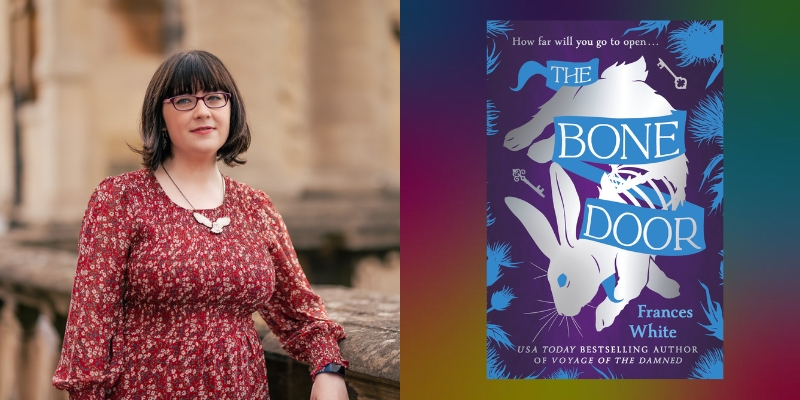
Frances White on the Power of Casual Representation in Mysteries
Sharing one reader's unexpected encounter with a queer detective character
A few months after my debut novel, Voyage of the Damned, was released in the U.S., I received a very curious message via my contact form.
Without giving away any identifiable details, it was from an older, white male who lived in the deep south and was a self-confessed “redneck” as well as a devout Catholic. He opened this message by saying that had he known that my book was a “gay murder mystery” he never would have picked it up.
Upon seeing this, my stomach dropped. I jumped to assumptions that this was going to be an abusive message (it wouldn’t be the first), maybe he’ll demand his money back, or try and get my book banned.
But then the reader went on to say that although he was shocked by my bisexual main character initially, the book slowly began to open his mind. It made him consider the overwhelming number of straight books that gay people must read, and also, despite all his initial wariness, he couldn’t stop reading.
By the end, he was hooked, and enjoyed the book for what it was, regardless of the fact he could not relate romantically to Dee, my lead. This man was in his fifties, and had never read a book with a queer main character, but mine sneak-attacked him.
I say sneak-attacked, because despite its online marketing being that of a “magical gay murder mystery cruise,” if you encountered the book itself in a shop there is no indication of Dee’s queerness. The cover isn’t covered with rainbows, and there’s no mention of sexuality or romance in the blurb. It sells itself as a murder mystery with magic, because to me, that’s all it ever was.
This reader’s message made me consider the kind of stories queer people get to tell, or the ones that make it to shelves. Although we are fighting against a new wave of censorship, there have been plenty of queer “issue” books published. I remember reading a lot of them when I was younger. Stories about realizing your identity, coming out, or a character’s first queer love.
These books are loudly queer. They feature covers with kissing boys or girls or rainbows, and often they are shelved in the LGBTQIA+ sections in bookstores. I am so glad these books exist; they are very crucial to queer youth and beyond. They deserve that shelf, and queer people through the generations have fought very hard for it, and to tell our stories.
But although being queer can be a key part of any queer person’s identity, it is not the only part. I never wanted to write a book ABOUT being queer, I wanted to write a murder mystery where the main character just HAPPENS to be queer. Being queer in our world can be exhausting, especially in growing hostile times. I wanted a story where the character’s sexuality had nothing to do with the plot. Yes, he sometimes kisses boys as well as girls, but also he has murders to solve and dragons to talk to.
It is the same case with my next book, The Bone Door, where Hop, the main character, isn’t clearly revealed as queer until much later on in the book. This isn’t some shocking reveal or twist, it’s just because he’s got far more important things to consider—he’s woken up in a labyrinth without memories, and has to solve impossible tasks to escape. And at one point, he has a crush on a boy.
It makes no real impact to the main plot. It’s just one of those things about him, along with the fact he’s a leader, he’s sweet and the most optimistic person you’ll ever meet (sometimes to a fault!)
Notably, Hop and Dee are also both plus-size, another aspect of a person that often is the sole focus of a book or show, where a plus size person has to go on a journey of self-acceptance about their body, or, worse, lose weight. In these stories, the characters are fat, first of all, before anything else. But in my books, their fatness has as much impact on the plot as their queerness, as in, not at all. It is just one descriptor in a long list.
This message from the U.S. reader made me think about the power of what I will call “casual representation.” That is, diverse people featured in stories where their diversity is not the focus. Where it just IS.
Some examples which come to mind are Benoit Blanc in the Knives Out franchise; indeed the viewers have no idea he’s queer until the second film, and by then the majority have already fallen for his charms.
Another is the casting of Peter Dinklage, a little person, in the role of Casca Highbottom in The Hunger Games movie The Ballad of Songbirds and Snakes. He being a little person, just as Benoit being gay, has no impact on the plot, it’s not even drawn attention to. He is first and foremost, a complicated addicted man struggling with his demons—none of which come from his short stature.
I think this kind of representation is quietly formidable. While the out and loud queer books are very important to the community, if the message I received is anything to go by, then often those not part of the marginalized identity at its centre will not read them (and indeed, perhaps they are not for them), but I also fear when these books are the only representation a marginalized group has, it builds further walls between us. It creates the “other,” the “not me.”
I believe the strongest representation can be when these characters and marginalized identities, just exist in places where we rarely see them, like the leads in fantasy books. It is this sort of “normalization” that I believe can break down the barriers between us.
Enjoying art, especially reading, is often an act of empathy. And this older white cis straight man who read my book, had never put himself in a queer person’s shoes before. In fact, he had actively avoided reading queer books, but there he was, cheering for my very queer protagonist (who wears sequins for the whole book!)
And if even a hint of that empathy sticks with him when meeting real queer people in the world, if he sees them as more than just ‘queer’ more than just “the other,” I think that is an incredibly powerful thing indeed.
***


Frances White
Frances White is a creative writing and English literature graduate from Royal Holloway, University of London. She has a soft spot for writing unlikely, flawed, messy heroes and loves mixing humor and heartbreak. Frances is also passionate about bringing more LGBTQIA+ representation and fat positivity into fantasy. When not writing, she can be found sewing nerdy costumes for comic conventions or researching obscure historical facts. She is the author of Voyage of the Damned and The Bone Door.