How a Career in Screenwriting Prepared Tim Sullivan to Write Crime Novels
On the transition from screen to books.
I have spent the majority of my career as a screenwriter and only lately come to crime fiction. It’s actually something I wish I’d done so much earlier in my life. As a novelist you are so much more in control. In the TV and film business you are subject to a vast number of opinions, changing fads and executive musical chairs. I’ve found it very different in publishing. Well certainly with my publishers. Everyone in the team wants just one thing, which is to achieve the best version of the book possible and everyone works towards that.
I started out in my screenwriting career with the filmmaker Derek Jarman. I initially worked on a screenplay called Neutron with him. It was never made but led to me writing another screenplay for him called Bob Upadown. While neither film got into production, it was a wonderful apprenticeship and Jarman was a strict taskmaster. My next collaboration was with another Derek, Granger who had just produced the extraordinary TV series Brideshead Revisited. I was a chauffeur for the actor Anthony Andrews at the time and spent most of the days on location scribbling away at Jarman’s screenplay in Tony’s parked car. Granger was intrigued and after he discovered what I was writing became something of a mentor. We co-wrote two movies together, A Handful of Dust starring Kristin Scott Thomas, Judi Dench and Alec Guinness. This was followed by Where Angels Fear to Tread starring Helen Mirren and Helena Bonham Carter. In a sense, the two Dereks were my screenwriting school. I learnt so much from them, lessons I still use to this day – and I am forever grateful.
I wrote and directed my own movie Jack and Sarah starring Richard E Grant, Samantha Mathis, Judi Dench and Ian McKellen, which then led to a lot of screenwriting work in Hollywood working for people like Ron Howard, Scott Rudin and Jeffrey Katzenberg. It’s been a wonderful, rewarding and frustratingly infuriating ride. But I wouldn’t change a thing.
It was after I co-produced and co-wrote My Little Pony: A New Generation in 2020 that I decided a change was called for. I often joke that having worked on that movie there was only one direction to go – crime fiction. But it is a joke, I loved working on it. But now I was going to try my hand at writing a crime novel.
Just the idea of it was intimidating, though. It seemed like writing for grown-ups. Proper scribbling. But I put my head down, ignoring all the discouraging negative voices inside it and began. I write in long hand with a fountain pen, always have, and in some sense, this made it feel less daunting. At the outset, the writing looked more like a personal journal rather than a lame attempt at a novel.
As I became more confident, I discovered that the two forms are similar but also vastly different. The first thing I found was that the rhythms of a novel are very different to those of a screenplay. Screenplays are obviously that much shorter. This meant I had become used to writing in time coded beats as it were. This initially led into my prose being quite episodic. I had to review this and understand that I needed to give the writing space and time – something you can’t do to the same extent with a screenplay. There are so many constraints when writing in that form, most of which are driven by financial considerations. These don’t exist in writing a novel. Films are also invariably constructed in three acts. This isn’t an arbitrary rule made up by someone. It’s just how it is – experience and history tell us so. Novels are not. They can be formed of several acts. I began to realise that constructing a piece of fiction also allows you to digress and go off on tangents, which was liberating. Again, something you can’t really do in a screenplay.
One thing I had to reassess when it came to writing a novel was the role of the narrator. As a crime writer, I just assumed that the third-person narrative was what I needed. I thought the narrator and author were one and the same thing. As a professional screenwriter, the consideration of who and what type of narrator you have is fairly straightforward. There are several types of narrator within a script– the single third-person voiceover, the first-person voiceover, the multiple-person voiceover and the narrator who addresses the camera directly – think Fleabag. But the main narrator in a screenplay is the screenwriter, the author, and he or she frequently appear in the stage directions. Here the screenwriter is both narrator in telling the story, guiding the reader through, but is also the author making sure that his or her intentions are made clear. What they think the scene should look like. How the characters are feeling. But a screenplay that is simply a good read will often not be made, because being a good read is not enough. A film has to emerge from its pages. The stage directions of a screenplay are often narrative in shape and form but are also the author’s voice saying “this is how I’d like this movie to be made, please.” The author in TV and film is a welcome and useful presence in a screenplay, due to the nature of the process, in a way that cannot necessarily be applied to fiction.
I think what I’ve taken from my career as a screenwriter is a good sense of the visual. Scene setting is so vital in a script. You need to give everyone a clear idea of what they need to look for in locations and environments. I think I also have a good ear for dialogue. Dialogue has been my bread and butter for over forty years, so I’d hope to have improved over the decades.
But one of the most important things I’ve taken from writing screenplays is plot and narrative drive. Plot is obviously key in both movies and novels but it’s also the narrative drive of both. This doesn’t mean the plot goes in a linear line from A to B. Subplots and subsidiary characters with their own story arcs lend themselves to the success of a strong narrative drive. These keep the reader’s interest moving forward in the same way as you maintain an audience’s attention in a cinema.
Character is another thing the two art forms have in common, and it is hopefully another well-burnished tool in my kit. I believe that good crime fiction has to have a good character at its core. To know more about that character and root for them, you also need a great supporting cast. As a screenwriter, you have to draw your characters well for the director, the casting director, the actor themselves even the costume and production designer. So, I guess from this experience I try and draw fully rounded and complex characters for the reader. In a novel, though, I can also explore a characters’ innermost thoughts, not often possible in a screenplay. I can describe them to a fuller extent rather than relying on an actor’s and director’s interpretations.
One of the many frustrations of being a screenwriter is that a large proportion of your work never makes it to the screen. This is because development is one of the cheapest parts of the movie-making process. Stacks of scripts, all commissioned and paid for, just end up metaphorically gaining dust on the hard drives of various producers and movie executives all over the world. Heck, they don’t even have the honor of being printed anymore since the arrival of the PDF. Sometimes a script will stagger towards production but falls at the last hurdle. It feels like a constant waiting game. A gamble in which the odds keep lengthening. This just isn’t the case with a book.
With a novel it’s simple. A date is agreed. You write the book. You go through the edit process and then the book is published and is out in the world. There’s a real fulfilment in seeing all the work you’ve put in over the months being read and appreciated. It’s something I’ve found surprisingly energizing creatively. It’s so encouraging and drives me to write more.
***

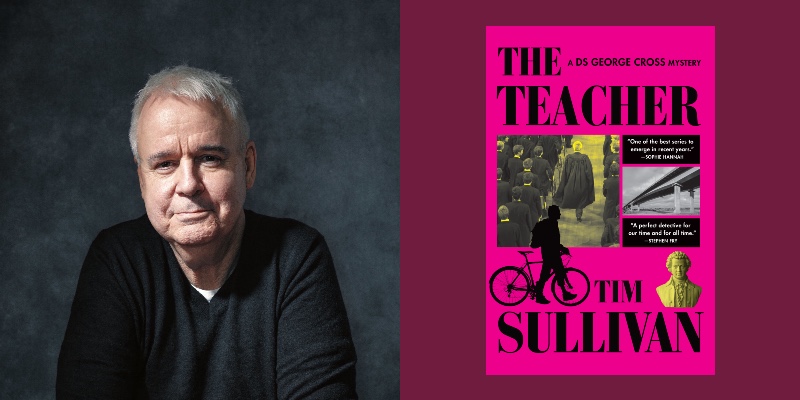
Tim Sullivan
Tim Sullivan is an internationally bestselling author and acclaimed screenwriter, whose credits include A Handful of Dust, Where Angels Fear to Tread, Jack and Sarah, and Letters to Juliet. He is also a television director whose credits include Sherlock Holmes and Cold Feet. His DS George Cross series was a breakout success in the UK and has sold over 850,000 copies worldwide. He lives in North London with his wife, Rachel.