
Matt Harry's 8 Favorite Dystopian and Post-apocalyptic Novels
The author of Ash Land recommends Emily St. John Mandel, Stephen Vincent Benét, Stephen King, and more
Ever since I was a little kid, I loved stories about the end of the world.
I think the first one that really impacted me was Omega Man, which was the movie version of Richard Matheson’s novel I Am Legend. I caught the 1971 film on some daytime television matinee, and I missed the first five minutes, so I didn’t fully understand why Charlton Heston was wandering around an empty New York City.
But seeing him alone in a place that was usually packed with people felt strangely comforting to me. The concept lodged itself in my brain. From that point on, I perked up whenever post-apocalyptic or dystopian stories crossed my radar.
And let’s face it, the end times offer some very appealing opportunities. No more going to work or paying your taxes. No more worrying about money or speed limits or mowing the front lawn. No more traffic! Apocalypses are also really good at giving people a sense of purpose. Who needs to worry about what to wear when you’re trying to rebuild human society?
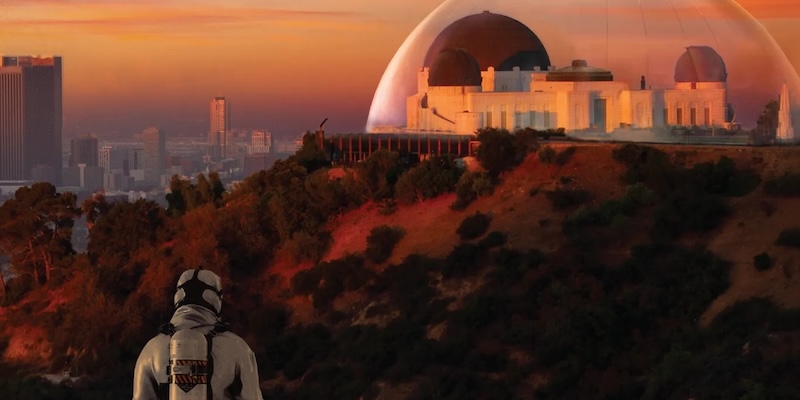
So when I finally had an idea for my own apocalypse scenario, I knew I had to make it unique. Ash Land is a dystopian detective novel set two years after a plague of flesh-eating microbots has forced humanity inside. It’s a world in which every house has an air lock, where delivery drones speed down empty freeways, and “Scrappers” in homemade hazmat suits illegally scavenge for valuables.
Whenever I write something, I try to steep myself in similar material. It helps me stay on tone, and it inspires me to see how other authors have approached like-minded themes. In order to build out my dystopia, I went back to my favorite end-of-the-world stories to figure out why they worked.
Out of all the stories on my post-apocalyptic reading list, these eight are the ones that really stuck with me.
*

Stephen King, The Stand
Stephen King was ahead of his time when he wrote about a virus that wipes out most of humanity. The people who survive become split into two camps, each one led by a psychic avatar for God and the Devil. There’s even a cool nickname for the world-ending organism: Captain Tripps. But my favorite aspect was seeing how people who were stuck in a certain kind of role before the apocalypse were able to reinvent themselves after the world ended.

George Orwell, 1984
This book is not an easy read. It starts off with the clocks striking thirteen, and it just gets bleaker from there. But I’ve read this probably more than any other dystopian novel, and I always find something new in it each time I revisit it. More than the other books on this list, it provides that purpose I talked about earlier.
What could be a more noble, more lofty goal than standing up to a corrupt, authoritarian regime? Now more than ever, such acts of defiance feel necessary.

Douglas Adams, The Hitchhiker’s Guide to the Galaxy
What would the end of the world be without a little humor? Earth gets destroyed to make way for an intergalactic freeway, and everyguy Arthur Dent gets to travel the galaxy in his bathrobe. Adams always surprises with his prose, and even has the audacity to reveal the meaning of life. (If you don’t know the answer, it’s well worth reading this to find out.)

Emily St. John Mandel, Station Eleven
This is the loveliest, most hopeful novel on the list. Like The Stand, most of humanity dies from a virus. Unlike The Stand, the survivors don’t form marauding gangs or murder each other. They put on plays. The main characters travel the Michigan countryside, performing Shakespeare for small farming villages. Their motto is “Survival Is Insufficient,” which should be a clarion call for all of humanity.

Max Brallier, The Last Kids on Earth
What kid hasn’t dreamed about all the adults disappearing so they could race monster trucks down Main Street and eat ice cream whenever they wanted? Brallier is definitely catering to a middle-grade audience here, but it’s nice to see folks actually enjoying the freedom an apocalypse can provide.

Matt Dinniman, Dungeon Crawler Carl
This was a recent discovery for me, but I sped through the entire eight-book series in six months. Aliens turn Earth into a giant, deadly dungeon, forcing the titular Carl and his ex-girlfriend’s cat Princess Donut to fight for their lives.
This series features some of the craziest ideas I’ve ever read, including talking cats that shoot eye lasers, massive rolling balls of living swine, and an AI with a foot fetish–all while celebrating the complicated, stubborn mess that is humanity. Glurp, glurp!
Stephen Vincent Benét, “By the Waters of Babylon”
I first read this 1937 short story in high school, and it always stuck with me. The setting seems to be pre-industrial, as we follow a young hunter who ventures into a forbidden zone. What the hunter finds in that area makes us realize that what we’ve been reading actually takes place in a post-apocalypse.
The techniques Benét uses to turn ordinary items into objects of mystery have inspired many other science fiction writers, myself included.

Ben H. Winters, The Last Policeman
This novel probably has the most similarities to Ash Land. I was very inspired by Winters’ story of a cop still trying to fight crime, despite the approach of a comet that will destroy the Earth.
The worldbuilding offers many clever ideas about how humans might spend their last months alive. What becomes important when money, posterity, and long-term consequences no longer matter? This book provides some interesting answers.
***


Matt Harry
Matt Harry is the author of six novels, including Sorcery for Beginners, which was optioned for television by Boatrocker Media (Palm Royale), and Ash Land. He has edited over twenty-five novels, created two immersive plays, and taught hundreds of students in creative fields. He lives in Los Angeles with his wife and two sons, all of whom (thankfully) like to read.