
How Chris Bohjalian Spent His Summer Vacation...
...writing a secret novel you won't be able to put down.
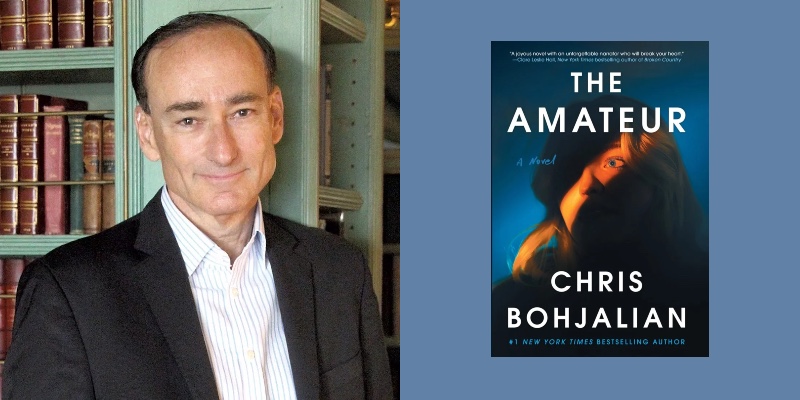
The Amateur begins with a death and builds to a courtroom drama, a trial for involuntary manslaughter. This is not a spoiler: the narrator in my new novel – a tale framed as a memoir – begins her story with a three-part table of contents in which the final third is called, “The Trial.”
But I don’t view my new book as a novel about a crime, at least not in the traditional sense or the way that I do such earlier works of mine as The Flight Attendant or The Lioness.
As I worked, however, I did think a little bit about Hamlet, a play which is, of course, about regicide and revenge. (When it came to crime, few playwrights took swings as big as Shakespeare.)
But I thought a lot about Hamnet, Maggie O’Farrell’s remarkable novel and how art sometimes springs from the subterranean parts of our soul and is given form by conscious planning. The Amateur obsessed me in ways almost none of my previous books have.
The truth is, I rarely have the slightest idea where my novels are going. I don’t work from an outline. I don’t know the last sentence when I write the first, a prerequisite for John Irving, a novelist whose work I revere.
When I embark upon a book, I know only two things. I have a vague premise of what it will be about: an alcoholic flight attendant wakes up in bed next to a dead body in Dubai, for instance, or a midwife is on trial after a disastrous home birth.
And I know the voice. I know whether it will be a traditional, Henry Jamesian third-person novel or a first-person story with a contemporary narrator.
I always want the book to be fun to write – and I’ll abort mission if I’m not having fun. After all, if I’m not having fun writing the novel, you sure as hell won’t have fun reading it.
Usually, a half-dozen people know what I’m working on: my lovely bride, our daughter, my editor, and my book and film agents. But then there was the summer of 2024 and (to paraphrase Joseph Heller) something happened. I heard that narrative voice that fuels a novel. And I told none of them what I was writing.
Moreover, it was actually voices (plural) I was hearing, including some of the entitled men for whom I would caddy at a swank country club in Westchester County as a teenager.
The narrator was a female version of me, a novelist with a lot of books behind her who was finally letting loose — telling it like it is, because, pure and simple, it’s time for a reckoning. For the truth.
And what is obsessing her? How one August afternoon in 1978, when she was 18 years old, she drove a golf ball through a practice net at her tony country club in a New York City suburb, hitting a classmate and caddy in the temple and killing him almost instantly.
There I am, both the narrator and the caddy, the instrument of death and the dead.
I wrote the novel in a frenzy, working some days from the moment I returned from walking my dog at the break of day until it was time to prepare or enjoy dinner.
As I worked, I kept coming back to this question: what if one weird, wild, and tragic accident changed your life in ways you could never come back from?
And, suddenly, there were secret affairs, predatory men, the class divide in America. . .and a teenage girl on trial for involuntary manslaughter.
On the morning when, much to my astonishment, I had a tight draft, I emailed the book to my editor with the simple subject line, “How I spent my summer vacation.”
I think this is why I love being a novelist. I’m as surprised by what occurs as, I hope, my readers are. When I started this new book, I never anticipated it would become:
— A courtroom drama;
— A novel of suspense;
— A page turner with (I hope) a wry sense of humor;
— A book with very good jokes about golf.
Which brings me back to Hamnet.
We’ll never know how directly the death of William Shakespeare’s son led to one of his greatest plays. But I know there was a connection, as did Maggie O’Farrell, because that is how artists try and make sense of the world.
I once had a friend chastise me for the length of my emails, and how much of what I write in them would be better spoken on the phone or on Zoom.
But writing is how I make sense of the world and organize my thoughts.
And, I have come to realize, it is also why I write books — and how, one summer, I wrote what might be both the most propulsive and the most autobiographic novel in my decades at this desk.
***

Chris Bohjalian
Chris Bohjalian is the author of 26 novels, including the single worst first novel ever published, bar none. It’s about a crime. The bigger crime was that it was published.