How the New T.J. English Reader Mines the Dark Soul of America
David Masciotra on the new collection of journalistic stories and essays, 'Blood in the Desert'
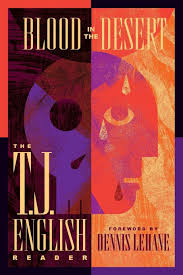
The title of T.J. English’s new collection of journalistic stories and essays, Blood in the Desert, captures an American reality of juxtaposition. The country’s Hollywood-Disney World-Wall Street Bell-suburban-porch patina comes with a gory stain. English selected the title, because it relates to one of his most personal and visceral articles in the Reader, set in the desert of his Albuquerque home. Beyond the literal image of frightening and worrisome red splatter over beige sand, there is the metaphorical capacity of the stain. In a setting of great beauty and wonder, there is an act of violence, perhaps even murder. When walking through the desert, and marveling at its rocky hills, endless skyline of blinding blue, and dry but seemingly miraculous flora, you are free to ignore the stain; to hear the surface crack under your feet as you act like the sight and smell of blood isn’t there. Or you can stop to look. T.J. English not only crouches down for a closer look, but he investigates. He inspects. He runs a forensic test, embedding the results in the missing persons report of his ultimate subject, America.
As the author of many books, including a history of the Irish-American mafia, The Westies, a chronicle of the war between the NYPD and Black Power organizations, The Savage City, and a biography of a brutal street gang of Vietnamese refugees, Born to Kill, English has built an expansive and insightful library that, collectively, functions as an anthropological study of a civilization that has made profit paramount, transformed violence into a tool of acquisition, and programmed its public schools, political system, and pop culture to instruct inhabitants to turn their heads away from the stain.
The pieces in Blood in the Desert complement English’s oeuvre, and together they work to verify the author’s working thesis that it is “impossible to understand America without understanding organized crime.” From the enslavement of Africans and the Indian Removal Act to the more recent catalogues of corporate malfeasance, including subprime loans and an entire health insurance system propped up by delay and denial of treatment, one could argue that the United States of America is a massive criminal conspiracy that worked. Its vast wealth, though unevenly distributed to a painful degree, allows many to live with the spoils. Comic legend George Carlin took this dark, but realistic view. English has a lengthy story about the hours he spent with Carlin, discussing everything from the comedian’s childhood to his political philosophy.
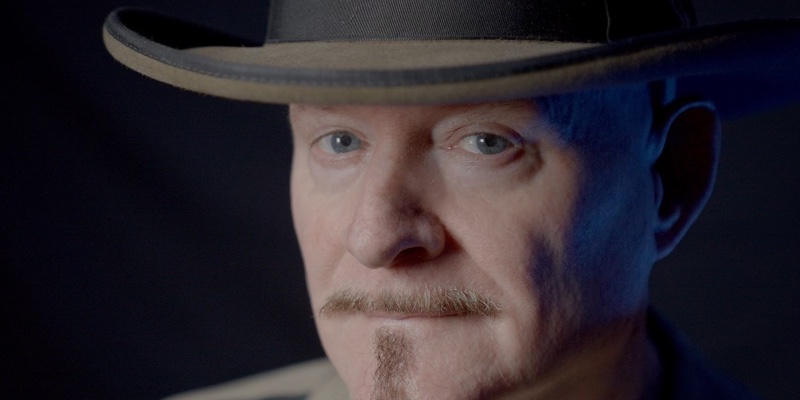
“I love gangster stories,” Carlin tells English, “Irish, Italian, Chinese, it doesn’t matter who it is. I love those stories.” When English asks him to explain, Carlin says, “Organized crime. Those people are engaged in the most honest form of American capitalism.”
It is safe bet that Carlin loved The Godfather movies. His appreciation of mafia stories, along with English’s body of work, offers a reminder of Michael Corleone’s exchange with his wife, Kay. When he claims that his father was no different than any other American man with power, Kay protests that he is naïve. “Presidents and senators don’t have men killed,” she says with an aghast tone. Al Pacino’s Corleone looks at her with his intense but unfeeling eyes: “Oh. Who’s being naïve, Kay?”
The stories in Blood in the Desert provide different laboratory tools and techniques to study the stain.
There is the story of Lam Trang, a brutally violent member of the Vietnamese BTK gang who seeks redemption through religion, acting as his mother’s caregiver, and counseling “at risk” youth. His declaration that closes the story, uttered to English during one of their discussions, provides inspiration frozen in ice: “I’m not cold-blooded no more.” It is a Hemingwayesque sentence that, like the best of that author’s work, captures a hard, jagged truth that isn’t so pretty to think about.
There is eerily titled, “A Killer for Trump.” Also with the basis of English’s own interviews, it chronicles the psychopathy of Kurt Wassenaar, an Arizona prisoner who, already convicted of murder, allegedly killed inmates and other prisoners with the belief that he is a messenger of God and avenger of his god-on-earth, Donald Trump. He tells English of hearing a voice in his head command, “Sacrifice him,” after learning that a cellmate opposed the real estate tycoon turned politician. English is wise to resist any editorial input, but his presentation of statistics showing that a vast majority of American prisoners support Trump is sufficient to provoke thought about how Wassenaar is an extreme iteration of many true Trump believers; citizens who are eager to “sacrifice” the lives of immigrants and protestors, the health of those who relied upon medicine and food from USAID, relationships with loved ones, and the very idea of democracy to prove fidelity to their leader.
There is the eponymous chapter that finds English taking a walk outside his Albuquerque home only to see emergency vehicles speeding toward some unknown, but approximate destination. A double homicide had taken place. When English learned the exact location of the crime scene, the hairs on his arm stood at attention. It was at a meth house in his own seemingly peaceful neighborhood. The blood in the dry air provokes English to reflect on the bodies of unsolved murders, likely the work of a serial killer, also found in the nearby desert.
There are not only stains, but entire worlds of misery, exploitation, and abuse that exist in the shadows, behind barely-hid secret doors, and down the alleys of the American dream.
The story of Dan Flanagan, an Irish immigrant who founded the Blarney Stone Irish Pub chain in New York, becoming an avatar of the national Horatio Alger mythos in the process, turns into a tale of depravity and predation. Behind closed doors, after Flanagan shook hands with the Catholic cardinal and took meetings with the mayor, he subjected his godson to years of horrific sexual abuse. The victim also describes episodes of sexual assault from a doctor who was friends with Flanagan, leading him to believe that there was a pedophiliac “network” of priests and professionals operating in his neighborhood.
These are painful stories, but English is such a vivid and skillful storyteller that it becomes impossible to resist the urge to turn the page. His prose has a hardboiled but colorful style, and the color scheme never includes purple. English knows how to control his voice so as to enhance its strengths, while never distracting from his topic. Consider how he opens a short piece about boxers who became embroiled in the criminal underworld:
“They died violently in a multitude of ways: beat to death with a pipe or a lead sash weight wrapped in newspaper; shot point-blank in the face with a .38 revolver; pistol-whipped, then shot in the head; strangled with bailing wire; stabbed to death with a butcher knife; shot in the balls and in the chest with a pump-action shotgun; behind the ear with a small-caliber handgun; in the stomach; shot in the back and then asphyxiated with a trash bag pulled tight over the head; shot on the street, in saloons, behind the wheel of a car; in a phone booth in the dead of night; shot in the temple and left floating in the Mystic River, hands and feet bound together with wire; bodies left in car trunks, on the side of the road, in the gutter.
A sane person would rightfully conclude that these were ignominious endings. Certainly, it is not the way you would want a loved one to ride out their final hours on earth.
Some might say, and did say, that these men got what they deserved.”
English’s writing has an intoxicating rhythm; staccato notes set against extended phrases, surprising key changes over familiar chord progressions. It isn’t entirely different from the jazz music that he makes the focus of several pieces in the Reader.
The story of the relationship between jazz music and the criminal element of American cities is one that he explored in detail in his brilliant book, Dangerous Rhythms: Jazz and the Underworld. In Blood in the Desert, English presents jazz as simultaneously a triumph and antithesis to American culture. It captures the possibility of freedom, and as many jazz musicians have explained, favors improvisation over a set structure, which makes for a nifty way to understand democracy. Rather than theorize, English tells the stories of individual musicians, the most riveting and heartbreaking of which is that of a virtuosic pianist who never reached his peak, Harry Whitaker. Mental illness, and attendant dysfunctions, prevented Whitaker from taking the ranks among Herbie Hancock, Bill Evans, and Thelonious Monk, even if those who heard him play believed that he possessed equal talent. By his own narration, it is a story that English stumbled upon by hanging out in the jazz clubs of New York, meeting fellow lounge lizards, and doing that simple thing that many people have forgotten, talking.
The artists and artforms that English celebrates, whether it is jazz music or George Carlin’s comedy, are those that find a home within America, even as they operate in contrary to the American mainstream. They represent alternative traditions. English himself is part of an alternative tradition, and it is one that grows more alternative with each passing day. As he would have it, he is a “scribe,” someone who makes his living from writing, and more specifically, writing stories that challenge popular bromides and collide with the falsities that comfort a market-driven society.
One of those falsities is the presentation of police officers as modern-day incarnations of knights in shining armor riding to the rescue of damsels in distress. In the section, “The Blue Wall,” English chronicles the open secrets of police corruption and alcoholism, leading to the crescendo of his story on the years of racism and violence that led to the fatal strangulation of Eric Garner, a Black man who white police officers killed for selling loose cigarettes on a street corner.
“It’s been a long time since a rank-and-file officer publicly bucked the system,” English writes in his introduction to the section on police criminality, “With rare exceptions, a cop’s loyalty is to other cops, and to the department, not to the public he or she serves. If there are scandals to be exposed – a violation of public trust – a cop would, realistically, be the last one to blow the whistle. I hope to be proved wrong someday.”
English, like the rest of us, is still waiting. In a later piece, he refers to the US as a “moral house of cards.” When the paper walls come crumbling down, the work of English, and similar scribes, will tell those left to pick up the pieces what happened.

David Masciotra
David Masciotra is the author of several books, including Exurbia Now: The Battleground of American Democracy and I Am Somebody: Why Jesse Jackson Matters. He has also written for CounterPunch, Salon, and the Washington Monthly, where he is a contributing writer. His Substack is Absurdia Now.