
Howard A. Rodman on Melville, Empire, and the Audacity of Resurrecting Literary Giants
Herman Melville never quite finished with Captain Ahab. Neither, it turns out, did Howard A. Rodman.
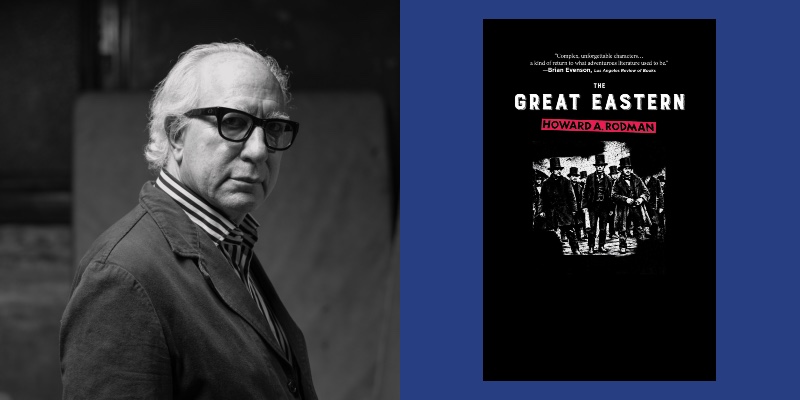
The Great Eastern, the new novel by Howard A. Rodman, begins where two of the nineteenth century’s most enduring literary characters leave off and forces them to clash in the most dramatic fashion. Melville’s Ahab and Verne’s Nemo are pitted together on a collision course across the Atlantic, with the fate of the transatlantic telegraph cable — and by extension, the architecture of empire — hanging between them. Into this brawl Rodman inserts a third figure: Isambard Kingdom Brunel, the real-life civil engineer whose feats of Victorian ambition included railways, suspension bridges, and of course, the Great Eastern itself which, at the time of its construction, was the largest ship ever built.
Between the pages, there is a sense of literary audacity that earns every risk it takes. Rodman uses a polyphony of voices to capture the essence of his characters in a way that never feels like you’re reading a pastiche. Instead, he creates a set of fully inhabited characters that are wholly his, and the friction between them is what generates the novel’s considerable heat.
But beneath the adventure — and The Great Eastern is, among other things, a genuinely propulsive thriller — runs a more searching set of questions. About what empire actually costs. About what obsession does to a man when its original object is taken away. About whether any death, literary or otherwise, is ever truly final.
During the twelve years he spent writing this book, Rodman experienced a series of life events that inconspicuously and, at times, poignantly found a place within his narrative. In our conversation, Rodman talks about the serendipities that built the novel, as well as the more personal discoveries that shaped it. He is candid, funny, and disarmingly honest about the years of work that taught him, among other things, how to write every character from the inside out.
Hassan Tarek: Where did the idea for The Great Eastern first come from?
Howard A. Rodman: I had one of those childhoods that made me want to read a lot. I loved 20,000 Leagues Under the Sea, and then in college I worked my way up to Moby Dick — Billy Budd first, then The Confidence-Man, which is just one gonzo piece of literature. And Moby Dick, which I’d always been afraid of, turns out — very late to the party — is also kind of great. Like Beckett, Melville is one of those authors who is hilarious, except he’s not advertised that way.
So I bought myself the Walter Miller edition of 20,000 Leagues, which restored passages cut by the original English translators because they were anti-colonial. And I learned, to my surprise, that Captain Nemo had originally been an Indian prince — Prince Dakkar of Bundelkhand — who, during the Sepoy Rebellion of 1857, sided with his countrymen rather than with the English, as someone of his class was supposed to. They killed his wife and children. And he said: my heart is black, I want nothing more to do with civilization, I’m going to live beneath the waves — and if I see a British ship, I’m going to sink it.
That fit my own anti-colonial predilections. And then it just came to me: you’ve got somebody who lives on the waves and, because of an old grudge, hates everything beneath them. Let’s set these two people against each other.
Then, quite by accident, I came across the name Isambard Kingdom Brunel. I thought: this is one of the great names of the Western world. I don’t care who he is. The more I researched, the more I found he was the preeminent civil engineer of Victorian England. And it occurred to me: if you’re an Indian prince who wants to build a submarine, the training you got as an Indian prince does not give you the engineering skills. But the timelines of Moby Dick, of 20,000 Leagues, and of Brunel’s real life were close enough that, with a little carpentry, they could fit together. So you kidnap a civil engineer and press him into service.
And then I found that Brunel had also built the Great Eastern — started as an extraordinary luxury liner, six times larger than any ship previously built, and ended its life as a cable layer, spewing cable from its ass end as it crossed the ocean. It just fell together: if you’re Captain Nemo, fighting colonialism, you really don’t want a technology that enables empire to communicate faster than a person can carry news. Twelve years later, there was a novel.
HT: Ahab is one of literature’s great obsessives, but in your novel he’s introduced as something closer to a washed-up figure waiting to be found. How did you land on that?
HR: I think because you’re staring at a washed-up version of myself. I had a great deal of promise in college. I was supposed to be successful. And the career I could see lying in front of me — high-end journalism — wasn’t what I wanted. So I basically sabotaged it, locked myself in a basement room, and wrote a novel, which I finished on my 21st birthday. My agent tried to sell it, couldn’t, through no fault of her own. So I wrote another, much more ambitious, much more literary, much more pretentious. She didn’t like it. So I wrote a third. That one got me an okay agent who couldn’t sell it either. And then I wrote a fourth. When you’ve lost sight of your goals, redouble your efforts.
It was getting pretty embarrassing. People would say, “What do you do?” and I’d say, “I’m a writer.” And then there would be that dread question: anything I might have read? I couldn’t do it anymore. So I started lying. People would ask what I did, and I’d say I was a defensive linebacker for the Green Bay organization. They wouldn’t believe me, but it shut them the fuck up.
At 32, 33, I was waiting for somebody to come and pluck me out of alcoholic self-pity. Waiting for the phone call that would allow a decade of impacted self-pity to become a torrent of self-congratulation. And that’s how I imagined Ahab — somebody who is a prophet without honor in his own house, just waiting for the knock on the door that would say: we see you, we understand you, we’ve always treasured you. The world may think you’re washed up, but we see the genius in you. What I knew about those emotions came from my own despair as a writer with four unpublished novels at age 32.
HT: Brunel and Nemo are almost diametrically opposed — one the empire’s greatest builder, the other its most determined destroyer. How did that dynamic unfold?
HR: I tried to imagine someone given a job that is repellent to him in every aspect, except for the technical challenges — which then become fascinating, dense, compelling. My own work as a screenwriter prepared me for this. Sometimes, if you want to paint ceilings, you go to work for the Pope.
I once wrote a screenplay for Michael Jackson. I took the job because I thought: this is a clusterfuck, but I’ll have stories to tell my grandchildren. Midway through, my own sense of who I was merged with the story, and suddenly it wasn’t a mercenary assignment anymore. That’s not unlike Brunel’s arc. You start out doing something at gunpoint, or for motives you know aren’t the best. Then the problem-solving part of the brain kicks in — the idea that you can do something nobody else could do. You begin to seduce yourself.
Part of Nemo’s seduction of Brunel is surface-level: you’re really French, Isambard, the English have never fully accepted you. But underneath it is: Do you remember the battles with Scott Russell to build the ship the way you needed to? I’m giving you every resource you need. I appreciate your genius in a way none of your previous patrons ever has. The seduction of Brunel by Nemo, and by himself, was something I understood.
HT: How did you balance Melville’s philosophical, almost biblical register with Verne’s scientific precision?
HR: There’s a line I love in Moby Dick: Towards thee I roll, thou all-destroying but unconquering [whale]. That was my sense of America, and that was my sense of Ahab.
My earlier novels all had a unitary voice, and I’d always been terrified that by the end of writing I’d be so different from the person I was at the beginning that the voice would waver. On this one, I just said: fuck it, I’m going to use many different voices. First-person passages, almost diaristic. Third-person passages. Passages where you think you’re reading a third-person account, and then a sentence or two later you realize you’re inside the head of a maniac — something I learned from Patricia Highsmith.
Abandoning the need for a unitary voice was liberating. It let me do a deeper dive into engineering and technical vocabulary than I’d have been comfortable with otherwise, and it let me be braver about the excesses — that wild, take-no-prisoners American yawp — because I knew I didn’t have to sustain it for three hundred pages. I just let them talk to each other without feeling like I had to resolve the differences.
HT: How much did technical research shape the plot?
HR: Research is a way of spending the day feeling virtuous without having to write a word. Is there a better win-win?
I don’t write a story and use research to fill in the gaps. I use research to find my story. Once I know the language, cadence, and technical vocabulary of my characters, that’s when I begin to know who they are. It goes: research, language, character. The moment where I read a sentence or a phrase and think — oh, I know who that guy is. The person who could have uttered these words could only have been this person. Now all I have to do is become him.
HT: At their final confrontation, both Nemo and Brunel survive. Why did you choose this outcome?
HR: We’ve got two characters resurrected from the dead — Brunel, ostensibly buried but living on in captivity; Ahab, who suffered a literary death at the hands of Herman Melville. At a certain point I thought: what if their second deaths were no more definitive than their first? That began as a wisp of an idea and became a mandate.
My way of not accepting the deaths of people I’d loved was to write a world in which people could come back again and again. A kind of literary reincarnation — human labor resurrecting one’s own characters from the dead.
With Nemo, he winds up being in the Paris Commune. When I first set foot in Paris at nineteen, I thought: this is home. I visited the Mur des Fédérés, where the last Communards were shot en masse in 1871, and left a little note for them between two pieces of stone. I just knew that my way of paying my debt to Jules Verne was by ending that character’s journey in Paris. The handing off of the torch from the Sepoy Rebellion of 1857 to the Paris Commune of 1871 fit the timeline that both the fiction and history had dictated.
As for Brunel, I didn’t have the authorial cruelty to kill him off. I love him too much. What I wanted to leave open was: what would it be like to be Isambard Brunel, freed from the obligation of being a genius? Freed from having to produce masterpieces, freed from friends and family, wandering on foot through the rest of his life?
After a lifetime of adventure, the door might open to the adventure of a lifetime. I wanted to leave that door open — for both the character and the reader to walk through.

Hassan Tarek
Hassan Tarek is an arts and culture writer with a focus on historical figures. When not working on long-form profiles, he enjoys learning new languages, including the one he’s been meticulously developing since the age of thirteen. He resides in Cairo, Egypt.