

Indiana Jones at 45: "It's not the years honey, it's the mileage"
Author Alex Dekker on the special magic of an iconic character.
Forty-five years ago, Raiders of the Lost Ark opened in theaters and introduced the world to the swashbuckling hero known as Indiana Jones. George Lucas and Steven Spielberg’s creation, a whip-cracking archaeologist played by Harrison Ford, has evolved since that time into one of the most enduring characters in the history of popular fiction. Five films, a television series, and numerous novel adaptations later, he has only grown in popularity over the decades. But what is the magic that makes Indy so appealing?
“Fortune and Glory”
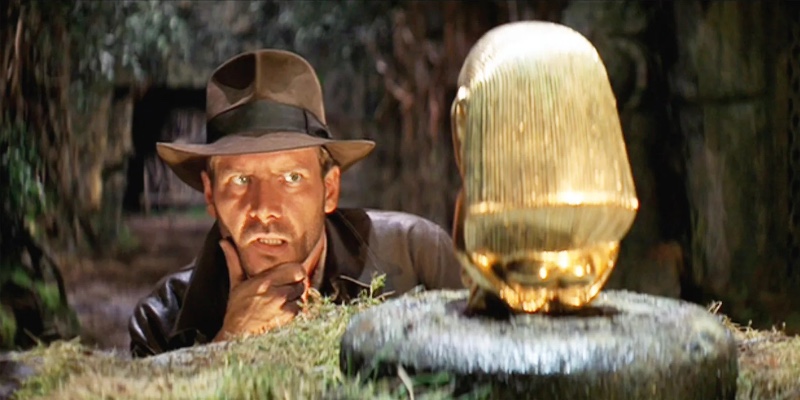
Alfred Hitchcock famously called it the “MacGuffin,” or the thing that drives the story. It’s the treasure to find or the item to seek, and Indiana Jones has always had quests that capture the imagination unlike any other franchise in film history. The Ark of the Covenant, the Holy Grail, the Sankara Stones, lost cities and epic artifacts that promise to unlock the mysteries of the past. Far from being invented treasures dreamt up in a writer’s room, these are real places and objects with deep historical roots that mankind has pursued across centuries.
Indy is not your average archaeologist, toiling away in the field for years, slowly recovering fragments of artifacts that eventually tell a story. He chases the big ones that can change history, and he always finds them, if not always in the way he imagined. The combination of historical legends and high adventure is what separates Indiana Jones from every other action hero.
“Superstitious hocus pocus”
Though steeped in history, Indiana Jones operates in a world of fact, not truth. The supernatural is real, and ancient legends turn out to be as well. The line between archaeology and something much older winds up being thinner than any university faculty would like to admit. It’s a difficult balance, and one that the original trilogy understood perfectly. The occult elements aren’t over the top, and Indy is skeptical enough that when the supernatural occurs, we believe it right along with him.
“X marks the spot”
Of all the elements that appear alongside Indiana Jones, one of the most important is the setting. Dr. Jones travels around the world to exotic locations that most people only dream of visiting, and he does so during a time when the world was still big, and the far corners of the map hadn’t been uncovered yet. The Amazon, Cairo, the Mediterranean, India, Shanghai, Turkey, Syria, Nepal, and of course, Venice. Each location is chosen not just for the visuals, but because reaching these destinations is an adventure of its own.
There is also something crucial about the era itself. The 1930s were a unique moment in history when the great age of exploration was winding down, global conflict was brewing once again, and the world’s antiquities were still moving through informal channels that would make any modern museum curator shudder. The world was still wild, and lost artifacts could still be found. But change was on the horizon, which added a sense of urgency to each of his expeditions.
“Top Men”
Everyone loves an underdog, and Indiana Jones is always outnumbered, outgunned, and under pressure as he races to solve mysteries and beat the bad guys to the punch. The stakes are never simply treasure, they’re Nazi power, enslaved children, and the kind of ideological domination that would rewrite history if left unchecked. The villains of the Indiana Jones films are believers, which makes them exceptionally dangerous. Belloq, Mola Ram, and Walter Donovan all want what Indy wants, but for reasons that would turn those same treasures into weapons.
Helping Indy along the way is a cast of characters that ground the adventure in kinship. Marcus Brody is Indy’s mentor, surrogate father, curator of the museum that buys his legally questionable collection of artifacts, and at times a charmingly useless burden in the field. Sallah is his Egyptian friend and local fixer who is strong, loyal, and inclined to break randomly into song. Short Round is everyone’s favorite adorable sidekick with enough spunk to warrant his own theme song. And then there’s Indiana’s estranged father, Henry Jones Sr., played by the late and incomparable Sean Connery, whose presence adds an entire layer of family therapy to The Last Crusade. Like most great heroes, Indy doesn’t do it alone, and the chemistry with both his allies and enemies is part of the secret recipe that elevates these films above the average adventure.
“You call him Dr. Jones, doll”
While he may be a swashbuckling hero, Henry Jones Jr.’s real superpower is his mind. He is exceptionally intelligent, and the films show us why. He can read a room, solve an ancient puzzle, identify an artifact by touch, and speak a language that he has no business being fluent in. Indy possesses a PhD in archaeology, is a polyglot who is proficient in multiple languages, and retains an inexhaustible knowledge of everything historical, from the precise dimensions of the Ark of the Covenant to the finer points of medieval Grail lore.
The Dr. Jones standing at a lectern in a tweed jacket, surrounded by students hanging on every word, is a version of the character that matters. For him, the whip and the revolver are a last resort. When Indy defeats his enemies, it’s almost always because he understood something they didn’t, be it about history or the artifact they were both chasing. Indiana Jones is a true warrior-scholar, and often the scholar is the more dangerous half.
“As human as the next man”
All of that aside, he’s still just a man. He tries, and he fails. He makes mistakes, gets it wrong, and gets beaten, literally and figuratively. He gets shot, blown up, pummeled, and humiliated by opponents who are often bigger, better armed, or more prepared. He is famously terrified of snakes, lousy with relationships, and usually makes things up as he goes. That’s because he’s only human, just like the rest of us.
What makes him special is that he doesn’t stay down. Indy gets back up and comes at the problem from a different angle. This indomitable spirit is why he succeeds and why we love him. Not because he’s the strongest or the most capable in any room, but because he is relentlessly unwilling to accept that it’s over until it is actually over. He bleeds just like any man, but he never stops.
“Cover your heart”
Much like James Bond, Indiana has his fair share of short lived, high intensity relationships. Marion Ravenwood works as a love interest because she is a woman who grew up in the same world Indy inhabits. Rather than needing Indiana Jones, she endures him, which is considerably more interesting. Willie Scott is a brilliant comedic addition, completely out of her depth, and at least partially aware of it. And Dr. Elsa Schneider is the beautiful cautionary tale about intelligence and ambition gone too far. But in the end, Marion is Indy’s missing piece. When the two of them find each other again decades later in Kingdom of the Crystal Skull, the complicated history between them resolves in a way that feels right.
“The best parts have already been spoken for”
Have the best days of the franchise passed us by? Could anyone else ever wear the fedora? It’s a question that resurfaces every few years, and the honest answer is, probably not.
Harrison Ford didn’t just play Indiana Jones, he built him across four decades of films. Ford brought a roguish wit to the role that made the character feel genuine. Raiders of the Lost Ark is a cinematic masterpiece largely because of what Ford brings to every scene, making that movie, and the franchise, inseparable from the man who carried it.
“He Belongs in a Museum”
Forty-five years is a long time to remain relevant, let alone for a fictional archaeologist. And yet, Indiana Jones has embedded himself into culture in a way that very few characters ever have. He is the archetype of the scholarly adventurer. He has inspired generations of archaeologists, historians, and travelers who grew up watching him and decided that the world was worth exploring. He made ancient history feel exciting and alive, and that’s no small thing. Indiana Jones is immortalized not merely because of what he added to popular culture but because, even decades later, he continues to inspire us to explore and seek the unknown.
***


Alex Dekker
Alex Dekker served as a member of the United States Army Special Forces Green Berets for nearly twenty years, first with 5th Special Forces Group and then as a special operations team member assigned to the United States Army Special Operations Command. He has deployed multiple times to Iraq, Afghanistan, and other locations worldwide, and has attended multiple advanced tactical and technical schools within the US Special Operations community and interagency. Alex has traveled to dozens of countries for work and personal adventures and has spent years living abroad. He is an avid student of history who has participated as a volunteer in numerous archaeological digs, is an Arabic speaker, and holds a master’s in applied Intelligence from Georgetown University. When not traveling, Alex lives in Northern Virginia with his wife Savannah, a former CIA operations officer, their children, and their German Shepherd Donovan.