Phoebe Atwood Taylor and the Search for the Quintessential Cape Cod Mystery
The trailblazing mystery novelist who helped define a region.
So many writers and artists have passed through Cape Cod it was probably inevitable that over time a formidable literature would grow up around the region. Mary McCarthy, Denis Johnson, Richard Russo, Stephen L. Carter, Norman Mailer, Geraldine Brooks: they’ve all made a go of capturing the Cape in fiction. Lately Elin Hilderbrand has made something of a cottage industry (and then some) from her Nantucket books. But when it comes to being the quintessential Cape author, none of them can make a claim to rival Phoebe Atwood Taylor.
In. her time, she was held up as an American answer to Agatha Christie and the other Queens of Crime then thriving in detective fiction’s Golden Age. Her most celebrated creation, Asey Mayo, the so-called “Codfish Sherlock,” appeared in two dozen novels and through all of them left a distinguished, salty impression on a healthy mass of readers. He was the perfect embodiment of a local archetype found in villages across New England: the homespun wise man, the fishing village jack-of-all-trades, capable of navigating high and low society without losing his head or his wry smile. Are there competent hands in other parts of the country? Of course, and some for hire. But none quite like Asey Mayo.
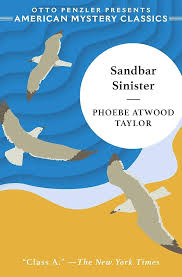
What strikes me more than anything in revisiting the Asey Mayo mysteries is just how definitively and precisely they capture the region – and capture it at a time when it was beginning to shift the cultural imagination, to become the place that would draw so many weekenders, summer people, and visiting artists over the coming decades. In that sense, the novel you’re about to read now, Sandbar Sinister, is perhaps the most timely of all. Here, we’re thrown into a country manor mystery, with all its insights into social upheaval and class divisions, at precisely the moment the modern Cape Cod was being born.
The year, I take it, is 1934. Prohibition has recently ended, and the Depression is fully entrenched, with massive public works projects underway across the nation. Not least of them is the Army Corps of Engineers’ expansion of the Cape Cod Canal, which will eventually see the channel brought to a width of nearly five hundred feet and a depth over thirty, making it one of the great canals of the world and cutting off the Cape from the “mainland” in dramatic fashion. (The canal was sold to the government only six years before, in 1928 – the culmination of events that began in 1918, when a German submarine caught the military’s attention by shelling the village of Orleans.) The new bridges, soaring over the canal, are under construction, close to completion, and the old drawbridges that once spanned the narrow waterways will soon be dismantled. A land rush, of sorts, has come and gone, which the narrator in Sandbar Sinister, Penelope Colton mentions by way of explaining how Caleb Frost came to acquire the enviable property where our cast of characters is busily assembling for a weekend on the beach.
It was, in short, a moment ripe for crime fiction: a sudden and drastic shift in societal winds, a void in law enforcement activity yet to be systematically filled, and an oncoming rush of outsiders flooding a once isolated region. Long the hold of fishermen and seafaring types, Cape Cod had now grown fashionable for smarter sets in Boston, with their rising and falling fortunes, intransigent social strictures, and Brahmin rituals. Adjacent to these rituals, let’s say, was a taste for the arts, and the Cape was one of the more attractive regions in which to pursue the interest: painting schools and theater colonies sprang up in Provincetown, Truro, and in the dunes and countryside surrounding. Quite representative of the time and the craze for popular fiction growing in book-mad Massachusetts, it seems one couldn’t throw a stone on Cape Cod without hitting a writer.
All this comes to play in Sandbar Sinister. The setup for the mystery is an alluring one: a boatload of pre-repeal booze has washed up in the small, picturesque village of East Pochet (an amalgam, I take it, of Wellfleet, where the Taylors kept a home, and Orleans), and the citizenry, locals and summer visitors alike, have come absolutely unhinged under the influence. Bodies appear. Victims are identified and unidentified. Crime writers, aspiring and accomplished, weigh in on the mounting evidence. The suspects are efficiently lined up for our inspection, and Asey Mayo, with all his charm, is on the case.
The mystery unspools with admirable precision in plotting, yet somehow the author never scrimps on the small, atmospheric details that make the place feel so utterly, indelibly real – and so enticing to today’s reader, dreaming of the long-gone times of village life, indulging for a while in the nostalgia that’s always been at the heart of the Cape’s appeal. (I’m hearing now my mother and grandmother on the deck, singing along to Patti Page: “If you’re fond of sand dunes and the salty air, quaint little villages here and there…” Followed somehow by the jingle to Thompson’s Clam Bar: relics of a later, equally nostalgic Cape.)
The Asey Mayo series was just a part of Phoebe Atwood Taylor’s body of work. She was prolific and highly-skilled across the genre. But there’s something special about these Cape mysteries. Her roots in the region run so deep: Wellfleet was the Taylor home, but Phoebe’s family connections spread up and down the coast. She was descended, after all, from John Atwood, the deputy governor of Plymouth Colony circa 1638. That’s about three centuries of roaming the shores and waters of southern Massachusetts–plenty of time to absorb and embellish all the local lore before putting it to good use in the name of mystery.
I’m biased, maybe. I’m a mystery writer, and I want very much to look at my home region (I’m from Wareham, on the wrong side of the “new” canal, but what can you do?) and to see a towering tradition of crime and mystery to stand alongside anything produced in bigger, more renowned cities, or for that matter out of Greenway and other picturesque English villages. In the Asey Mayo novels, in the work of Phoebe Atwood Taylor, we find those essential American mysteries that informed so much of what would come in the century ahead, and which still ring true: engrossing, witty, clever as the day they were written. In the end, Phoebe Taylor Atwood, with all her knowledge of the terrain, all her formidable wit, proves herself the quintessential Cape writer. The rest of us are tourists.
***

Dwyer Murphy
Dwyer Murphy's new book is The House on Buzzards Bay, available June 24, 2025 from Viking Books. He is the author of An Honest Living and The Stolen Coast, both of which were New York Times Editors’ Choice selections. He is the editor in chief of Literary Hub‘s CrimeReads vertical