

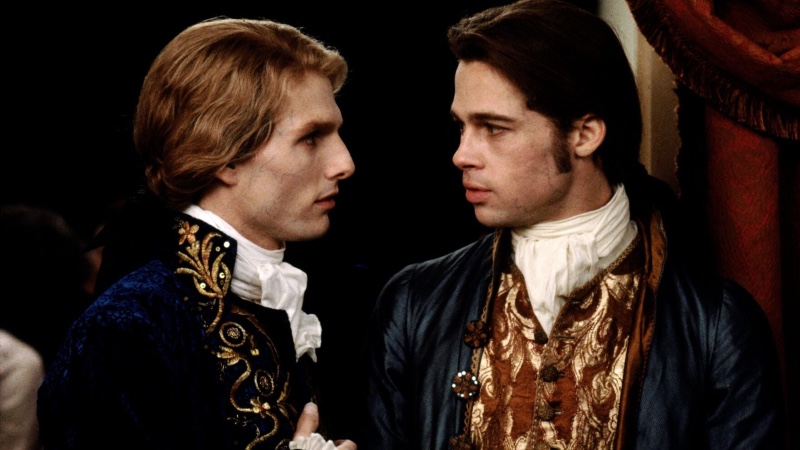
Leigh Bardugo on 50 Years of 'Interview with the Vampire' and the Immortality of Anne Rice's Lestat
How does an author's mythology enter the collective consciousness?
I’m not really interested in wrestling with what defines a classic. It’s the kind of question that fills up think pieces and podcasts with bouts of teeth gnashing and hand-wringing and endless rumination on the Western canon. But let’s agree on two things: the term is used too frequently, often in breathless blurbs (I may have committed this crime myself, so I’ll issue my apologies here), and no one lives long enough to see what truly becomes immortal.
Will Lestat live on as Dracula did? As Hamlet did? Will he enter our cultural canon and drag his creator along with him? I think so, and I’m going to make my case, but I can’t pretend it’s a scientific one. Science demands an experiment that can be reliably repeated, and if I knew the alchemy by which a character, a world, or a mythology lodges in our collective consciousness, I would deploy it myself. All authors hope their work will outlive them, but we understand that’s not a goal with a proper plan of action attached. It doesn’t matter how many books we sell or accolades we acquire. Most mega-bestsellers of eras past are forgotten, and even the award winners that make their way into academic syllabi fade into dusty bibliography. Only a mysterious few transcend this. We can’t quantify what makes a Narnia or a Middle-earth, a Darcy or an Ebenezer Scrooge. J.M. Barrie’s Peter Pan and E. T. A. Hoffmann’s Nutcracker attained a longevity and cultural cachet their other creations never touched. So let’s not pretend there’s a formula to be replicated. The process by which something passes from fiction into legend is mysterious, magical even. We can’t solve for this particular variable, but we can at least try to understand the sorcery Anne Rice worked when she wrote Interview with the Vampire.
In her own interviews, Rice acknowledged this novel as a response to the death of her daughter, Michele, the child she lost to leukemia. Claudia, often understood as the avatar for Michele, is the child vampire Louis had to love, lose, and grieve for Rice to attain any kind of catharsis. She wrote directly into the tradition of folklore, building a new cultural metaphor for the things that frighten and hurt us over the scaffolding of old monsters.
Vampire lore is often traced to anxiety around death and disease. As early as the first century, the Church had to prevent people from desecrating corpses they feared would return from the dead. We can connect the sudden uptick in paranoia around vampires (and the attempt to dig up bodies and chop off their heads or set fire to them) to the spread of rabies and pellagra in the 1700s. Bram Stoker’s Dracula was at least partially inspired by his mother’s gruesome stories of the cholera outbreak she survived in Sligo. As people suffer the effects of disease, the vampire rises to plague our nightmares. It offers an otherworldly explanation for physical malady, but the monster also embodies a shared emotional response.
Rice understood and communicated this response through Louis’s physical transformation and emotional journey. What is the vampire really? Something that died but will not stay dead, that sustains itself by feeding on the living and destroying them in turn. Yes, this is a metaphor for plague, pollution, bodily corruption. But it’s also a metaphor for grief: You’re gone, but I see you still, hear you still, love you still. You’re gone and yet you haunt me. When we grieve, we lose our appetite and our capacity for pleasure. We struggle to enjoy the company of others. The depth of our loss can make us feel unfit for society. We know our pain is unpalatable to others, and so we have no choice but to hide it. Our joy in the world is drained away, along with our ability to feel fully human. We become monsters ourselves, hiding in our caves.
In the past I’ve described grief as a dirty fighter, the foe you think you’ve bested who pops back up with a sucker punch. But the vampire may be a better analogy: a creature who cannot accept death, who lives on and on, sustained by the love and loss we feel and keep feeling. Living with loss means discovering that time does not, in fact, heal all wounds, because time is itself the wound. We continue and we change, while those we lost remain the same, frozen in their final moments, made more perfect by memory. We age, we near death ourselves, the grief arrives less frequently, but it is never truly gone. Grief does not die. But we know we can.
To read Anne Rice is to become both vampire and victim. Her vampires exist in the same mold as Stoker’s Count and his predecessor John William Polidori’s Lord Ruthven. They are seductive, intelligent, often moody, ever philosophical. Louis broods. Lestat destroys and enchants in equal measure. I’ve been told that, when the sequel to Interview with the Vampire finally arrived, some readers were scandalized by the idea that Lestat could become the hero of his own book. But to me it’s very obvious that we are being seduced alongside Louis and the reporter to whom he tells his tale.
If Louis is Rice’s grieving surrogate as she herself claimed, then at novel’s end, we have to accept that the journalist has completely missed the point of his story. And yet, as the author, Rice must also take on Lestat’s role. She seduces us through the sights, sounds, and unforgettably rendered scents of New Orleans, through the erotic tension that imbues every feeding, through the seemingly divine permanence she grants the streets and monuments of Paris, through the eloquently described beauty of every gorgeous, tormented monster we encounter. We understand Lestat and the lure of the offer he makes to those he chooses before we ever inhabit his point of view. We understand the interviewer wants to be chosen as Louis was chosen, no matter the price. Because we fear not only our own vulnerability to death and illness but the possibility that we will have to bear witness to these things in those we love, that we will inevitably be left behind to grapple with grief and loss. The myth of the vampire may present some illusion of control, but Rice’s Lestat makes no promise to spare you that kind of suffering. He only offers that you will endure it for as long as you possibly can. Here’s something I’ve noticed in readers of Interview with the Vampire: no matter when or where we first encounter this novel, we somehow feel we are the first to discover it. We know rationally it is a bestseller. Depending on which edition we hold in our hands, the cover may even shout at us about the many millions of copies it has sold. But in the reading, we forget all that. We are seduced into a secret world that we believe we share only with Rice. It is an intimate experience, one that absorbs and acknowledges the loneliness of the reader, while igniting our desire for the company of these characters. Rice chooses us, just as Lestat chooses those who are privileged or cursed enough to become his companions instead of merely his victims. She invites us into a world more dangerous and glamorous than our own. While we read, while we remain immersed in her words, we brush up against all that is possible in fiction. It hurts to leave that possibility behind with the final page. This book is about Louis; at least that’s what it says on the tin.
But I would argue that the story belongs more powerfully to the seemingly callous Lestat—that is, He Who Brings on the Plot amid all of Louis’s ennui. Rice must have felt similarly because nearly ten years later she would give us the sequel: The Vampire Lestat, bloodthirsty villain recast as equally bloodthirsty antihero. And it is Lestat who has entered our canon of legendary monsters beside Stoker’s Dracula and Mary Shelley’s Victor Frankenstein and his creation.
How does one become a legend? There is a timelessness to The Vampire Chronicles that gives these stories weight—even when Lestat is donning leather pants and preening on a stage. Take a look at the reviews of any new entry into the vampire canon, and you will almost always see comparisons to Interview with the Vampire—and usually, even fifty years on, these new works are deemed to have come up short. Maybe it’s that Rice’s novels are so firmly rooted in history. Maybe it’s her mastery of atmosphere or the way she wrestles with the moral questions posed by immortality in such deeply human ways.
We can’t know. We can only watch Lestat beguile and let ourselves be beguiled in kind. In this seduction, in a text that manages to be both grandiose and intimate, Rice works the mysterious alchemy of creating permanence. Before we even realize it, the transformation takes hold: character becomes legend; author becomes icon. In these pages, Rice offers us a glimpse of the eternal, and with that invitation, in glorious vampiric fashion, she seizes immortality for herself.

Leigh Bardugo
Leigh Bardugo is the #1 New York Times bestselling and USA Today bestselling author of Six of Crows, Crooked Kingdom, and the Shadow and Bone Trilogy. Visit her online at leighbardugo.com and follow her on Twitter at @LBardugo. She is the first author in the DC Icons series, a collection of books in which the DC Comics super hero icons are written by megastar young adult authors. The series also includes Batman: Nightwalker by Marie Lu, Catwoman: Soulstealer by Sarah J. Maas, and Superman: Dawnbreaker by Matt de la Peña.