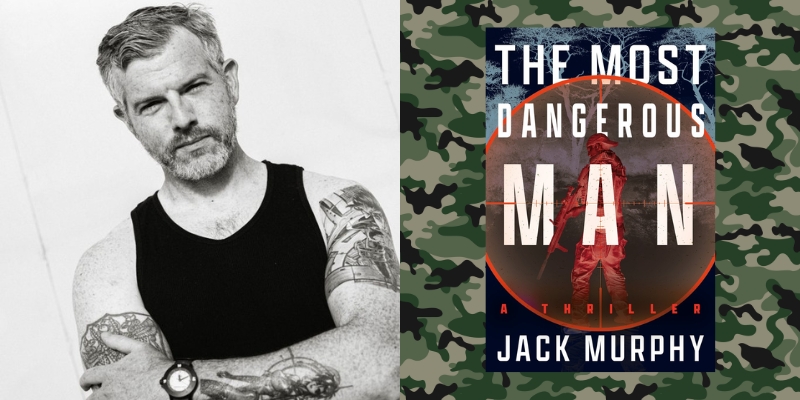
Jack Murphy on Modern Military Thrillers, Tech Moguls, and Sniper Safaris
The author of The Most Dangerous Man in conversation with I.S. Berry
When you’ve served as a Ranger and Green Beret, trained as a sniper, and spent fourteen years as an investigative journalist, you have a full magazine of material from which to craft a novel. And this is precisely what Jack Murphy has done in his latest military thriller, The Most Dangerous Man, a story of an Army Ranger kidnapped in West Africa and hunted for sport by an elite but megalomaniacal cadre of Silicon Valley moguls and European royalty. It’s the first in what Murphy plans to be a series about Jeremy Lopez, an indefatigable, raw, and valorous young soldier from Alabama with a weakness for bedroom-eyed women and a keen sense of justice.
The Most Dangerous Man is a pulpy, breakneck read that harkens back to dime novels and pays homage to classic tropes—the survivalism of Lord of the Flies, the unapologetic violence of the film Hardboiled—above all, to the iconic short story, “The Most Dangerous Game” by Richard Connell, in which a big-game hunter becomes prey for an aristocrat on a deserted island.
But Murphy has modernized Connell’s tale, using his own Special Forces and journalism background to infuse it with granularity of both weaponry and terrain, and to craft villains from contemporary headlines, including a South African veteran of the notorious Koevoet (“Crowbar” in Afrikaans) paramilitary unit, an entrepreneur who builds rockets and lives in his own virtual reality, and a bumbling social-media magnate.
With his firsthand knowledge of survival, escape and evasion, global politics, and guns, Murphy feels uniquely suited to write this story—one that twines wits and bullets, wields social commentary, and brims with tactical knowledge. (Among other things, readers will learn how to catch rainwater with a tee shirt and lower their profile with “light discipline.”)
And in our current world of AI, where readers increasingly crave authenticity (a recent survey found that the vast majority of Americans felt less fulfilled after learning a book was artificially generated), Murphy’s realism feels like both a potent antidote and, perhaps, a rebuke to his villains.
Unsurprisingly, Murphy wrote The Most Dangerous Man in cigar bars and his podcast studio in Brooklyn—from which he broadcasts The Team House, conversations with veterans and former intelligence officers—a room that contains a Claymore mine plushie labeled “Front Toward Friend,” a piece of lapis lazuli from Afghanistan, a kukri from Kathmandu, and an assortment of army gear.
*
I.S. Berry: The Most Dangerous Game inspired your book. What aspects of the story resonated with you, why do you think it’s so timeless, and in what ways did you change the story?
Jack Murphy: It’s a classic century-old short story that I read in high school and that’s inspired countless books and movies. I think the notion of people hunting others for sport puts us into the point of view of an animal that we might hunt for food or sport, and there’s a visceral quality that continues to resonate with people today. To bring the premise into the 21st century, I made the villains a group of tech billionaires and the protagonist a Ranger, a modern-day commando.
ISB: There have been reports of so-called “sniper safaris,” in which Italian citizens paid Serbian soldiers for the opportunity to shoot civilians during the Bosnian civil war. Was this in your mind when you were writing or is truth simply as strange as fiction?
JM: The latter. I actually came across a Sarajevo safari documentary after reading a series of news stories as I was finishing edits on my book. There’s a reference to the Bosnian sniper safaris that made it into my story, but I can’t say they really served as inspiration.
The real inspiration was stories I’d heard from contacts about these activities in Africa. More than a decade ago, a private security contractor told me about a safari guide in West Africa taking clients out to hunt poachers. More recently, someone told me about a European royal family traveling to the same area to hunt poachers, flying in helicopters and shooting the poachers with rifles as if they were hog hunting.
ISB: Other than The Most Dangerous Game, what are your literary inspirations? Your novel has a pulpy, throwback quality—was this intentional?
JM: It’s what I know how to write, probably from having grown up reading “action adventure” (a term coined by author Don Pendleton in the1960s): stories featuring military/paramilitary elements, a heroic protagonist, cute girls, a high body count. The genre has also been labeled “men’s adventure,” though today this term might seem exclusionary, and Pendleton was always happy when women read his books. As a teenager, I probably read hundreds of Pendleton’s Mack Bolan novels, and those short and to-the-point action-adventure novels did the trick. I’m not a big fan of books with uninteresting subplots that detract from the heroes and villains.
ISB: Jeremy Lopez, your protagonist, is a slightly cynical but mostly earnest kid from Alabama. How did you come up with his character? Did you draw from real life? What do you want readers to glean about the military?
JM: He was incredibly easy to write, because I know hundreds of guys like him. Once I realized the main character would be a Ranger, he snapped right into focus. He’s based on the Rangers I served with in Afghanistan and Iraq, my teammates, my squad and platoon leaders, and the young soldiers I was later in charge of. There’s such a disconnect between the public and the military because we don’t have conscription, so Lopez depicts what a soldier is like. For veterans, a military character is familiar and offers representation. I wanted a character who exemplified the best of America—someone who volunteers to serve, who holds himself to, and achieves, a high standard.
ISB: Can you talk about your villains—they leap off the page—and the real-life inspiration behind them? To what degree did you want to use humor in your story? (The villains’ names alone are worth a conversation.)
JM: I think my editor was a bit surprised by the amount of humor in the story, but it never seemed out of place to me because gallows humor is almost a requirement for a soldier. All kinds of ridiculous things happen in war, stuff gets screwed up—the sort of things they don’t show you in the movies—and soldiers have to shrug it off, laugh at it, and continue with the mission.
The villains in this story—Balthazar Botha, Gold Copper Silver, Lucas Ramashandran, among others—were inspired by real-life tech billionaires set on ruining our lives. I began writing the book just as Elon’s DOGE boys were dismantling the government, and knew that by the time my novel came out, the public would be truly sick of these people. Recent public statements from Alex Karp and Sam Altman confirm my view that people like this cannot be allowed to chart humanity’s path into the future.
ISB: Why did you choose West Africa as a setting? Did you serve there, and what did you take away?
JM: I did some work there over a decade ago in the private sector, testing open-source intelligence methods, which was an adventure in itself, but I set the book in the tri-border area of Niger, Burkina Faso, and Benin because it’s a terrorist hotspot and the woodland terrain suited the plot I wanted to write. Interestingly, as I was writing, I got a call from a retired Special Forces officer who was recruiting former Special Ops guys to train local Rangers in Benin.
ISB: The tactical aspects of your book—escape and evasion, weapons, terrain, survival—come across as incredibly realistic (and useful). How important was it to get details right, and did you fictionalize any tactics or tradecraft? (In my spy novel, one of the characters uses invisible ink, but case officers never used that in real life; it was purely literary license.) Did you have to do any research?
JM: Research for this book was pretty light. I searched the internet about terrorist activity in Northern Benin, and hit my reference manuals for weapons once or twice, but I spent more time researching the philosophical underpinnings of the story as espoused by the villains. This research brought me to Nick Land’s Xenosystems, essays about the future, artificial intelligence, numerology, and patterns.
A few details are lightly fictionalized in my book, but ninety-nine percent are accurate and true to life. As far as researching weapons and tactics, I’ve come to realize that if I’m diving too deep into the research on something, I’m probably losing the audience. So, while I try to show authentic tactics and procedures, I make sure to keep the pace moving.
ISB: At one point in your story, Jeremy Lopez encounters a SEAL who took a different path and ended up behind the wrong lines. What message were you trying to send, and how susceptible do you think people are to malign influences?
JM: I think in the world of private security and intelligence contracting, things become murky fast. Employers lie more often than they tell the truth. Many times, contractors don’t even know who they are really working for. Living the life of a spy or a special operator requires breaking some of society’s rules. Some lose sight of their moral baseline entirely as they become desensitized over time. So how susceptible are people to malign influences? It’s easy to give in to the dark side. Retaining your core personality is the difficult part.
ISB: How do you think military thrillers have evolved over the years, and what are some titles in the genre you feel embody the modern world well? What makes a military thriller “modern?” What elements are classic and essential?
JM: That’s an interesting question. The world is changing so rapidly now that I’m not sure the “modern” military thriller has been written yet. There’s speculative fiction and science fiction, but the speed of modernity is quickly outpacing the fictional aspects of these stories, leaving them feeling a bit dated. There are elements people expect to see, understandably—the guns and gear, the technology. I think what’s hard to model is the complexity present in modern geopolitics or in specific military operations.
The classic and essential element of military thrillers, however, is the human. The soldier is the weapon; guns and bombs are merely tools.
I’m a fan of Mark Greaney. And Robert E. Howard, who wrote Conan the Barbarian, is the high-water mark. All military-thriller writers are trying to live up to his standard.
ISB: Your story touches on technology and some of the stranger conspiracy theories floating in our zeitgeist—mostly in the form of the villains. What inspired you to write about these, and how did you strike a balance in the plot between action and exposition?
JM: The inspiration was literal. There are real-world figures who believe in the occult and AI conspiracies, and have obscure and anti-human views. I simply researched some of their source material. Nick Land’s work, as mentioned, was an inspiration for me in crafting the villains’ philosophies. Writing a fast plot that balanced the philosophical portions was fun.
And I enjoyed writing a story that takes place in the wilderness. When characters are pulled out of society and into the wilderness, it strips them down and shows who they really are. There are no gadgets. No one is coming to help. My book is devoid of much of the high technology and political intrigue often found in the genre, so I focused instead on making the hero and villains as colorful and interesting as possible.
ISB: You envision The Most Dangerous Man as the first in a series. How do you foresee Jeremy Lopez’s arc and what’s on the horizon?
JM: If the publishing gods smile down, the path is fairly straightforward in my mind. Jeremy Lopez will continue to get promoted through the military system, finding new jobs and challenges along the way, eventually becoming a team leader. Maybe I can get into spookier topics, like special access programs inside Special Operations. Recently, I wrote an article on Non-Official Cover operators working for Joint Special Operations Command that might serve as inspiration.
When characters are pulled out of society and into the wilderness, it strips them down and shows who they really are.
ISB: What message do you want readers to take from your book?
JM: When I started writing, I had to figure out what I wanted this book to say, what I wanted the protagonist to say. Don Pendleton said that he wrote Mack Bolan in part to re-dignify the soldier after the Vietnam War.
I don’t think our War on Terror veterans need me to do that, but I was struck by how our morality shifted after 9/11. From Jack Bauer in 24, and even Batman, one can see how we’ve sunk into a post-9/11 cauldron of believing that we need to descend to the moral level of our enemies in order to defeat them. I’ve grappled with that my entire life.
But what do people need right now? I realized we are in a moment where people need a truly heroic character who can inspire them and remind them of who and what we can be as Americans.
***

I. S. Berry
I.S. Berry spent six years as an operations officer for the CIA, serving in wartime Baghdad and elsewhere. She has lived and worked throughout Europe and the Middle East, including two years in Bahrain during the Arab Spring. She is a graduate of the University of Virginia School of Law and Haverford College. Raised in the suburbs of Washington, DC, she lives in Virginia with her husband and son.