When is a Sports Mystery Not a Sports Mystery? When It's Greek Tragedy.
Andrew Welsh-Huggins on getting the world of athletics right
Over the past several years, I’ve had similar conversations about my Shamus Award-nominated Andy Hayes private eye series at numerous book festivals. I expect to have more of the same with my newest release, Rescue Me (Swallow Press). The back-and-forth typically goes something like this.
Me: “Hey there. So, this is the latest in my Columbus-based private eye series—my character is a former Ohio State and Cleveland Browns quarterback turned investigator.”
Festival attendee (often, but not always, a woman): “An Ohio State quarterback? Wow—my [insert male relation: husband, brother, son, etc.] would love this!”
What I should say at this point is, “Oh, definitely. Especially if they’re into a character who, while he once was a gridiron hero, now has deeply unsettled feelings about the corrosive effect of fanatical devotion to a college team, plus regrets about the toxic male behavior that he exhibited as a player, which was nurtured by the macho environment he was surrounded by. If they appreciate that character’s bildungsroman from a largely unaware sexist brute to a man trying to redeem himself as a father and romantic partner, then, yes, they’re going to love this series.”
Of course, what I actually say is, “Would you like me to sign this book for them?”
I first conceived of my ex-football star character when I challenged myself to develop a private eye series set in my adopted city of Columbus. I’d long been a fan of the genre, starting with Robert B. Parker’s Spenser and Sue Grafton’s Kinsey Millhone, looking backward to the greats like Dashiell Hammett’s Sam Spade, Raymond Chandler’s Philip Marlowe, and Ross Macdonald’s Lew Archer, then looking ahead to everyone from Sara Paretsky’s V.I. Warshawski to Loren Estleman’s Amos Walker.
When it came time to craft the baggage my character would drag around—all private eyes must walk those mean streets with a dark cloud over their head, right?—I considered and dismissed the usual tropes, including bitter ex-cop, psychologically battered former-soldier, shakily recovering alcoholic, etc., etc. In the end, I was inspired by an event on Saturday, Nov. 7, 1998, when I had lived in Columbus for all of three weeks after relocating to take a job with The Associated Press.
That was the day—it’s okay if you don’t know this; the entire city of Columbus has you covered—that the undefeated Ohio State football team lost to Michigan State in an upset.
At the time, I distinctly recall thinking something like, “Well, that’s too bad. Win some, lose some. I mean, they’re still 9-1, right?”
Wrong. The next day, it was as if the city was draped in black bunting and the streets were filled with the lamentations of mourners beating their chests and weeping to the heavens. Defeat—even a single loss—is not easily accepted by Buckeye Nation, as I soon learned.
Instead of penning a sports series, I’ve chosen to write about Hayes through the lens not of athletics but, as it turns out, Greek tragedy.
Fast-forward fifteen years or so, and I realized the baggage for my private eye had been in front of me the whole time. I mapped out a backstory that envisioned Hayes as Ohio State’s star quarterback, leading the team on the road to the national championship. Then, the week before the storied Michigan game, Hayes is arrested for point shaving and spends game day in a prison cell instead of on the field. He quickly goes from the most beloved to the most reviled sports figure in Ohio, a reputation he never completely sheds.
At the time, I patted myself on the back for crafting such an original storyline. As a newbie crime novelist, what I didn’t realize was that so many fictional private eyes have been either college or professional football players that they should form their own union. The list is far too long to enumerate here, but includes everyone from William Campbell Gault’s Brock (The Rock) Callahan, a former pro with the Los Angeles Rams turned upscale private investigator in L.A.; Ace Atkins’ Nick Travers, an ex-New Orleans Saint turned part-time detective and full-time Tulane University blues historian; and Paul Levine’s Jake Lassiter, an ex-Miami Dolphins linebacker turned lawyer.
Heck, Andy Hayes wasn’t even the first Ohio State football star turned investigator. That honor goes to Amos Decker, the cop turned FBI consultant, from David Baldacci’s “Memory Man” series. Meanwhile, Keanu Reeves played Johnny Utah, an ex-Ohio State quarterback turned FBI agent in the 1991 thriller Point Break, and then played another ex-Ohio State player, Shane Falco, in the 2000 comedy The Replacements.
You get my point. My original concept turned out to be tried and true. However, this is where the mystery deepens, so to speak.
Readers often say things to me like, “As a huge Ohio State fan, you must…”
Correction. I am not—confession time—an Ohio State fan.
Before you bring out the tar and feathers, however, let me further say that I am not not an Ohio State fan.
In reality, I am a UN observer on the topic of Ohio State football specifically and college football generally. Instead of penning a sports series, I’ve chosen to write about Hayes through the lens not of athletics but, as it turns out, Greek tragedy. As a college Classics major, I spent a lot of time on Homer’s Odyssey. Hayes, I decided, is a modern-day Odysseus—wily, arrogant, testing the patience of the gods, and always trying to get home in the form of a stable personal life. This is one of the reasons I’ve quoted a passage from the Odyssey as the epigraph for each of the nine Andy Hayes books to date.
Rescue Me finds Hayes close to reaching his personal Ithaca. He finally has a solid relationship with his two teenage sons, each by a different ex-wife, and with his grown daughter, a Columbus cop, whose existence he only learned of recently. He’s contentedly single. Life is good. Naturally, I toss a firecracker his way.
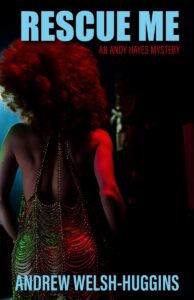
In Rescue Me, Hayes is stretched personally and professionally after he’s hired to protect a young Black drag performer being threatened over a drag story hour appearance, during an investigation that uncovers a deadly and far-reaching conspiracy.
Are there sports references? Plenty. Is it a sports mystery? Hardly. Will it appeal to readers of all stripes who enjoy an engaging private eye novel?
Touchdown, I hope.
***

Andrew Welsh-Huggins
Andrew Welsh-Huggins writes from Columbus, Ohio, where he is the author of the Barry Award-nominated Mercury Carter thriller series, the Shamus Award–nominated Andy Hayes private eye series, and the stand-alone crime novel The End of the Road. Andrew also edited the anthology Columbus Noir, and his mystery and sci-fi short stories have appeared in multiple magazines and anthologies, including The Best Mystery Stories of the Year 2021, 2024, and 2025, and The Best Private Eye Stories of the Year 2025. His nonfiction title, No Winners Here Tonight, is the definitive history of the death penalty in Ohio. His latest novel, Rescue Me, is now available.