
Jane Harper on Australian Crime Fiction, Settings, and Crafting Slow-Burn Suspense
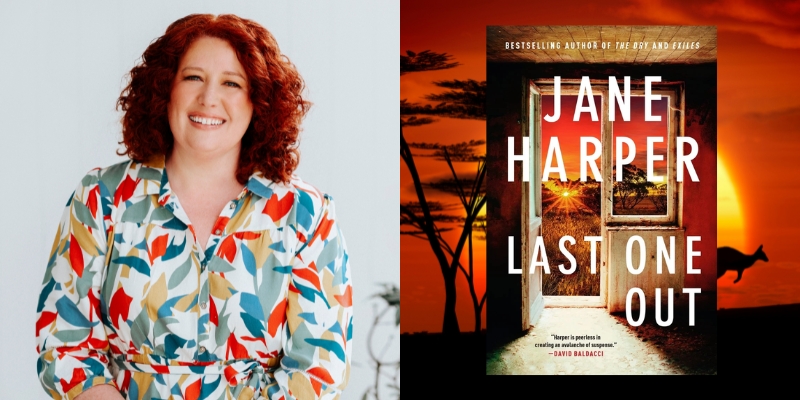
The author of Last One Out in conversation with John B. Valeri
The landscape of crime fiction is as vast and voluminous as the Australian terrain—and both have proved fertile territory for the queen of “outback noir,” Jane Harper.
A dual citizen of the U.K. and Australia, Harper was born in Manchester but moved to “the Land Down Under” with her family at the age of eight. They returned to England when she was a teen, where she finished her schooling and began her career as a reporter. Harper once again relocated to Australia in 2008 (and currently makes her home in Melbourne with her husband and children), continuing her work as a journalist.
In 2012, she submitted a short story to the Big Issue, which was one of twelve chosen for publication in their annual Fiction Edition and served as a catalyst for her transition to novelist. Harper’s debut, The Dry (2016), was an international smash, earning accolades and awards across the globe. Her books have since sold more than 3.5 million copies worldwide, and three of her works have been adapted for the screen.
Harper’s sixth standalone novel, Last One Out (Flatiron Books; March 14, 2026), was an immediate #1 bestseller in Australia upon its release. The book introduces grieving mother Ro Crowley, who is desperate to learn what became of her son, Sam, who went missing on his twenty-first birthday. Five years have now passed, and Ro—who left the dying town of Carralon Ridge behind under the weight of her grief and uncertainty—returns to attend the annual memorial held in his honor.
While this homecoming provides an opportunity for her to continue looking into the circumstances surrounding Sam’s disappearance, it also necessitates a reunion with her estranged husband, Griff, who can’t seem to reconcile the idyllic vista of his youth with the modern-day ghost town it has become.
Told in Harper’s signature style of slow-burn suspense, Last One Out isn’t simply the story of a missing person (or a failing marriage) but an examination of a community under the threat of extinction. Carralon Ridge has become a shell of its former self since a coal mine began operating on its outskirts, its dwindling townsfolk faced with the choice of moving on or being left behind—until there’s nothing left behind.
As long-buried secrets and suspicions begin to surface, Ro and Griff are forced to confront the shattering truth about Sam’s disappearance. But with this knowledge set them free or will they be forever prisoner to the past?
Now, Jane Harper discusses her unique brand of contemplative crime fiction, which finds its place in the aftermath of tragedy.
*
John B. Valeri: Last One Out opens five years after Sam Crowley disappeared on his twenty-first birthday. In what ways has the resultant grief of his inexplicable loss affected your core characters (Ro, Griff, Della) differently despite the commonality of the loss?
Jane Harper: The idea that people respond very differently to the same traumatic event is always interesting to me. The novel centers around Sam’s mother, Ro, who is struggling to find peace after her son’s disappearance leaves her with unanswerable questions. Her husband, Griff, and daughter, Della, are equally touched by the tragedy but the different ways in which they approach their grief sees their family crumble, only adding to their misery.
All their responses are equally valid, and as an author I like to invite the reader to consider what their own reaction would be and which character they feel closest to in that sense.
JBV: As a wife and mother yourself, what was it like to have to imagine a family ripped apart by the loss of a child and the breakdown of a marriage—and how did you fortify yourself against the heaviness of that? Additionally, what responsibility do you feel to readers who may have experienced similar grief in terms of capturing the truth of trauma?
JH: Last One Out did pack quite an emotional punch when I was writing it! Writing always does, I find, not least because a big part of the writing process is putting yourself in someone else’s shoes and trying to imagine exactly what they’d be thinking and feeling when faced with something difficult.
Attempting to capture emotion authentically is crucial because it helps the reader connect with the characters, but ultimately novels are a form of entertainment. They don’t carry the same weight of responsibility as a true crime book or a documentary, they are about storytelling and creating a world that readers hopefully enjoy visiting.
JBV: The story plays out against the backdrop of Carralon Ridge (Australia)—a modern-day ghost town haunted by the spectre(s) of its own history. Tell us about how past informs present here. In what ways does this create intergenerational fissures among family and friend groups who are torn between lifestyle and livelihood?
JH: I do love an isolated setting in my books, and the skeletal town in Last One Out was a great one to explore. When we join the story, the community has become a shadow of its former self since a large industrial mining operation opened on its outskirts. The town was once beautiful and beloved, but almost everything that people valued has now disappeared, and the fractures that creates between those who think it’s worth fighting for and those who have decided it’s simply a lost cause run deep.
Emotions around a sense of home and familiarity are always strong ones, especially when people don’t see eye to eye.
JBV: Sam remains a strong presence throughout the narrative despite going missing in the prologue. What strategies did you employ to achieve this sustained characterization—and why is it important that readers see him both as he was and as he is remembered?
JH: The mystery at the heart of Last One Out is Sam’s disappearance, but the book is really about his mother, Ro. It’s through her eyes that we see and feel the devastating impact of the unexplained loss of her son, and it’s through her memories and actions that we grow to know Sam and what he meant to the people who loved him. We care about Sam primarily because Ro cares about Sam, and she shows that in everything she does.
JBV: You write slow-burn suspense in which people and place drive plot. What appeals to you about character/community-forward storytelling—and how do you endeavor to balance emotion and atmosphere with action so that the little sparks ignite a fire?
JH: I absolutely love the fact that the crime and mystery genre is so broad, ranging from really fast-paced action novels through to much more contemplative works. The place that really interests me is the aftermath of a tragedy, and that strange time when the frantic immediacy has past and dust has settled. There are still questions lingering and those impacted are trying to work out what life looks like for them now, so it’s a great opportunity to bring out emotions and connections between the characters and allow the mystery to unspool at its own pace.
JBV: Several of your books have been adapted for the screen. What is it like to see your stories come alive in a different medium? Is it difficult to relinquish creative control to others or are you able to separate your own work from their interpretation of it?
JH: I’ve loved the adaptations of my books. The Dry and Force of Nature were made into excellent feature films starring Eric Bana, and The Survivors was adapted into a Netflix series and I’ve enjoyed seeing them all come together from afar! I tend to take a very hands-off approach because ultimately they are someone else’s creative projects.
My only real hope for any adaptation is that my readers will enjoy it, and I’ve been lucky that that has been the case each time.
JBV: You have a background in journalism. What elements of that discipline did you find most transferable to fiction? Least? And what satisfaction comes from telling stories that are completely of your own devising?
JH: My journalism background was such a gift when it came to writing fiction, and to this day I still use so many of the skills I learned. It taught me to write to a deadline, how to express myself clearly on paper, how to tackle a blank page, but also how to listen to what people say and think about how best to tell a story in a way that will draw people in.
I really enjoyed being a journalist, but nothing compares with the fun of being able to create my own stories and see them develop and grow.
JBV: Before breaking through with The Dry, you wrote a short story that was selected for inclusion in a prestigious Australian magazine. Tell us about how that experience served as a catalyst to pursuing longform fiction. What advice would you offer to those who may feel the call of creativity but have yet to find the confidence to answer?
JH: Writing a whole novel is a huge undertaking, and it can feel incredibly overwhelming. Focusing on practical things can help, such as figuring out if you work best to deadlines, or need a regular writing time, or do your best writing in a quiet space without pressure.
But it’s also very important to remember that every author you admire was once a beginner, trying to find their style and coping with uncertainty and rejection. It can be very challenging but it can also be so rewarding, and there will always space in the world for more good books.
*


John B. Valeri
John B. Valeri is a book reviewer, author, and host of the web series “Central Booking.” He has contributed to The Big Thrill, CrimeReads, Crimespree Magazine, Criminal Element, Mystery Scene Magazine, The New York Journal of Books, The Strand Magazine, and Suspense Magazine. Visit him online and watch past episodes of “Central Booking” at JohnBValeri.com.