
Jim Ruland on writing a campus heist novel inspired by Bad Bunny and 'Bullet Train'
The author of Mightier Than the Sword directs a fictional scholastic crime spree
I should have suspected my wife was up to something.
When we go to the movies together, usually one of us has to compromise. I like horror movies and action flicks; Nuvia prefers comedies and animated features. She works long hours and travels a lot. She doesn’t want to spend her down time watching something that’s going to stress her out or make her anxious. Nuvia wants to be entertained.
So in the fall of 2022 when she suggested we go see Bullet Train, I was puzzled.
Bullet Train, directed by David Leitch, is a comedy action movie about five assassins who are all passengers on a high speed train in Japan. One of the assassins is played by Brad Pitt. Another has beef with the yakuza. The trailer promised a gory mess with nonstop action. I bought the tickets faster than you can say “arterial blood spray.”
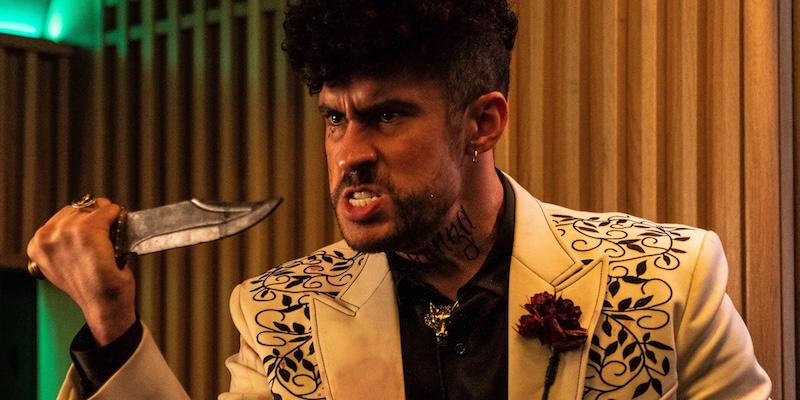
I didn’t stop and wonder why Nuvia wanted to see a Brad Pitt shoot-em-up, but I got my answer when Benito A. Martínez Ocasio appeared on the screen as a Mexican assassin known as “The Wolf.”
I didn’t know Benito was the birth name of Puerto Rican superstar Bad Bunny, but I knew what he looked like, and as soon as The Wolf was introduced I knew why she’d picked this movie. I looked over at Nuvia as if to say, “Really?” and she hid her smile behind a fistful of popcorn.
I didn’t mind being tricked by my reggaeton-loving spouse because I loved everything about Bullet Train. I loved the conceit, which is preposterous, and the over-the-top action, which is first rate—Leitch has a background as a stuntman and stunt coordinator.
But what Bullet Train lacks in realism it makes up for in lore. Sins of the father visited upon the son. The daughter searching for payback upon her cruel father. The son who has disgraced his family’s honor. Brothers who can’t stand each other but will take a bullet so the other might live. And we haven’t even gotten to the yakuza gang known as the White Death decked out in dark suits and frightening masks.
One of the reasons why Bullet Train is so rich in lore is because it was adapted from a 2010 novel by the award-winning Japanese writer Kōtarō Isaka, who also writes short stories and manga. Bullet Train’s plot isn’t complicated, but it’s complex. It’s packed with information. Sorting through all the assassins’ shifting allegiances and loyalties distracts the viewer from how implausible it all is, which makes it so much more satisfying than the one-note, revenge-obsessed thrillers that Hollywood is so obsessed with.
Bullet Train made me yearn for the nineties when it seemed like there was a crafty new crime thriller in the theaters every week, and John Woo, Quentin Tarantino, Robert Rodriguez, and Guy Ritchie were showing us things we’d never seen on the big screen.
I loved Bullet Train so much I went back to the theater to see it a second time. Now that I had a handle on the plot, I was able to appreciate how each assassin represented an archetype and brought their own perspective to the story. Walking out of the theater, I wondered why crime stories like that rarely get made anymore. So I decided to write my own.
*
In 1993 I moved to Flagstaff, Arizona, to pursue a graduate degree in English. The university waived the tuition and paid a modest stipend to candidates willing to teach composition to incoming freshman. I signed the contract and was crammed into an office with three other part-time English instructors.
One of those instructors was an Arizona native named James who took delight in my obsession with old paperback crime novels. James was a study in contradictions. He was a poet who set the bench press record at his high school gym. In his spare time he made his own ammunition.
On more than one occasion he approached me while we were alone in the office. “Hey, Ruland. Let’s go rob a bank. Who would suspect us? We’re English teachers!”
James was enamored with our status as part-time professors. I suppose we all were. Even though we were paid a pittance and exploited for our intellectual labor, we weren’t that far removed from working shitty, part-time jobs at bars, bookstores, and record shops. You could still do that in the late eighties and early nineties and earn just enough to pay for your rent—as long as you didn’t expect anyone to take you seriously.
Now the script was flipped: our roles as adjunct professors at a university conferred dignity and respect, and required that we take the job seriously. Some of us were better at that than others. Our students referred to us as “Mister” and “Missus,” which was hilarious and strange because we lived check-to-check in shitty apartments and when we went out at night it was for happy hour specials in awful bars our students shunned.
We didn’t know that cosplaying college professors without the benefits, compensation, and status that tenured faculty enjoy was the dirtiest job of them all, but we would soon find out.
*
I never did take my colleague up on his offer to rob a bank, but the idea of a group of English teachers who plot a heist and embark on a crime sprees rattled around my imagination for thirty years. Bullet Train showed me a way in to the story. Instead of five assassins, I had four adjunct English teachers. Instead of a claustrophobic high-speed train, I had an insular college town. Instead of the yakuza I had university administrators who have perfected the art of death by bureaucracy.
I turned these English teachers into archetypes and set the ambitions of The Poet, The Punk, The Gambler, and The Storyteller against corrupt university boosters, local leg breakers, and fraternity drug dealers who conspire to defeat their outlaw ambitions.
As for weaving lore into the story, that was the most enjoyable part of the project. Hovering over our heroes is the legacy of a cult writer of paperback westerns, and a mysterious golden pen that passes in and out of the hands of all the major and minor characters like a MacGuffin in a Hitchcock movie.
Naturally, I set the novel at a mid-size university that resembled the school I attended in Flagstaff, Arizona in 1993. Flagstaff is a place that many people pass through but few people really know. Of course, by 1993 Arizona was no longer the Wild West of yore, but it was a lot wilder back then than it is now.
I’m glad I waited as long as I did to write this story because now I understand the desire to rob and steal, at least for my crew of overeducated English teachers, is rooted in class. These aren’t hardened criminals like the yakuza who make up the White Death in Bullet Train, but people driven by desperation because they are being exploited by a system that doesn’t value them. The university could pay them a living a wage, but chooses not to. Who are the real criminals here?
Less than six months after I saw Bullet Train (and unofficially joined the Bad Bunny fan club), I had a draft of a new crime novel sitting on my desk. It starts as a campus novel and ends in territory mapped out by the four apostles of neo-noir: Ritchie, Rodriguez, Tarantino and Woo.
I have remained lifelong friends with my former colleagues from Flagstaff. There’s not a week that goes by where I don’t communicate with someone from those bad old days, and most of them have read Mightier Than the Sword and offered me their input. They encouraged me not to play it safe, and I honored those requests.
While The Punk, The Gambler, and The Storyteller are all composites, The Poet is pretty clearly based on my old friend and colleague James. After teaching composition and poetry for a few years he bought a dingy old pool hall and turned it into a beloved institution in downtown Flagstaff where a story, poem, or song is always welcome.
I can’t think of a better use of a poetry degree. It’s also a great place to plot a crime spree—a fictional crime spree, of course.
And Benito, if you’re reading this, I’ve got just the part for you….
***

Jim Ruland
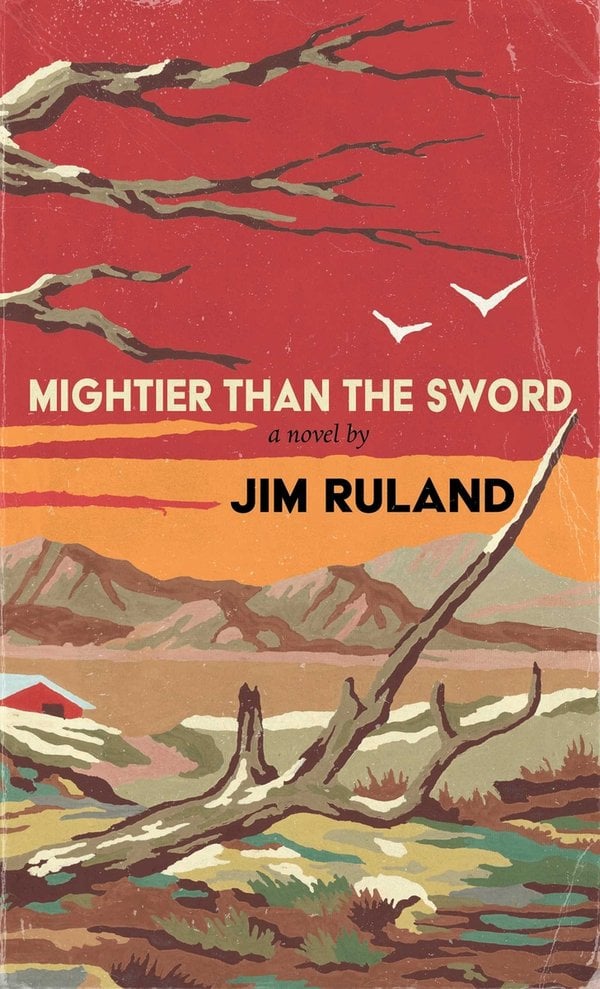
Jim Ruland is an old punk who lives by the sea. He is a bestselling chronicler of punk rock, writes the weekly Substack Message from the Underworld, and is a veteran of the U.S. Navy. His new novel, Mightier than the Sword, will be published by Rare Bird on October 27, 2026.