Jonathan Santlofer: Why the Art World is Tailor-made for Crime Fiction
The painter and author of 'Ten Perfect guests' explains the intersection of art and crime.
Why? Because art is expensive. Think about it, paintings and sculptures are unique objects made by one artist over a lifetime, limited in supply, ergo valuable. Example: Leonardo da Vinci made only 15 or 16 paintings in his entire lifetime. Not a lot to keep up with supply and demand. When, in 2005, a painting of Jesus Christ, Salvator Mundi, appeared at a small auction house in New Orleans a couple of savvy art dealers thinking it was possibly school of Leonardo (made by one of Leonardo’s students) bought it. They paid $1,175. When they had the painting cleaned and restored it was recognized as an actual Leonardo (though some experts continue to debate its authenticity) and sold at Christie’s for a record-breaking $450 million! Now who wouldn’t kill for that kind of return?
According to INTERPOL, art crime is the highest grossing criminal trade globally behind drugs, arms and human trafficking.
The famed 1990 heist at Boston’s Isabella Stewart Gardner Museum—thirteen artworks, including Rembrandt’s only seascape, roughly cut from their frames—has inspired books, movies and a Netflix series. To this day, the art has never been recovered. The job is widely believed to be a ‘commissioned theft.’ That is, someone paid thieves to steal the art to be bartered or held as collateral for a criminal venture.
For years, art has been used as barter for drugs and arms. Suppose you want to start a business selling heroin or Uzis but don’t have the cash. Get a bank loan? Unlikely. Better, hire a thief to steal a work of art, name brands are best, Rembrandt, Van Gogh, Warhol or trinkets belonging to a celebrity—Christie’s auction of actress Elizabeth Taylor’s jewels still ranks about as high as jewelry auctions go.
Where to snatch the art? A small local museum with poor security is always good. But apparently so is the Louvre, one of the biggest and grandest museums in the world. Just a year ago, thieves staged a daylight break-in making off with a stash of eight priceless Napoleonic crown jewels valued at over $100 million. (I swear I bought those antique earrings for my fiancé at a local Kay Jewelers).
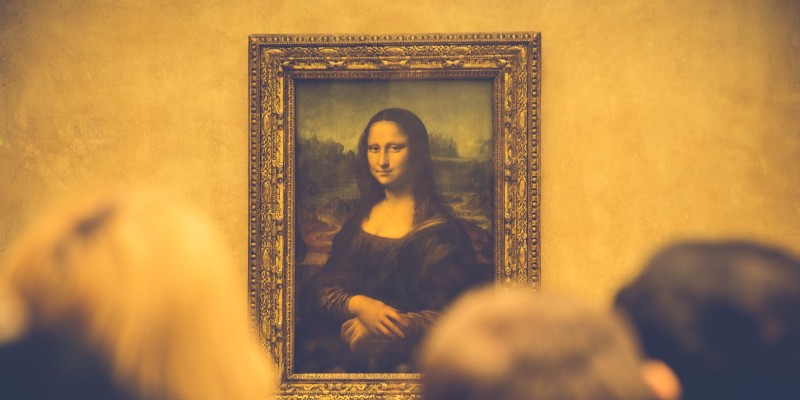
This was not the first time the Louvre was hit. In 1911, a disgruntled Louvre employee, Vincenzo Perugia, stole the Mona Lisa right off the wall, hid it for 2 years, and might have gotten away with it had he not tried to sell it to the Italian government. But hey, I got a novel out of it, The Last Mona Lisa, so thank you, Vincenzo!
Once you have the stolen art, then what? Hand it over to the money lender as collateral, he gives you cash, and voila, you’re in business. When you turn a profit, you pay back the loan and the artwork is returned. If you’re industrious, trade it to another nefarious character. And so on, the stolen art continues to move around the globe from creep to creep to creep.
Or maybe, once you have the stolen artwork in your possession, you think: Perhaps I can get more money than the collector who hired me to steal it is willing to pay. So, you hold a dark web auction, everyone bidding in untraceable bitcoins of course.
I spent the first half of my professional life as a painter deeply entrenched in New York’s contemporary art world, so when I write a novel that uses art, art theft, or art forgery, I pretty much know what I’m talking about. For years, I have been making exact replicas of famous paintings and drawings for wealthy collectors. Not as lucrative as making illegal ones but I prefer to stay out of prison. I have no idea if my clients try to pass my fakes off as the real thing though I warn them that the art has been made with modern paints and solvents which will show up under a blue light and more sophisticated means of detecting forgeries.
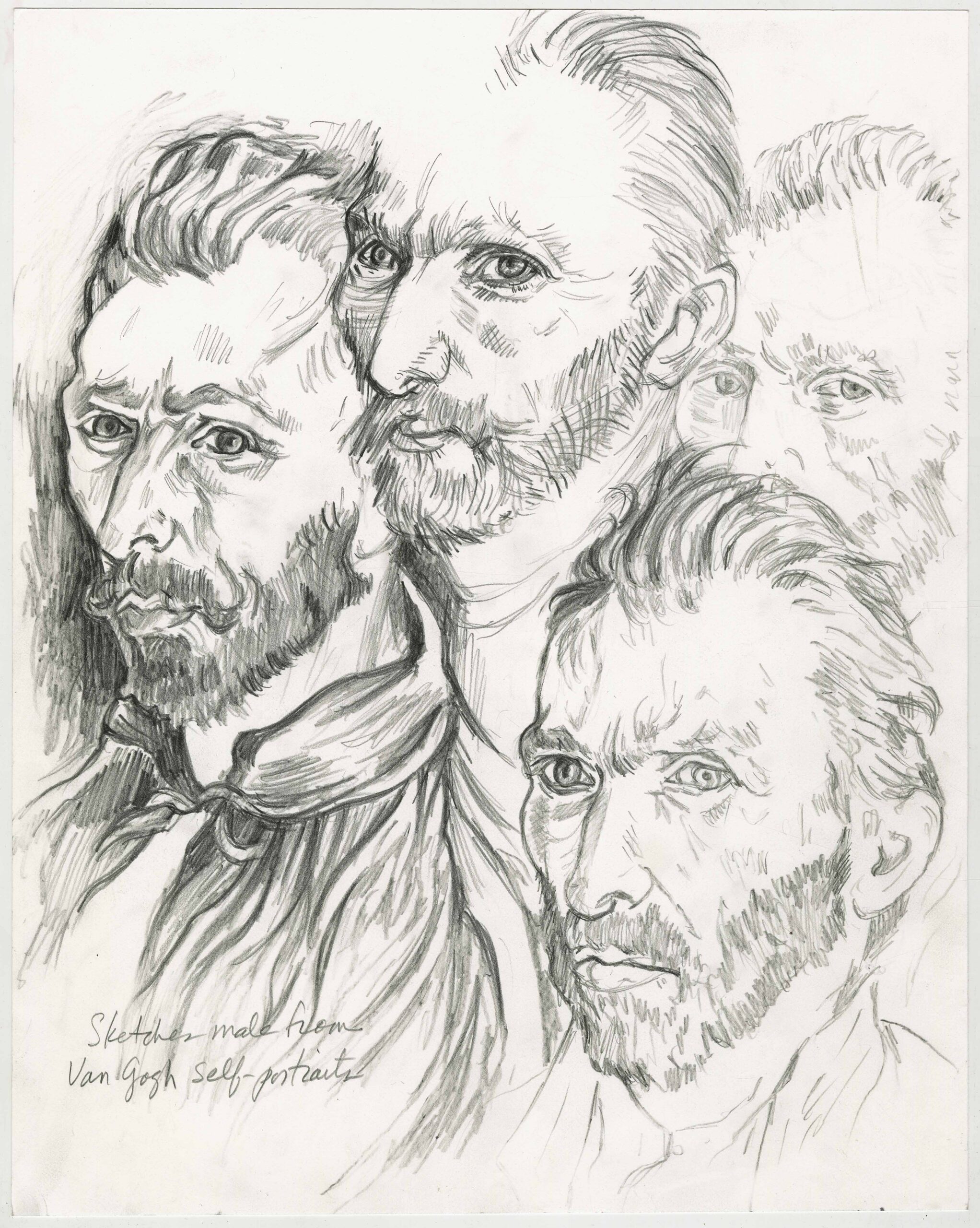 courtesy of the author
I made the above drawing recreating a page of original Van Gogh self-portrait sketches as closely as possible, imitating the artist’s hand, every pencil stroke and mark and smudge. I did this to gain a closer understanding of how the artist made his drawings, not to sell as the real thing. If I were a professional art forger, I would have used paper dating from Van Gogh’s time and made sure I did not accidentally leave a fingerprint behind (which I probably did).
My two recent novels were historical art thrillers. The Last Mona Lisa used the real life 1911 theft of the Mona Lisa and suggests that the painting later returned to the Louvre Museum just might be a fake (something the Louvre protests loudly). I loved mixing fact and fiction, the past and the present so much I did it again in The Lost Van Gogh. This time the search was for Vincent Van Gogh’s last self-portrait, stolen by the Nazis, lost for more than 60 years, and worth mega-millions.
For my latest novel Ten Perfect Guests I used my knowledge of art and the art world to create ten characters invited to a destination memorial for a famous artist with one caveat: show up or forfeit your inheritance. The bait: money. The motive: greed. I used several whodunnit tropes: a locked room (in this case an isolated island), a large cast of characters all with a motive, and a killer among them. I wanted to play with the genre, expand it and inject it with new life knowing that certain human characteristics—and failings—will always remain true and that art as an object of status and desire just never gets old.
As long as art remains valuable, people will covet it, some possibly die for it, and writers will write about it. Me, I’m at work on another art thriller, this one concerning an Andy Warhol Marilyn, sold at auction in 2022 for $195 million, its current whereabouts unknown.
***
 Screenshot

Jonathan Santlofer
Jonathan Santlofer is the author of The Death Artist, Color Blind, The Killing Art, The Murder Notebook, and Anatomy of Fear, which won the Nero Wolfe Award for best crime novel of 2009. His first novel, The Death Artist, was an international bestseller and translated into 22 languages. Santlofer is the recipient of two National Endowment for the Arts grants, has been a Visiting Artist at the American Academy In Rome, the Vermont Studio Center and serves on the board of Yaddo, the oldest arts community in the U.S. He also serves on the boards of the Mystery Writers of America and the International Crime Writers of North America. A well-known artist, Santlofer's work is in such collections as the Metropolitan Museum of Art, Art Institute of Chicago, and Tokyo's Institute of Contemporary Art. He lives in New York City where he writes and paints. His new novel, Ten Perfect Guests, is now available.