
Karin Slaughter on Mo Hayder, thrillers by women, and the legacy of "Gone"
From Slaughter's new introduction to a pivotal crime classic
I clearly remember the first time I read Mo Hayder. Birdman was published in 2000, a year before my own first novel was published, and I felt an intense sense of wonder with every finely crafted sentence. The plotting was fantastic. The characters were not just believable but brought out an array of emotions from lust to disappointment to love to abject fear. The tension knotted more tightly with every turn of the page. I had never read anything like it—and it made me feel more inspired, more challenged, in my own career.
At the time, the genre was a hard place for women. We are supposed to be sugar and spice, the docile victims of these sorts of stories, not the ones who gain control and agency by writing about them with an unblinking eye. That Mo was able to accomplish this, that she broke ground for the many who came behind her, will always be an enduring part of her legacy.
The women who were able to follow, from Gillian Flynn to Ivy Pochoda to Jennifer Hillier, owe a tremendous debt to Mo for helping carve out space in a genre that often celebrates women on the page, but seldom celebrates them the same way in life.
But that’s exactly who Mo Hayder was: a mold-breaker. She was an iconoclast who could not be put in a box, neither as a person nor as a writer. She was bold. Her wit razor sharp. Her humor quirky. She didn’t shy away from writing about very dark things, and that made her an outlier. Her voice on the page was always confident and assured but never bordered into authorial intrusions. She never wrote the same book or told stories the same way twice. Mo Hayder was an icon.
In Birdman, Jack Caffery is a young, driven, seemingly unshockable detective who is faced with the daunting task of hunting down a serial killer who’s leaving behind a trail of horrific crimes—but the story is much more than the plot. Caffery is a character who grabs you by your bones and shakes you into seeing all the darkness in the world. He has messy relationships. He screws up a lot.
But in the end, you’re rooting for him—not just because you want the crime solved but because you want something, anything, to finally go his way. Readers often take it for granted that they will care about a character, but making them care about a character who does unlikable things is the difference between a writer and a master storyteller. Mo certainly deserves that title.
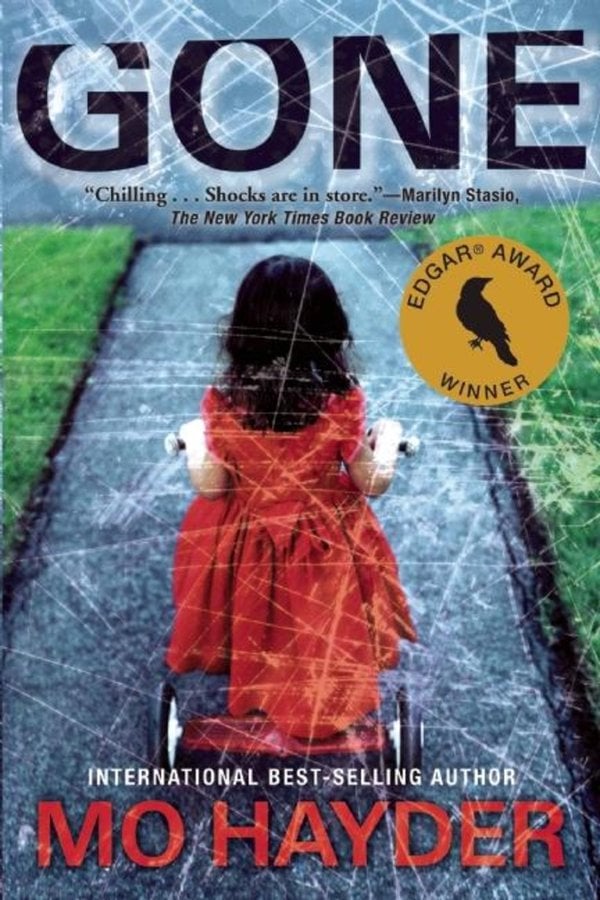
Gone is the fifth book in the Jack Caffery series but it stands very well on its own. By this point, Caffery’s counterpoint, Police Diver & Sergeant Phoebe “Flea” Marley, has been introduced. Marley is a lot like Mo: determined, beautiful, incredibly capable, but not invincible.
Flea and Caffery should have a closer relationship. They would fit together like two puzzle pieces. Unfortunately, they both carry around an awful lot of baggage. While this is tough for them, it makes them come alive on the page. They are excellent counterparts as detectives, and by the end of this novel you’ll be rooting for them both, despite their very deep flaws.
It’s no surprise that Mo won the Edgar® Award for Gone. She takes what already worked so well in this series and pushes up the volume by a thousand. The villain is completely fresh and extremely frightening. The plot takes amazingly satisfying twists that you’ll never see coming. And the story will creep and crawl right under your skin where it will stay forever.
Mo Hayder’s novels are dark, visceral, bold, and brilliant, and she leaves behind a lasting legacy. When she passed away in 2021, the crime writing world was devastated—tributes poured in and readers found solace in her novels—the incredible, brave, important stories she left behind.
Mo was always a writer—and a person—who looked at life as a question to be answered, as shown by her varied career path—not one to simply sit down to write in a vacuum, she made sure she had a wealth of life experience under her belt (she worked as a barmaid, security guard, filmmaker, hostess in a Tokyo club, educational administrator, and a teacher of English as a foreign language, to name but a few). Mo also held an MA in film from The American University in Washington, DC, and an MA in Creative Writing from Bath Spa University.
Writing was her love and her craft, and she took it very seriously. The legacy she leaves behind is not only that of a thriller writer, but of a generous, smart, passionate author and champion of other authors. I remember her as someone who squeezed every ounce out of life and did us all the great kindness of pouring some of that energy into her novels.
Over her many years as a writer, Mo, whose real name is Clare Dunkel, and detective Jack Caffery earned a legion of loyal fans, with Mo’s compulsive stories becoming staples of every crime reader’s bookshelf up and down the country—and indeed, across the globe. The series went from strength to strength, and Mo’s unique writing style and her refusal to shy away from the darker side of life became more and more apparent, setting her apart from other thriller writers and making it impossible for anyone to replicate her.
I am to this day still in awe of her tremendous talent and am deeply saddened that she is gone. We are so lucky that her work lives on.
***
Introduction by Karin Salughter to Gone by Mo Hayder copyright © 2026 by Karin Slaughter. Reprinted by permission of Grove Atlantic, Inc.

Karin Slaughter
Karin Slaughter is one of the world’s most popular storytellers. She is the author of more than twenty instant New York Times bestselling novels, including the Edgar-nominated Cop Town and standalone novels The Good Daughter and Pretty Girls. An international bestseller, Slaughter is published in 120 countries with more than 40 million copies sold across the globe. Pieces of Her is now a #1 Netflix original series, Will Trent is now on ABC and streaming on Hulu, The Good Daughter will soon be a limited series from Peacock starring Rose Byrne and Meghann Fahy and further projects are in development. Karin Slaughter is the founder of the Save the Libraries project—a nonprofit organization established to support libraries and library programming. A native of Georgia, she lives in Atlanta.