

Which international thriller should you watch this weekend?
A tale of organized crime in Shanghai, a Ukrainian absurdist film, or a Chilean political suspense movie
This month’s recommendations feature Zhang Yimou’s sumptuous story of organized crime in 1930s Shanghai; Sergei Loznitsa’s disturbing satire set in Russian-occupied Ukraine; and Manuella Martinelli’s quietly haunting depiction of Augusto Pinochet’s Chile.
*

Glamorous, criminal underworld,1930s Shanghai
Shanghai Triad (1995)
With Gong Li (Memoirs of A Geisha, Farewell My Concubine) in the lead role as Bijou, a nightclub singer and the mistress of an underworld boss (Li Boatian), Zhang Yimou’s Shanghai Triad features opulent period sets and a propulsive narrative. The story unfolds from the perspective of 14-year old Shuisheng (Wang Xiao Xiao) who has been sent from the countryside by his uncle to work for the Boss, who in turn makes him a personal servant to Bijou. “This is Shanghai,” Shuisheng is told. “There are hidden rules in everything you do or say.”
Over the course of seven days, Shuisheng learns about those rules as he witnesses gangland shootouts, discovers that Bijou is having an affair, and watches as Bijou’s relationship with the Boss unravels in intrigue and betrayal.
Before making Shanghai Triad, Yimou and Li had previously collaborated on several classic films including Ju-Dou (1990) and Raise the Red Lantern (1991)—which is being re-released in theaters across North America for its thirty-fifth Anniversary.
Directed by Zhang Yimou, 108 minutes.
Streaming on multiple platforms
Satirical, disturbing, timely
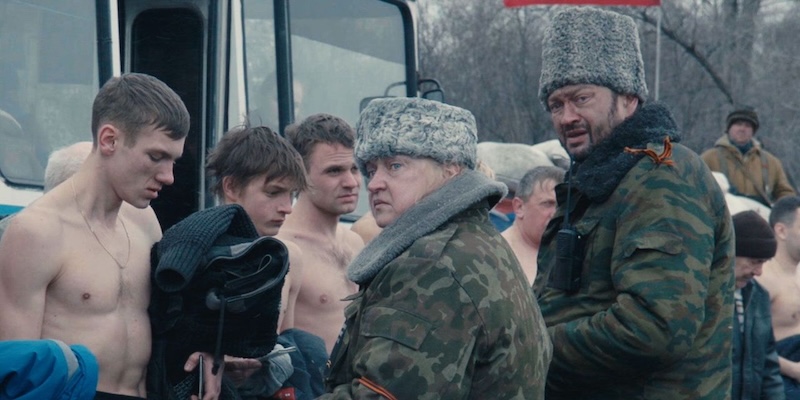
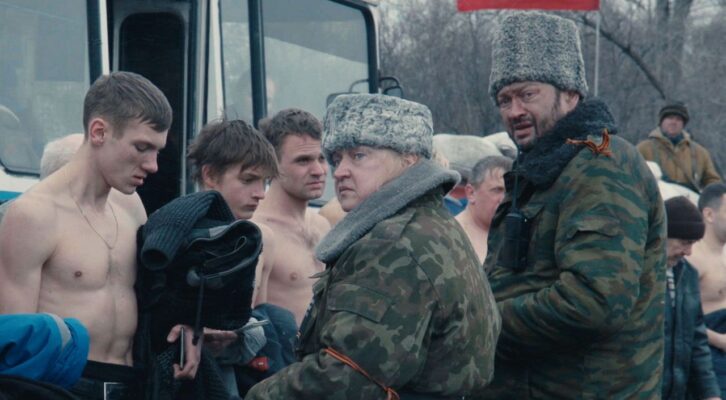
Donbass (2018)
Composed of a series of several loosely linked vignettes that take place in Russian-occupied territory in Ukraine, and based on real-life amateur videos, Ukrainian director Sergei Loznitsa’s (The Two Prosecutors) Donbass makes you question everything you’re seeing. Up is down and right is wrong as actors get dressed to film what is supposed to be real news; a police chief explains to a man why his car no longer belongs to him; a bureaucrat at a maternity hospital shows staff a huge stock of food that they say they haven’t received.
Loznitsa’s skills are on full display as he dips in and out of incidents with minimal set-up—you really don’t know where you’re headed, or what anyone will say or do—which is perhaps a good summary of what life was and is like in these zones.
Filmed after Russia’s 2014 annexation of Crimea and its covert operations in the eastern Donbass region, but before its full-scale invasion of Ukraine in 2022, Donbass keeps you transfixed with its bewildering and inexorable logic. In that sense, it hits too close to home. Donbass isn’t out there. It’s right here, wherever home may be. We are all living in Donbass’s world of greed, corruption, and the perversion of truth.
Directed by Sergei Loznitsa, 122 minutes.
Streaming on multiple platforms

Slow-burning, tense, thriller
Chile ’76 (2022)
In preparation for Manuella Martelli’s gripping new film, The Meltdown (2026), which releases early next year, you should watch her directorial debut, 1976 (released in the US as Chile ’76). The two films are part of a planned trilogy that explores Augusto Pinochet’s dictatorship and its aftermath.
Chile ’76 takes place three years after Pinochet seized power, overthrowing the democratically elected government of Salvador Allende—but none of that is top of mind for Carmen (Aline Küppenheim), a well-off middle-aged woman who heads out to her summer home to supervise renovations. In the course of her daily activities, Carmen witnesses incidents that give her pause—for instance, people on the street being dragged away—but since they don’t directly affect her, she moves on.
When a priest asks Carmen to help care for a wounded young man, she slowly discovers what’s actually happening in her country. Chile ’76 doesn’t hit you over the head with lessons about authoritarian regimes and how they operate. Instead, it shows how even well-meaning people can turn a blind eye to violence and repression…until they can’t anymore.
Directed by Manuella Martelli, 96 minutes.
Streaming on multiple platforms
***

Radha Vatsal
Radha Vatsal is the Film/TV Columnist for CrimeReads. She is the author of No. 10 Doyers Street and the Kitty Weeks mysteries, and her essays have appeared in the The New York Times, The Atlantic, the Los Angeles Review of Books, and elsewhere. She holds a Ph.D. in Film History from Duke University. You can find her on Instagram or email: rvatsal@lithub.com