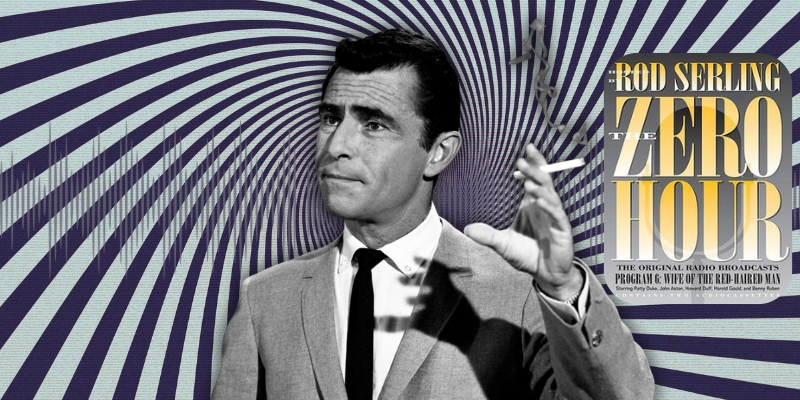
Keith Roysdon on the Genius of Rod Serling's Forgotten Suspense Radio Show
A retrospective on The Zero Hour and the 1970s rebirth of radio mystery dramas
The voice is unmistakable. Even if he had not introduced himself, there would be no question you were listening to Rod Serling introduce tales of suspense and the unexpected.
But this isn’t The Twilight Zone or even Night Gallery. This is The Zero Hour, and it was a radio series that aired for two seasons in the mid-1970s, after Night Gallery left the television airwaves.
Serling is justifiably. considered a god of writing, producing and hosting suspense and thriller dramas, In the 1960s and 1970s, he was such a household name–before his untimely death at age 50 in 1975–that even my mother would refer to something having a Twilight Zone ending, and she was not a pop culture maven.
Serling’s career was always notable for its small, odd corners, and I don’t mean just the twisting tales in his Twilight Zone series—which aired 1959-1964—and Night Gallery, Serling’s lesser but still beloved series that ran 1970-1973. The Zero Hour fits right in.
Like those two TV series, The Zero Hour was an anthology show, with a new story every week, quickly amounting up to 130 episodes from 1973 to 1974 and carried by the Mutual Broadcasting System on radio stations around the country.
Because it was a radio series, we couldn’t see Serling’s handsome, weathered face or dark suit or the mannerisms that became so familiar to viewers. But his voice was so distinctive.
“Rest your eyes,” Serling would say after introducing himself. “Exercise your imagination.” The introduction emphasized the two qualities of enjoying a radio drama: listening—not watching—and filling in the blanks of drama that we couldn’t see on a screen.
The Zero Hour was part of a 1970s rebirth of radio drama that was as varied as CBS Radio Mystery Theater and public radio adaptations of Star Wars.
Serling hosted The Zero Hour but didn’t write its stories, and we can only speculate if it would have been more memorable if he had.
The Zero Hour has mostly been relegated to the odd corners of our memory. I’d never heard of it before just a few weeks ago.
*
High-Profile and Surprising
Serling is overwhelmingly remembered for The Twilight Zone but the untypical and pointed edges of his career are hugely rewarding. He wrote or co-authored more than 90 of the TZ’s 150-plus episodes. He wrote Night Gallery episodes as well but clashed with NBC over the type of series the network wanted.
After his meritorious service in the Army during World War II, he wrote and directed radio shows in New York and elsewhere before moving into writing for TV. In 1959, he and a peerless group of writers began to write scripts for Twilight Zone and Serling was producer and host of the groundbreaking series. But Serling’s odd corners are consistently entertaining, like A Carol for Another Christmas, a TV movie from 1964 that starred Peter Sellers in a post-apocalyptic version of Dickens’ holiday story.
His theatrical film writing included long acknowledged but very disparate classics like Requiem for a Heavyweight, Seven Days in May, and (as co-author) the original Planet of the Apes film.
It’s fascinating that despite all this work, all these high-profile film and television projects, he found his way back to radio.
*
The Return of Radio Drama
The late 1960s and much of the 1970s were driven by nostalgia. Marx Brothers movies and the Buster Crabbe “Flash Gordon” serials played on campuses. It was probably inevitable that radio would make a nostalgic comeback. I fondly remember buying cassettes of vintage radio shows like The Lone Ranger and The Shadow, for sale in my neighborhood supermarket.
The nostalgia wasn’t limited to old stories on cassette tapes. CBS Radio Mystery Theater began in 1974, shortly after The Zero Hour, and is widely considered the dean of the 1970s radio mystery dramas, airing 1,399 episodes starring dozens and dozens of performers in new stories and adaptations of great writers’ work.
The series to this day has a fan following, including a Facebook page with nearly 3,000 followers. Sears Radio Theater debuted in 1979 and, in a variation from the two mystery and thriller-driven series, had theme nights: Monday was Western night, Tuesday was comedy night, and so on. Celebrities hosted each night, with Vincent Price hosting thrillers night, for example.
Each radio series had its qualities, but only The Zero Hour had Serling. He wasn’t the only notable voice in it. From the first episode, “The Wife of the Red-Haired Man,” featuring Patty Duke and John Astin, through guests like Jessica Walter, Brock Peters, Mel Torme, Lyle Waggoner and William Shatner, The Zero Hour rivaled CBS Radio Mystery Theater in its strong voice casting.
Like other shows in the radio drama revival, the series mixed dialogue, sound effects, music and sometimes narration to tell their stories.
The Zero Hour stuck to a particular format in its first season—each story took five episodes airing over five nights to play out—but probably wisely switched to a story-in-a-day format for its second season. It was a lot to expect people to tune in for five consecutive nights to hear a story to its completion. The second season’s half-hour shows are a lot punchier and move more briskly.
I understand the idea of the five stripped shows: Mutual hoped to inspire dedicated followers who would get into the habit, back when tv viewers made a habit of watching not just weekly episodes but also nightly news every night. But was it too much to expect listeners to rest their eyes and use their imagination every weeknight?
The producer of The Zero Hour was Elliott Lewis, who had made his radio debut as an actor in 1936, and his Wikipedia biography said he was “involved in” more than twelve hundred radio productions. He also directed many television shows.
Despite lacking Serling behind the typewriter, The Zero Hour did have some authorial credentials: The series devoted five episodes to adapting Tony Hillerman’s “The Blessing Way” (in episodes not written by Hillerman). And writer Keith Walker, whose credits were as diverse as episodes of MASH and Quincy and the movie Free Willy, wrote twenty-six episodes.
There’s a lot about The Zero Hour that recalls vintage radio, including the keyboard score, musical cues and stingers and old-fashioned, done in the studio sound effects.
It’s a treat that the series is still easy to find online. As a bonus, the Internet Archive postings of the episodes include the original commercials, so during each radio play you can look forward to the woefully earnest spots for joining the Navy or fulfilling commercial products for women or the use of Zip Codes. And the commercial jingles: Using Melanie’s “Look What They’ve Done to My Song, Ma” as “Look What They’ve Done to Our Mustang” is certainly an experience not to be missed.
Talk about twilight zone.
***

Keith Roysdon
Keith Roysdon is the author of two crime novels, “Seven Angels” and “That October,” as well as numerous short stories on sites like Punk Noir and in anthologies like “Fighting Words,” “Bad Intentions” and “Daydream Believer,” the latter to come later in 2026. He’s written more than 75 pop culture pieces for CrimeReads on everything from Dennis Lehane to juvenile mystery novels to odd 1970s TV movies.