
Leslie Baird on Surveillance in Society and Fiction
How George Orwell, Laila Lalami, and others capture the tension of being watched by governments, peers, and more
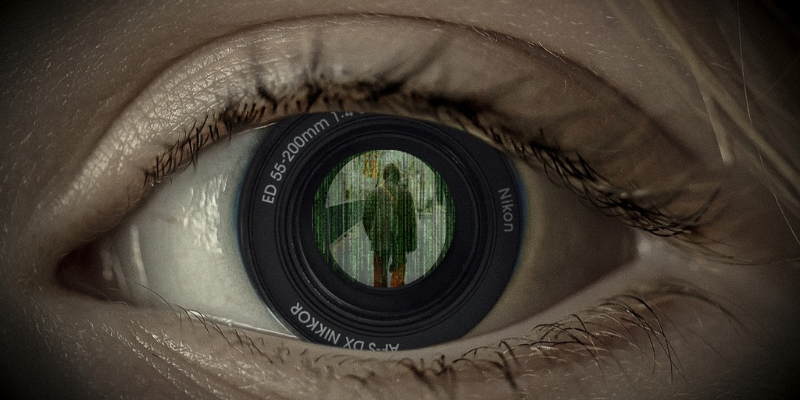
There’s a camera just above the screen upon which you’re reading these words. You probably assume it isn’t watching you, recording and transmitting even the most minute changes in your facial expressions, your pulse, your rate of breathing…but it could be. How would it change your behavior if you thought that someone could pop in at any time to analyze you, even down to your biomarkers? What if that “someone” wasn’t even a person, but a device, logging your data for future reference?
Surveillance is creepy in any world, no matter how fictional, which is why it has been an effective theme in works of literature for decades, bridging the gap between fiction and reality. In the real world, surveillance is deployed as a means of control by governments, abusive partners, workplaces, and even by ourselves in the form of self-policing, as many of the literary examples listed below explore.
As a literary theme, surveillance spans genres, expanding into speculative fiction, sci-fi, or dystopian, seemingly by imagining the next software update that could automatically install on your phone at midnight.
One key psychological element that makes surveillance such a rich topic is the idea of the panopticon—an eighteenth-century prison design by which all prisoners can be watched by a single guard. A key aspect of the panopticon’s effectiveness is that the inmates can’t possibly know for certain when they are being observed, so they must alter their behavior to assume they are being observed at all times.
In his 1975 book Discipline and Punish: The Birth of the Prison, the French philosopher Michel Foucault expanded the model of the panopticon by drawing parallels to the way surveillance technology can be deployed in institutions such as prisons, schools, hospitals, and military barracks. Each technological advancement in surveillance adds another potential viewfinder into the lives of private citizens. Foucault died in 1984 (which seems a little on-the-nose), but one can only imagine the philosophical feast he might’ve had at the invention of smartphones, social media, and the attention economy.
In my new novel, Salomé, the protagonist, Courtney, grapples with her irritation that her college friend has become a “move-to-Paris” influencer, trying to capitalize online engagement by “selling” Courtney’s favorite place on earth. The wannabe influencer hopes to be watched, but struggles to rack up views.
Meanwhile, Courtney finds herself as the unwilling target of surveillance in the form of security cameras mounted in the corners of Salomé’s mother’s house—their taciturn eyes a reminder that an unknown entity could be tuning in at any time, compiling information about her that could be weaponized to scare her into submission.
There is an often-cited Margaret Atwood quote about the male gaze from her 1993 novel, The Robber Bride:
Even pretending you aren’t catering to male fantasies is a male fantasy: pretending you’re unseen, pretending you have a life of your own, that you can wash your feet and comb your hair unconscious of the ever-present watcher peering through the keyhole, peering through the keyhole in your own head, if nowhere else. You are a woman with a man inside watching a woman. You are your own voyeur.
For a person willing to appear onscreen, the smartphone becomes a panopticon in their own pocket—though the psychological torment comes from not being watched. The “keyhole in your own head” becomes the gaze of the potential audience, and the subject has no choice but to become their own voyeur, always viewing their thoughts and actions as something to commodify.
Quickly this translated into shared videos of what used to be private moments—including a phenomenon of people setting up the camera to film themselves crying, ostensibly to prove their humanity, their gritty realness, to the (hopefully) omnipresent audience. Now, instead of a uniquely male gaze, the gaze is capitalism, the ultimate goal being to monetize every moment of existence.
The theme of surveillance in fiction is evergreen, and easily renewable with each technological advancement. Now let’s take a look at some of the most iconic depictions of surveillance in fiction from the past century.
*
Surveillance as Government

George Orwell, 1984
Of course this list should begin with the book that coined the phrase, “Big Brother is watching you.” In Orwell’s novel about totalitarian control, citizens of Oceania live in a constant state of surveillance. Ubiquitous devices called “telescreens” function as a means to deliver government broadcasts of propaganda to citizens, both in public spaces and in their private homes.
The telescreens also allow the government to spy on citizens, so everything they say, and every expression that crosses their faces, and even a change in their heart rate, could be monitored by the Thought Police: “You had to live—did live, from habit that became instinct—in the assumption that every sound you made was overheard, and, except in darkness, every movement scrutinized.”
A fleeting facial expression of doubt or any other negative emotion, if detected by The Party, could be punishable as a “facecrime.” In this way, The Party can penetrate the mind, creating a dominating presence over the lives of individuals, shaping even their thoughts.
1984 explores how deeply surveillance, or even the suggestion of surveillance, can permeate the psyche, altering every aspect of human behavior.
Surveillance as Peers

Margaret Atwood, The Handmaid’s Tale
“Under his eye,” is a standard greeting or farewell spoken between handmaids in Margaret Atwood’s classic dystopian novel, serving as a reminder that their every movement and word could be surveilled at any time—not only by officials in the guardtower, or the police—but by each other.
Women of reproductive age, the Handmaids, have become property of the state run by the Republic of Gilead. In order to ensure their compliance, Gilead uses a form of secret police called The Eyes. The true tactic of this mass surveillance is that anyone—including another Handmaid—could be an Eye. Handmaids can hardly trust each other and must weigh every word they utter, creating a life of paranoid isolation. Revolution, then, is nearly impossible, as every Handmaid must worry that every person she meets could be an Eye.
The protagonist, Offred, has a tattoo on her ankle of “four digits and an eye, a passport in reverse,” so even when stripped of her red habit and winged hat, she lives with a constant reminder that she is being observed, and her life depends on her utter compliance.
Surveillance as Preemptive Justice

Laila Lalami, The Dream Hotel
“Day after day she lay on her cot, ruminating about how she had ended up at [the facility] and how she could prove herself innocent of the violence they thought she was planning.”
Why wait for a crime to be committed before stopping it? In The Dream Hotel, algorithmic technology has the ability to detect the possibility of violent behavior by analyzing data from people’s dreams.
When Sara lands back in the United States after an international conference, agents from the Risk Assessment Administration pull her aside and inform her that she is at risk of harming her husband, and must be kept in a retention center for twenty-one days. Outfitted with a neuroprosthetic device on the back of her skull, Sara is under constant surveillance, even down to her thoughts.
The other women at the facility are also guilty of having been flagged by the dream algorithm, held against their will, and often separated from their children for months, as they try to prove their innocence from crimes yet to be committed.
In this space where unconscious, subconscious, or even intrusive thoughts could be labeled a crime, innocence is nearly impossible to prove, or even maintain.
Surveillance as Transparency

Dave Eggers, The Circle
Sometimes considered an update on 1984, The Circle explores surveillance technology’s effects on human nature. The narrative follows protagonist Mae Holland, a recent college graduate, who gets a job at The Circle, a company which develops and sells technological products such as SeeChange—portable bodycams worn by politicians in the name of transparency.
Opting to wear a SeeChange device is known as “going transparent.” After all, the company’s three mantras are: “Secrets are lies, sharing is caring, privacy is theft.” The company asserts that privacy on any level is selfish, and can lead to corruption and deceit.
Mae, naive and eager to please, opts to “go transparent,” despite receiving warnings from her ex-boyfriend and a fellow employee of The Circle that if left unchecked, the company’s technology will infringe on human freedom. After she goes transparent, Mae’s interactions with an old friend are suddenly different, as she finds herself performing for viewers rather than connecting naturally. She further alters her behaviors around eating junk food and telling white lies. Mae ultimately experiences a drug-like addiction to being watched.
The Circle’s new product, PastPerfect, does exactly what it sounds like: it digs into an individual’s past, allowing for perfect transparency into their history. Even when this has terrible consequences for her friends, Mae remains loyal to The Circle, even going so far as to daydream about the day when The Circle will develop technology that can read people’s thoughts.
Surveillance as Isolation

Jenni Fagan, The Panopticon
“I am an experiment. I always have been. It’s a given, a liberty, a fact. They watch me. Not just in school or social-work reviews, court or police cells—they watch everywhere.[….]They watch me, I know it, and I can’t find anywhere, anymore, where they can’t see.”
Thus begins the prologue of Jenni Fagan’s debut novel, The Panopticon, about fifteen-year-old Anais, an orphan in the Scottish care system, who has been arrested for assaulting a policewoman. The youth facility where she is held is a former prison, designed using a panopticon, so each room (built to be a cell) is under constant surveillance from the watchtower.
The C-shape of the building allows for each resident, or inmate, to see only the watchtower, but never each other, creating a feeling of profound isolation. The constant scrutiny fuels paranoia amongst the residents.
Anais is an orphan, and likens her own birth to a Petri dish. In her cell, where she can’t even use the toilet in privacy, she feels the microscope on her, analyzing. Or, potentially analyzing. Anais knows that the guards aren’t in the watchtower at all times, but they could be there. The result is that the residents internalize the disciplinary gaze of the watchtower, becoming their own constant overseers.
Surveillance and attention work two ways in the facility—a marked lack of the nurturing care that these minors need from adults in order to heal their emotional wounds, and the paranoia-inducing presence of the watchtower, consistently reminding the inhabitants of who they are and why they are there. They are chronic offenders, criminals, most of whom are unlikely to ever make it out of the system. What they can learn to expect from society is this level of constant scrutiny and assumed guilt.
***


Leslie Baird
Leslie Baird is an American novelist, ghostwriter, and editor, living in Europe. Her debut novel, Salomé, was published by Putnam in May 2026.