
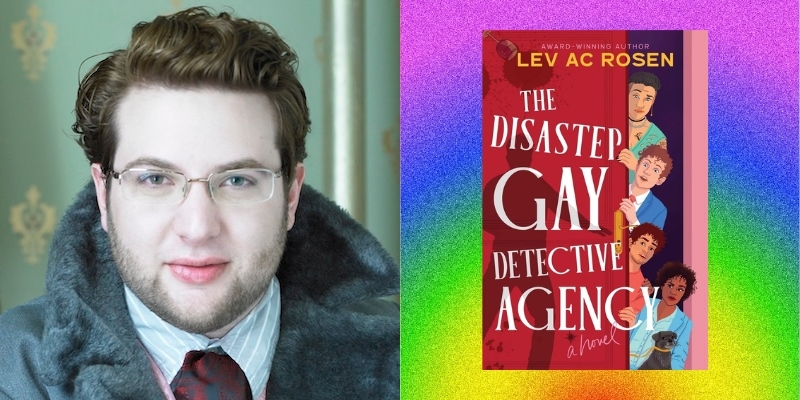
Lev AC Rosen on POV, Capers, and Creating a Messy Queer Detective Novel
The author of The Disaster Gay Detective Agency in conversation with Alex Dueben
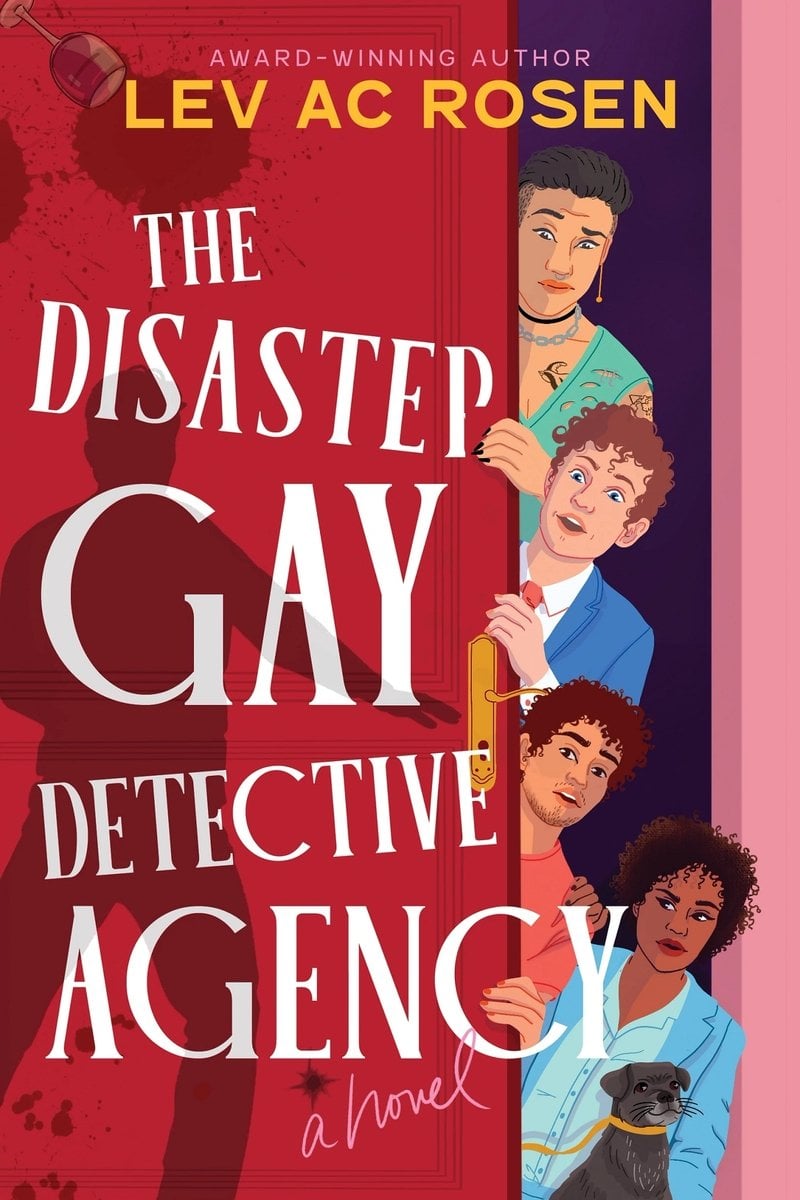
Lev AC Rosen is the author of many books for adults and children, including the award-winning Evander “Andy” Mills mystery series, the fourth book of which, Mirage City, came out last fall. His new book is The Disaster Gay Detective Agency. Despite the title, the books is a Hitchcockian thriller rather than a mystery where four friends– Brandon, Ollie, Nicole, and Ian–are thrown into an international caper that is completely over their heads.
A very funny novel about people making very bad decisions, Rosen manages to balance these elements in a way that’s fun, and centers the four of them and their relationship, and delivers a story that is pulls everything together in a tightly structured manner. Rosen is a very busy writer and we spoke recently about the book as his daughter napped for most of our conversation.
*
Alex Dueben: What was the kernel of this idea? Where did the story begin?
Lev AC Rosen: It came out of a group chat. The people it’s dedicated to are old friends. One I went to high school and college with, and the other two I went to college with. We’re not all queer, although the one of us who isn’t feels really bad about it. [laughs]
I was talking about how I love these mysteries where it’s like the worst person you know who’s trying to solve everything, but as with all things, I wish it were queer. My friends and I started naming stereotypes of terrible queer people. I was like, I can make this work. [laughs]
It was pretty easy. I was like, the one who falls in love with anyone who smiles at them. The one obsessed with their ex to a stalkery place. The one who is just work and no personal life. The one who is deeply, deeply lost.
AD: Is starting with character how you usually work?
LACR: It varies. I’m a big believer that every book writes itself differently. Character is something you have to figure out very early on. With the Lavender House series, it was not character so much as it was concept. Once I had that, I had to be, who is this detective? Why would he be doing this?
With my YA stuff like Camp or Emmett– well, Emmett was, I’m just going to do Emma, so everything came kind of pre-developed. Camp was also more concept. I wanted to do a sort of 60s battle of the sexes style comedy at a young adult queer summer camp, how would that work? Sometimes it’s concept, sometimes it’s character, but you need both before you start writing, in my experience. Even if the first kernel is one or the other, I’m not going to get much done until I figure out the character.
AD: Was the idea of alternating chapters between all four of them part of your concept early on?
LACR: I really wanted to rotate between all of them. If this is going to be about a friend group, it has to be about the friend group. We have to see every perspective. Some editors were like, this is too many perspectives. I know a lot of people hate rotating perspective, which I don’t understand. I’ve always loved it.
I wanted it to be about all four of them. I wanted each of them with their “skill set” to learn different things at the same time, or learn at slightly different times, but not have the opportunity to tell each other. So we would get the drama of someone going into a situation without the information that the reader has.
Even know the word detective is in the title, I don’t think of it as a mystery. I think of it more as a thriller. These distinctions are so academic and silly, but to me, it’s about the fact that the reader isn’t solving along and everything is pretty open. I put something on Instagram, less “who done it?” more “what the fuck?” That’s was my mantra for it. This isn’t going to be like the Andy Mills mysteries where it’s a classic mystery. This is more about, how am I going to get out of this one? What have we gotten ourselves into? Which I think also lends itself more to comedy.
AD: It does lend itself to comedy and there’s a lot of heavy, dark stuff happening but also, it’s fun and they’re all in it together.
LACR: I always called the Andy Mills mysteries soft-boiled noir, instead of hard-boiled. Or jammy-yolk noir, because you end with this warmth. This idea that community can save you. You’re not alone.
This is similar to that where everything is insane and screwball and people are dying, but at least we’ve got each other. I think that’s reflective of times we live in. I think that writing that kind of friendship, especially queer friendships– I mean, I’m obviously biased– but I feel like those are more special. [laughs] I think writing them into any kind of situation shows how we as queer people can survive. And have survived!
I did an event two years ago, but this quote from Ryan La Sala has stayed with me. He said, as queer people, our lives are multigenre. That has stuck with me. I think that’s true. As queer people, it is about the horror of our rights getting taken away, and our trans siblings being put on terrorist watch lists, but also the joy of hanging out with your queer friends. I think we’ve always had that. We’ve always had the ability to create joy in awful spaces.
You think of the quote about the AIDS crisis where they would protest all day and party all night. I think that is something inherently very queer. The idea that we can find love and joy even in the most horrendous of circumstances is very queer to me. Maybe straight people can do that, too. I don’t know. I don’t talk to them. [laughs]
AD: Each chapter rotates between the four characters. Did it take a lot of planning out structurally, figuring out how that would work and the order?
LACR: Yes and no. I am a structure guy. With the rotating perspective, I wanted to start with Brandon. On some level, this is “Brandon’s book” though it’s really all of their book. I’m writing the second one now, and it starts with Ollie, so it becomes “Ollie’s book.” I wanted to rotate between them, and I wanted to show the overlap via text messages.
That came to me very quickly. If you’re going to do four rotating perspectives, things are happening at the same time. I wanted to start with Brandon. It goes to Ollie next, then it goes to Nicole, and then to Ian. When I was writing the first four chapters, there was a real intention behind, this character next because it’ll set this scene up for this one. Once I had that order of the four based on those first four chapters, this is the order now.
That did annoy me at times. I had to move things around, and it got a little awkward, and then my editor made it less awkward. Once you lock yourself in, it can be really frustrating, but I don’t mind that. It makes it a fun challenge.
The big struggle was the “Rashomon sequence,” as I call it, which is the party scene. I knew I wanted to do it, and I had to repeat the exact same dialogue over and over again, which is frustrating. My rule was, if I’m going to repeat a line of dialogue, something new has to happen internally for the character whose perspective we’re seeing now.
Some of the dialogue, Nicole is reading this as aggressive, and Brandon is reading this as flirtatious. These little things that if you’re giving it a careful reading, you’re going to learn something about how each character is approaching the moment.
That was a difficult sequence to pull off. Even between the arc and the final copy, some stuff was cut because it was a little too repetitive. I really wanted to do that and show how these four people—because that’s the climax. The moment where maybe their friendship is going to really collapse. I wanted to show how these four people have come to this moment and are approaching every single thing that happens in it with such a different mentality that it is resulting in this conflict.
AD: I was going to say, the party scene is both the climax and the heart of the book.
LACR: That’s how I thought of it, too. You know if they stick together, they’ll make it through. My editor and I worked really hard on making sure the emotions were really high in those moments. It’s a microcosm of what I was trying to do over the course of the book. It is difficult to know exactly which lines of dialogue you can summarize again, which you can repeat, which are worth repeating. I won’t lie. That was hard, but I had fun doing it.
AD: Throughout the book you have scenes where one character will text and they’ll receive a reply and the next chapter will show what that character was doing and why they replied in that manner, giving the reader slightly more information, but also more emotional context.
LACR: The reveals aren’t so much clues as they are psychological stuff. That’s always been more interesting to me. I love the trappings of a mystery, but when I read a mystery, I’m not trying to solve it. I’m more interested in why people want to solve a mystery in the first place. Why they would put themselves in a dangerous situation. Why people kill. All of that is fascinating. When I write mystery, I am so much more interested in character. The mystery to me is more about the vibe of it.
AD: The book is so highly structured, but it’s also loosely plotted.
LACR: The plot is essentially crazy shit happening. That’s what I wanted the plot to be. Again, it’s not about solving the crime and understanding what’s going on. It’s about seeing how these folks get into and out of this situation, and how they’re changed by it. As I’m writing the second one, I want to show the way they’re traumatized by what happened in the first book in the second book and how they’ve changed because of that.
There’s a line towards the end that gets a little into spoiler territory, but Ian says something about making better bad decisions. That is sort of how I’m thinking of each book moving forward. What do they think a better, but still bad, decision is. That’s been a lot of fun to do. I try to show why they’re making these bad decisions in the first place and where this is coming from. They’re not going to solve the crime! They’re just going to survive if they’re lucky.
AD: They were lucky to know what’s going on. But you mentioned you initially envisioned this as four books, with one centered around each of them.
LACR: Ideally, yeah. I always joke, one around each of them, and then maybe a holiday novella. I think it’d be funny. I sort of have it mapped out in my head. It was only a two-book deal, so fingers crossed.
AD: You mentioned you’re writing the sequel. Are you mostly done?
LACR: I have three books to do this year and three books out next year. I had a baby three months ago. So it’s been busy.
I’m about halfway through the rough draft right now. I am pleased with what I have so far. I’m having a lot of fun writing each character. One of the first things I did for the sequel was go, you know what’s not fair, Ollie didn’t get laid in the first book. Everyone else got laid. Ollie needs to get laid. So that was one of my priorities going in. [laughs]
So what would a femme fatale look like in this situation? Or an homme fatale, because Ollie’s pansexual. I’m pleased with who I came up with. Because there’s a missing wig from Ian’s place of work, I get to name a million drag queens and kings and that was fun.
***

Alex Dueben
Alex Dueben has written for The Believer, Vulture, The Millions, The Los Angeles Review of Books, The Brooklyn Rail, and many other publications. He is the writer and editor of the artist monograph Hurricane Nancy, and his debut novel is forthcoming.