
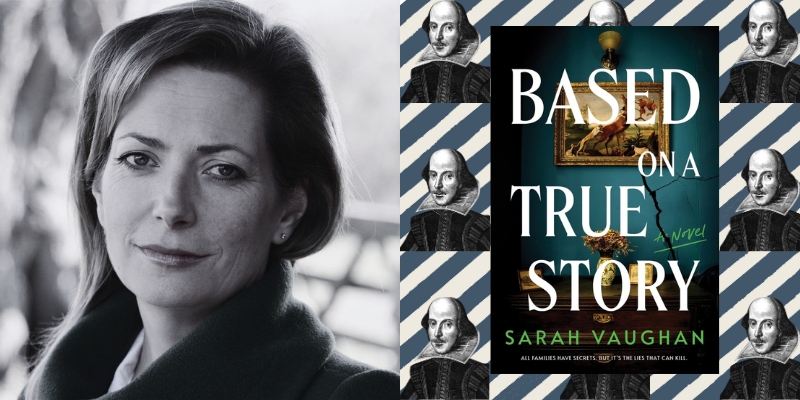
Sarah Vaughan on How Shakespeare's Plays Shaped Her Suspense Novel
The author of Based on a True Story takes craft lessons from King Lear, Othello, and more
Almost exactly two years ago, as I was deep into my second proper draft of Based on a True Story, my sixteen-year-old son came to me with a confession.
He didn’t really know Macbeth.
This wouldn’t matter except that he was due to take his English Literature GCSE, a public exam teenagers take in the UK, the following week and Shakespeare’s tragedy about the corrupting impact of “vaulting ambition” pursued by a toxic power couple was a key set text.
So began an intense weekend of discussing possible questions and learning quotations. I’d spent a term studying Shakespeare as a student at Oxford, but this was a deep dive which made me think about “the Scottish play” again.
I’d already incorporated a few Macbeth Easter eggs into Based on a True Story—a key line from Lady Macbeth, and three conspiratorial sisters dancing around a bonfire as my final scene—and my work-in-progress was a loosely feminized King Lear. But as we brainstormed ideas, I was reminded not just of Shakespeare’s influence on the English language—all those idioms that have entered our lexicon: “break the ice,” “heart of gold,” “cruel to be kind,” “own flesh and blood”—and on me as a writer, but of how effectively he uses suspense.
In Macbeth, one immediate device is his use of the three “weird sisters” who prophesize who Macbeth will be “Thane of Cawdor” and “King” and incite him into action. Given that he acts on their encouragement, these prophecies become loaded with significance. “Beware Macduff” he’s told, before being warned he’ll be safe until “Great Birnam Wood” moves against him and that “none of woman born/Shall harm Macbeth.”
With suspense already generated as we anticipate the various murders, the audience rightly deduces that these riddling prophecies might be deceptive and we’re left on tenterhooks, suspecting “brave Macbeth” will become a “dead butcher” with “his fiend-like queen.”
Of course, modern psychological suspense writers tend to veer away from the supernatural, although there are exceptions. But prophecy of a kind is provided in modern suspense novels through warning letters and notes.
Agatha Christie famously used the letter as prophecy in The ABC Murders, in which retired detective Hercule Poirot is taunted by a serial killer who sends cryptic letters before each murder, while Lucy Foley uses a note warning of the true nature of the groom—something the reader and bride must find out—in The Guest List.
In Based on a True Story, I provide a sort of prophecy via email threats: the sender knows Eleanor has an unsavory fifty-year-old secret and intends to expose her. “Perhaps it’s time, though, that the truth came out. A party would be a great time for that to happen.”
Shakespeare’s tragedies also generate suspense by playing with unsettling, unknowable madness. Tragic heroes doubt themselves, often after seeing apparitions—see also Hamlet—or through mental deterioration, as happens with Lear who fears he’s no longer “in perfect mind.”
In Macbeth, the warrior hallucinates a bloody dagger—”Is this a dagger which I see before me?”—while a sleepwalking Lady Macbeth cannot scrub the imaginary blood from her hands—”Out, damned spot!” Lear’s descent into madness is so extreme that, railing on the heath in a storm, he hallucinates his daughters, Goneril and Regan, standing trial.
Again, while my protagonist, Dame Eleanor Kingman, never reaches such extremes, I wanted to convey a sense of a net closing in, and of her mind being if not “full of scorpions” like Macbeth’s, then extremely troubled by the threats. At various points, she imagines seeing “ghosts from her past,” who may just turn out to be the real thing.
My previous thriller Little Disasters features a mother whose intrusive thoughts cloud her judgment and make her fear she is going insane, while Ashley Audrain’s The Push also features a mother questioning her sanity, and similar themes are explored in Nikki Smith’s debut thriller All In Her Head. Appearance vs reality, truth vs fiction, and the question of whether one’s own thoughts are trustworthy are at the very heart of psychological suspense.
The weather is also used to generate tension and suspense, particularly in King Lear where the dethroned King’s raging naked on the heath occurs during a vicious storm, and, in a clear case of pathetic fallacy, the weather’s changeability reflects the tempestuousness and fragmentation of his mind.
Daphne du Maurier was inspired to write Jamaica Inn after getting lost in the mist on Bodmin moor and similarly uses weather and a sense of place to create foreboding and a sense of isolation and suffocation in her psychological thriller, Rebecca, while the oppressive nature of heat, caught so superbly in modern classics such as LP Hartley’s The Go-Between or F Scott Fitzgerald’s The Great Gatsby, is used to build a sense of growing unease in dark destination thrillers such as Sabine Durrant’s Dead Heat or Lie With Me.
With Based on a True Story, I also used the weather’s mercurial nature to up the stakes. The novel’s set in north Cornwall where you can experience “four seasons in a day” and where a scrubby heathland separates the sheer cliff path leading to the sea from Dame Eleanor’s manicured lawns. Just as Lear’s emotional crisis comes as he rails on the heath at the end of Act III, so Dame Eleanor’s comes in a storm as she runs from the party in the final chapters of the book.
The dramatic geographical environment also generates a sense of fear. Eleanor’s son-in-law Tom imagines being “skewered” on sharp rocks if he falls from a cliff. Shakespeare plays with this danger, too, as Gloucester’s son Edgar, disguised as the beggar Poor Tom, leads him off an imaginary, but to the blind Gloucester very real, cliff, to shock him out of his desire for suicide.
Dramatic irony—the audience being aware of something a character isn’t—also plays a part in the Gloucester/Poor Tom relationship and again generates tension and suspense. It’s another favorite technique of Shakespeare’s: we know for instance, that when Macbeth asks Banquo to attend a banquet, he has already arranged for him to be murdered. Similarly, at the end of Hamlet, we, unlike Hamlet and Gertrude, know about the unbated sword and poisoned chalice.
Film and TV love this device—think of Jaws where the viewer knows the shark is lurking by those on the beach don’t, or The Godfather, in which we’re aware that Michael Corleone has hidden a gun in toilet cistern when he meets Sollozzo and McCluskey, though they’re ignorant—as do suspense writers. In Durrant’s Dead Heat, for instance, the narrator Matt witnesses illicit relationships of which other characters are unaware, and a part of the suspense arises from us wondering when or if he’ll reveal this information.
The use of an unreliable narrator, particularly one who lets the audience in on the secret, is often related to this and similarly creates delicious tension. It’s a device loved by thriller writers—think of Patricia Highsmith’s Tom Ripley or Amy and Nick Dunne in Gillian Flynn’s Gone Girl—and which I use in Based on a True Story, too.
Shakespeare’s best example is perhaps Iago, in Othello, the precursor to Frank Underwood in House of Cards. The ultimate unreliable narrator, Iago’s admissions of deceit—”I am not what I am” as he informs us in his first soliloquy—and frequent asides ratchet up the dramatic irony and leave the viewer wondering quite when he will be exposed.
Finally, while Shakespeare uses these devices plentifully throughout his plays, he uses a “spoiler technique” to generate suspense just the once at the start of Romeo and Juliet. “From forth the fatal loins of these two foes/A pair of star-crossed lovers take their life” the prologue announces—and the audience is left realizing the entire two-hour tragedy will build inexorably to this point.
It’s a technique loved by thriller writers and used in shows such as HBO’s three seasons of The White Lotus, The Perfect Couple, and Big Little Lies.
Perhaps it’s apt, then, that Based on a True Story opens in this way, with the discovery of an unidentified body on the beach.
I thought I was drawing on a favored trope of psychological thrillers, but perhaps I had just learned from Shakespeare, all along.
***
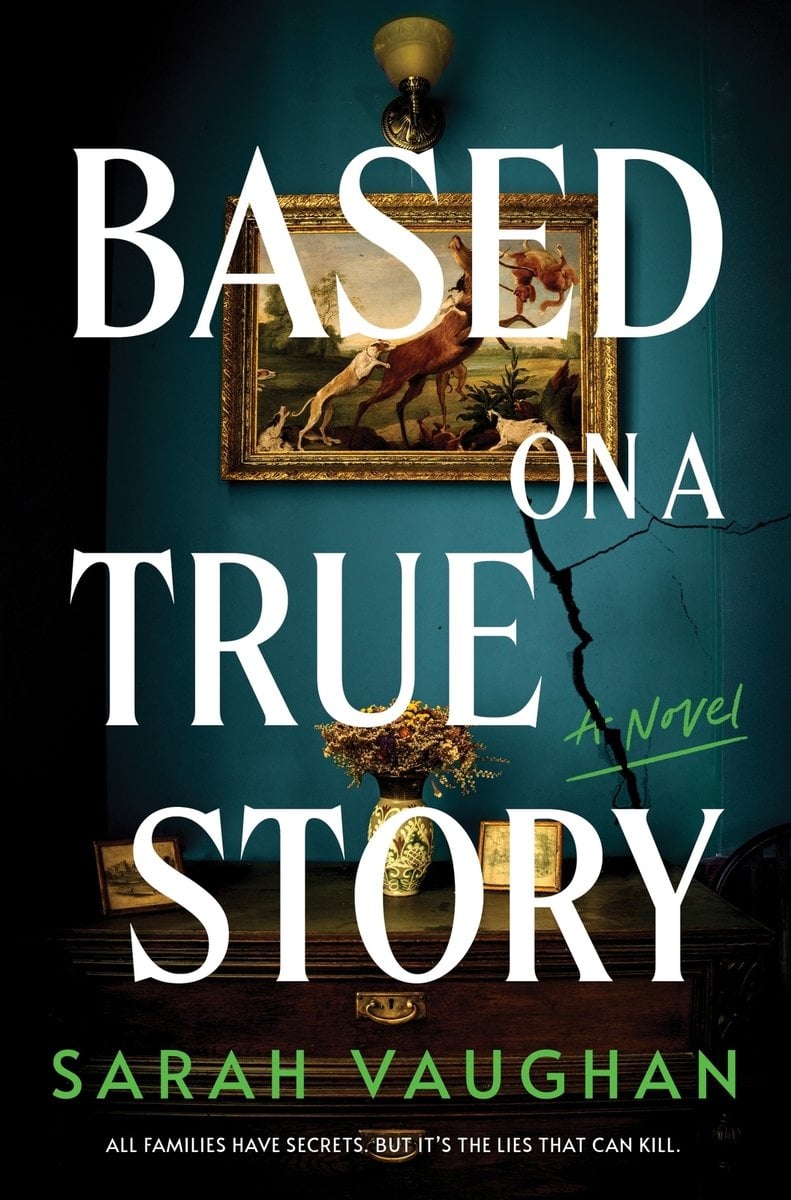

Sarah Vaughan
Sarah Vaughan studied English at Oxford and went on to become a journalist. She spent eleven years at The Guardian as a news reporter and political correspondent before leaving to freelance and write fiction. Her first thriller, Anatomy of a Scandal, was an instant international bestseller, translated into twenty-two languages, and was adapted for Netflix as a six-part series starring Sienna Miller, Michelle Dockery, and Rupert Friend. Her bestselling novel, Little Disasters, has also been optioned for television. Reputation is her fifth novel. Find out more at SarahVaughanAuthor.com.