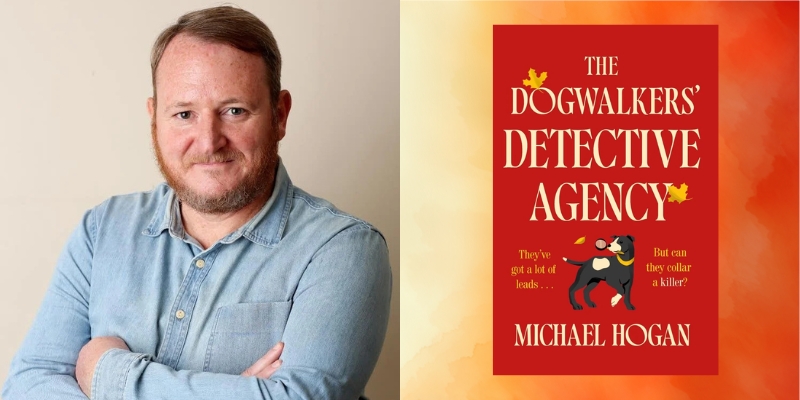
Michael Hogan on Settings, Pets, and the Off-Page Grittiness of Cozy Mysteries
The author of The Dogwalkers' Detective Agency mulls how cozies turn murder into reassurance
There’s nothing cozy about murder. Not really. Yet by some sort of magic, murder-mystery stories can be very cozy indeed. It’s about their setting, their characters, their atmosphere—and the quiet satisfaction of a killer being caught. After all, there are few things more comforting than a puzzle solved. The rule of law is restored. Order is brought to chaos. Lights beats dark. What could be more cozy and reassuring?
Agatha Christie is the genre’s all-time queen, of course. The fact that her books are now period pieces is only one part of her enduring appeal. Christie’s detectives are egg-shaped Belgian eccentrics and meddlesome elderly spinsters. Her crimes occur in historic manor houses and aboard steam trains. Sure, it sounds like the epitome of coziness. Yet contrary to popular perception, Christie’s work is no comfort blanket.
Her stories often have a harder, grittier, more unsettling edge. Some of her all-time classics—particularly the stories which don’t feature Hercule Poirot or Miss Marple—can be very dark indeed. Try reading Crooked House, Endless Night, or And Then There Were None, then tell me they’re the product of a kindly, cuddly old aunt.
Most cozy mysteries star a quirky amateur sleuth. An unlikely investigator who subverts the expectations of police and criminals alike. Jane Marple is a sweet old lady from a sleepy village. G. K. Chesterton’s Father Brown is a Catholic priest, while Ellis Peters’ Brother Cadfael is a medieval monk.
More recent additions to the cozy canon include the wily retirement home residents in Richard Osman’s Thursday Murder Club bestsellers, the amateur dramatics club in Janice Hallett’s Appeal novels and the snooping schoolgirls in Robin Stevens’ Murder Most Unladylike series. None are stereotypical detectives.
My day job is television critic and some of my all-time TV favorites fit into this category—BBC gems such as Pie In The Sky (about a chef with a taste for crime), Ludwig (about a crossword-setter who cracks cryptic cases) and Jonathan Creek (a magician’s consultant uses his knowledge of conjuring tricks to unravel locked room mysteries). You can probably guess who the sleuths are in my own debut novel, The Dogwalkers’ Detective Agency. As the book’s tagline goes, “They’ve got a lot of leads. But can they collar a killer?”
Cozy mysteries usually unfold outside cities—in rural towns, quiet villages or remote islands—thus revealing the darkness lurking beneath the peaceful surface of these seemingly idyllic settings. Even in the twenty-first century, when nobody tends to be off-grid for long, a more provincial location lends a whole different dynamic to a whodunit. It can explore the impact of crime on a smaller, closer-knit community.
In a bustling city, a murder it wouldn’t cause as much of a ripple. In practical terms, a non-urban location also means it’s darker at night, cellphone coverage isn’t as good and the police aren’t as closed off to the public. All helpful for a mystery story.
The Dogwalkers’ Detective Agency is set in the English seaside town of Framstone—a fictionalized version of where I grew up, Felixstowe on the East Anglian coast. All windswept beaches and kitschy amusement arcades, Framstone is slightly faded from its heyday as a resort destination but, post-pandemic, is showing signs of resurgence and gentrification.
Beneath the twee charms of such coastal towns, there’s often an underbelly of poverty, drugs and crime. They can become forgotten places, populated by thwarted young people who long to escape, like my protagonist Charlie Boardman. He once left Framstone for the bright lights of London but a combination of mysterious events and the need to care for his elderly mother Polly has now drawn him back.
Having lost touch with his roots, Charlie is pleasantly surprised to find companionship and community with his fellow dog-walkers. Dogs often throw disparate people together. Pet-owners of diverse ages and backgrounds meet through their dogs. There’s something about walking along side-by-side, talking and listening sideways, which puts social intimacy on fast forward. Before you know it, you have a dog pack.
That idea for the book took hold on a dog walk, naturally. My dog Ivy and I chanced across a comatose man in the bushes. Luckily, he was alive, just drunk and sleeping it off.
I did some research and discovered that forty percent of the U.K.’s “unexpected dead bodies”—a strange phrase which just means people who didn’t die at home or in hospital—are found by dogwalkers. That’s why you often hear it on news reports: “Human remains were discovered by a couple out walking their dog.” There’s nothing like fact to inspire fiction. I thought it was an intriguing starting point for a murder-mystery.
The Dogwalkers’ Detective Agency is a wet-nosed, waggy-tailed story which begins when Charlie discovers a murder victim in Framstone Woods. He and his fellow dogwalkers take it upon themselves to investigate the crime. Thanks to their local knowledge, familiarity with the landscape and, frankly, their love of gossip, the dogwalkers are soon on the tail of the culprit. Their four-legged friends sniff out clues and dig up evidence. It all makes for a pedigree whodunnit.
I most enjoy the deductive element of mystery stories—along with the atmospheric backdrop, the camaraderie and, of course, the dogs, who are characters in their own right. In The Dogwalkers’ Detective Agency, there isn’t much blood and guts. No gory torture nor grisly autopsies. We don’t get inside the head of a killer, evoke a mood of hard-boiled noir or crank up the psychological horror.
I tend to think there is enough conflict and darkness in the world right now. I’m more interested in solving a proper puzzle, with plot twists and humor along the way. I hope potential readers are too.
There has to be a crime, of course, but if there is sex or violence in cozy crime, it tends to happen “off-camera” (my TV critic background is showing itself again). It isn’t gratuitous or described in graphic detail. There are none of those “naked dead woman” clichés that are such a reductive trope on screen. You won’t need a hot shower or a stiff drink afterwards. Although both can be nice.
There is more to the best cozy mysteries than meets the eye. An insight into the harsh truths of human nature. A peek into the shadows, before hurrying back to our home comforts. As well as Queen Agatha, I’m an avowed fan of her fellow “golden age” British crime writers—the likes of Dorothy L. Sayers, Margery Allingham, Ngaio Marsh, and John Dickson Carr. Arthur Conan Doyle’s Sherlock Holmes stories were formative for me and remain firm favorites.
I wouldn’t dare to put myself in the same bracket but attempting to follow in that tradition was huge fun and a true labour of love. The Dogwalkers’ Detective Agency takes a stroll on the lighter side of crime, hopefully told with warmth, wit and charm. It’s a playful mystery which provides gentle escapism and a well-constructed puzzle to solve.
There might even be a sequel in the pipeline. After all, dogs will always need walking. Who knows what they’ll find next? And how cozy (or otherwise) will it be?
***


Michael Hogan
Michael Hogan is a television critic for The Telegraph and written for The Guardian, The Observer, Radio Times, Red, Q, Empire, Marie Claire, Grazia, Glamour, InStyle, Esquire, ES, and You magazine. He writes mainly about television and pop culture, but also turns his hand to lifestyle pieces, topical comment, celebrity interviews, and humor. Michael lives in London with his family and a rescue dog called Ivy. To escape them all and get some work done, he commutes to a shed at the bottom of his garden. The Dogwalkers' Detective Agency is his debut novel.