

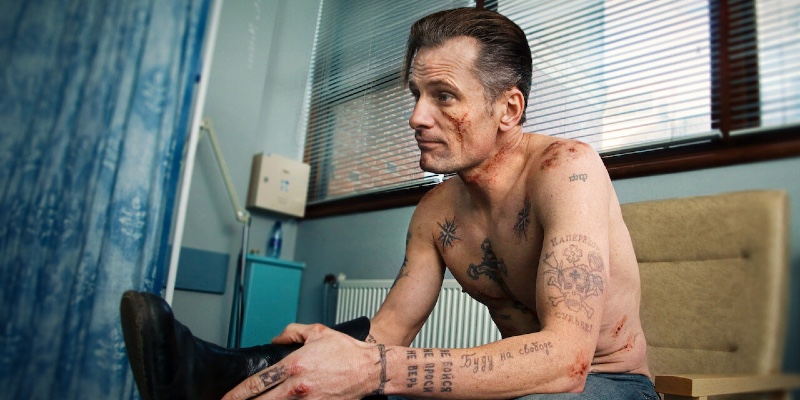
Why this movie: David Cronenberg’s Eastern Promises is a film about bodies and violence in London’s underground Russian mob scene. There are horribly mutilated and murdered bodies, bodies that get trafficked, bodies that fight naked in a bath house, and heavily tattooed bodies that perpetrate violence. Watching it for the first time, I felt like I was being offered a glimpse into a fully fleshed out and secret world that I had never before seen on screen. This is not the usual London of the movies.
A British-Russian midwife, Anna Khitrova (Naomi Watts) finds a diary written in Russian among the possessions of a teenage prostitute who dies in childbirth. There’s a business card in the diary for the Trans-Siberian restaurant. Anna meets the owner, Semyon (Armin Muller-Stahl), who seems friendly and welcoming at first—but we soon learn that he’s the head of a Russian crime family. His aggressive son Kirill (Vincent Cassel) works for him, as does Kirill’s taciturn and ruthless driver, Nikolai (Viggo Mortensen).
Anna’s discovery of the diary opens up a can of worms for Semyon. He wants the diary back. She holds on to the original. This puts her in the crosshairs of the mob and unleashes a spiral of violence.
The film draws you into both Anna’s conventional world and Semyon’s hidden reality. Semyon runs a brutal business but is a warm family man. Kirill seems to be attracted to Nikolai but as the son of a Russian mob boss has to repress his desires. And Nikolai seems inscrutable, capable of physical violence, but he might also have another side to him… Eastern Promises is one of those movies you can watch repeatedly and still discover new angles.
What they said: Cronenberg compares Mortensen’s famous bath-house scene to the shower scene in Hitchcock’s Psycho: “You’re naked, you’re wet and there’s some people with knives who don’t like you… I said to the stunt coordinator and the camera man, ‘This is not Bourne-like impressionistic cutting away where you don’t see anything. Violence is physical. It’s all about bodies. It’s about the destruction of bodies. And I insist on that as the reality of this… This fight scene has to make physiological sense. It has to make mechanical sense. It has to make body sense.’”
The tattoos that the mobsters carry on their bodies also add to the authenticity of the world-building. Discussing the subculture of tattoos among Russian criminals, Cronenberg says “I sent that book [Russian Criminal Tattoo] and a documentary that Viggo [Mortensen] found as well called The Mark of Cain (2001)—which is really fantastic, shot in Russian prisons with prisoners showing their tattoos and describing what they mean and so on—I sent that to [the screenwriter] Steve Knight and said, “This will blow your mind.” As if the script had almost been waiting for this last piece of the puzzle to become the central metaphor of the movie and to make everything gel around it.”
Written by Stephen Knight. Directed by David Cronenberg. With Viggo Mortensen, Naomi Watts, Armin Muller-Stahl, Vincent Cassel. 101 minutes.
Streaming on multiple platforms.

Radha Vatsal
Radha Vatsal is the Film/TV Columnist for CrimeReads. She is the author of No. 10 Doyers Street and the Kitty Weeks mysteries, and her essays have appeared in the The New York Times, The Atlantic, the Los Angeles Review of Books, and elsewhere. She holds a Ph.D. in Film History from Duke University. You can find her on Instagram or email: rvatsal@lithub.com