
Midwest Murders: The Dark Legacy of Iowa's Adoption Program for Korean Children
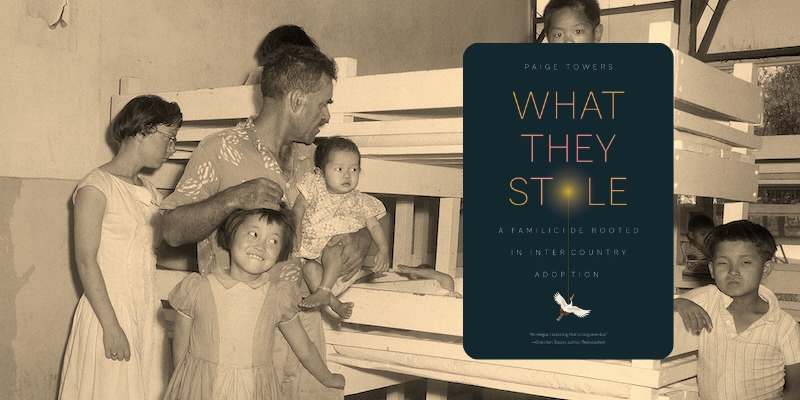
An excerpt from What They Stole: A Familicide Rooted in Intercountry Adoption by Paige Towers
The Iowa River overflowed its banks about three months after the murders. Most locals sensed the threat of rising water. In Iowa City, a vibrant college town in the southeastern corner of the state, fog usually doesn’t come until spring, but that winter, Iowans awoke to barren crop fields and highways draped in thick clouds—a result of warm, wet air carried north from the Gulf of Mexico.
Here, like much of the Midwest, there is little protection from the weather. Smooth limestone bluffs border eastern Iowa’s waterways, but once you enter the populous river valley, paper-flat farmland—tiled and stripped of its natural, complex prairie root system—stretches on for miles. By June 2008, unrelenting rain turned the rich soil into mud pastures.
The river widened until it was nearly level with the University of Iowa’s grassy grounds while, two miles away, the Coralville reservoir swirled at the concrete edges of the spillway. Then it came.
Reeking of manure and pesticides, the dark brown floodwaters spread across the land like brush fire. The river overtook interstates and railways; dashed against sheds, silos, and utility poles, wrecking them; and surged through campus buildings, businesses, schools, churches, and homes. Crops and animals drowned. Century-old wooden bridges collapsed as if built from toothpicks before being swept away, beam by beam.
The neighboring rivers, all tributaries of the Mississippi, flooded too, as did the lakes, creeks, and streams, and so for weeks, the local news played clips of emergency vehicles creeping along empty streets, searching for those stranded on rooftops with spray-painted signs that read “Save Us.”
In the end, twenty-four deaths were attributed to the disaster, as was the destruction of tens of thousands of homes. Calculated recovery costs hovered in the billions; time required for reconstruction was estimated in decades. In some instances, previously thriving riverside areas were abandoned altogether.
After the flood of late spring 2008, many Iowans agreed that the state should have mitigated the damage. Yes, residents and students were evacuated. Yes, civilians worked alongside National Guard soldiers to construct miles of sandbag barriers. But these were last-ditch efforts. Why hadn’t there been a long-term plan? Why had the state’s natural flood resiliency been decimated for decades without accountability?
Over cups of coffee at roadside diners, some Iowans shook their heads, lamenting what they saw as an act of nature: unpreventable, uncontrollable. Others argued that lawmakers should have listened to environmentalists’ warnings about what was coming: a deluge so strong as to surpass the great floods of 1851 and 1993.
“The sad truth is that while we learned a lot from the 1993 flood about how to prevent losses, we have not acted on those lessons,” Gerald E. Galloway, a civil and environmental engineer, wrote in an op-ed for the Iowa City Press-Citizen in June 2008. Galloway, who led a 1994 White House study on reducing flood damage in Iowa, also noted that residents were unaware of the hazards they faced; the old levees— most “woefully undersize”—would not hold.
“When floods occur, public officials flock to the disaster scene,” Galloway added. “They would be far more useful if instead they got serious about dealing with the problems we know exist before the next flood comes.” Meaning, this was no spontaneous rush of water. Disaster had been brewing for some time.
*
Based on interviews, discussions, and newspaper archives, it appears that the same opinions weren’t always expressed about the murders, or at least not publicly. Before the flood, that tragedy was all anyone could talk about. Who could have known? What could we have done differently? “There was no indication this was going to happen,” one neighbor told The Cedar Rapids Gazette in late March 2008.
Born into a prominent family, Steven Sueppel was the vice president of a local bank, a devoted husband, and a churchgoing father to four young children adopted from South Korea through a private Christian agency called Holt International Children’s Services or, originally, the Holt Adoption Program.
Before Steve’s life unraveled, the Sueppels frequently donated money to charitable causes and participated in community fundraising events. Had he still been alive at the time of the flood, the Press-Citizen might have printed a photo of Steve passing sandbags down the line, his thin frame rigid with the effort, the bottoms of his khaki pants soaked in mud, glasses fogged from the rain.
Instead, in the early morning hours of March 24, 2008, Steve Sueppel fled his suburban Iowa City home and parked his family’s gray minivan near the Iowa River. Hidden from the glare of streetlights, he stared out at the dark water. Steve had scrubbed his hands in the kitchen sink before leaving, but flecks of blood still stained his clothes.
From the driver’s seat, he opened a flip phone and left a message on his home answering machine: He was about to drown himself in the river so that he could join his wife, Sheryl, and their four adopted children, Ethan, Seth, Mira, and Eleanor, in heaven. He was so sorry.
The river was calm that night—its grassy banks descending into a wide, gravelly shore. Steve climbed down and put one foot in, then the other, the frigid water reaching his chest, then his chin.
Did he say the names of his victims before going under? Maybe not, but like so many children who came from Korea before them—like all the others who suffered and died—their deaths might have been avoidable. Their stories can be traced back through over fifty years of reckless actions: ill-considered and irresponsible at best, barbarous at worst. Who was to blame?
The truth is, some Iowans can predict a flood, a drought, a good year, a bad yield because, despite the destruction, they know the land. They can trace the lineage of each acre and tell you about the seeds planted, the machinery used, and the rotation of the crops. They can recall a year’s rainfall to the centimeter.
What the average citizen didn’t know about were the risk factors of familicide, the history of the Holt agency, and inter-country adoption’s intersections with white, colonial, Christian beliefs, which traverse borders, both geographical and geopolitical.
For those connected to this case, the pain is unending, the grief tremendous. But had the Global West been better acquainted with the tributaries this story traces, fewer people in power might have shaken their heads and said, “What a shame,” as if a storm had just rolled in and then rolled on out, as if a flood isn’t linked to this powerful pattern in the atmosphere.
Upon resurfacing, Steve—wet, shaking with cold and adrenaline—crawled back into the van and left another message. (He was documenting the night, creating an hour-by-hour timeline of his crimes.) Despite just trying to drown himself, his voice was composed, as if he was almost exasperated with the situation. He couldn’t do it, he said. He’d waded in deep but he just kept floating. It was the river’s fault, not his.
He started the minivan’s ignition and drove off.
It wasn’t until hours later, after the sun rose, that Steve began to comprehend the devastation he’d caused. But even then, in those last minutes before his final act, he couldn’t see beyond the first ripples. Admittedly, few could.
***


Paige Towers
Paige Towers is author of The Sound of Undoing: A Memoir in Essays and What They Stole: A Familicide Rooted in Intercountry Adoption. Her writing has appeared in The Washington Post, The Guardian, McSweeney's, and Harvard Review. Originally from Iowa, Towers now lives along the Washington coast.