

How Alain Delon Got Caught Up in a Murder Investigation at the Height of His Fame
Excerpted from the new book, 'Murder in Paris '68'
Piscine
2 October 1968 – Saint-Tropez
The actor lies still. Eyes closed. Waiting for the signal.
‘Silence sur le plateau . . .!’ shouts director Jacques Deray.
The crew falls quiet. A silence descends upon the Saint-Tropez villa. Just the clicking of the cicadas, drunk on the late-summer heat in the scrubland surrounding the azure pool. Thick cables everywhere. Lighting rigs. Flight cases.
‘. . . Moteur . . . Ça tourne . . .’ calls the assistant director.
The camera motors fire up, a soft clicking as the film turning on the reels gets up to speed. The entire crew poised, ready . . .
‘Et . . . action!’
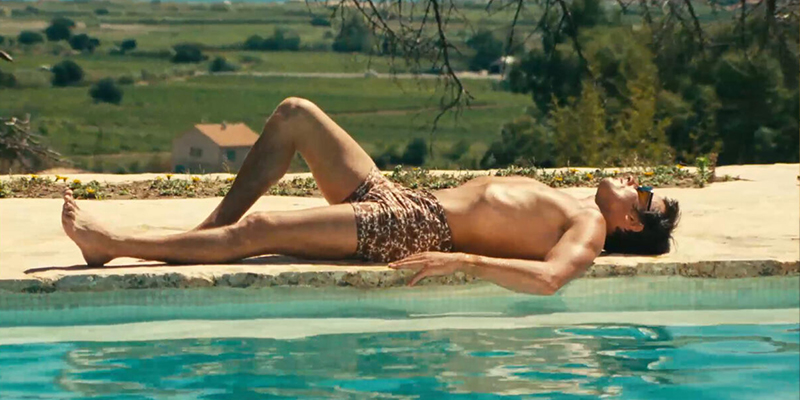
The camera pans slowly across the glimmering, phosphorescent surface of the swimming pool until, languidly, it finds him: bronzed, lean, 33. Reclined by the water. Dark hair resting on hot sandstone slabs. A glass of orange juice perched on his belly, rising and falling with his breath.
His other hand toys with the water’s surface. Delicately it is withdrawn. Glistening droplets run the length of his fingers and drip sensuously onto his face, revealing to the camera for the first time one of the most famous men in the world.
Not Narcissus, but something colder, l’homme fatal. Nonchalantly, from being mesmerized by the water’s surface and his own reflection, he turns his head towards the sky, raises the glass from his chest and pours the juice into his mouth, slow and sensual.
‘And . . . cut!’
He doesn’t move.
Dark glasses on. Eyes closed. Pinned to the tiles by the late-summer heat. The remnants of the orange juice drying on his tanned skin.
His hand returns to the water.
He is, for now, untouchable. At the height of his powers.
‘The most beautiful man in the world.’
*
Once the initial observations are complete, the two forensic pathologists begin the next phase of the autopsy. They make a clean incision across the scalp and peel the skin down on either side, revealing the smashed cranium beneath. The top of the skull is sawn off, the brain removed. Next, they open the torso, slicing through the abdomen to extract the vital organs. No major anomalies, except the liver. Enlarged, discoloured. Consistent with long-term alcohol abuse.
Once the examination is complete, the organs, including the brain, are placed back in the body cavity. The skull is reassembled; the skin pulled back into place and stitched at the crown. Fingerprints are taken and sent to the central police archives in Paris. The man still has no name.
Based on decomposition, the doctors estimate the time of death to be a week earlier, most likely during the night of 22 to 23 September. In their report, they write plainly: the skull had ‘completely collapsed in’. Cause of death: blunt force trauma to the head with a heavy object. The theory holds – for now – that it was a fight, something that got out of hand.
They sign the paperwork. The report is dispatched to the investigating judge.
To Patard.
Patard reads the autopsy report and gives the photographs a cursory glance. He can’t place it, but something feels off.
It’s the hands that catch his eye. Everyone insists the victim is a vagabond. But how many vagabonds have manicured nails?
The next day, a fingerprint match comes through. The deceased is one Stevan Markovic. Thirty-one years old. Born in Belgrade, 1937. The same prints first appear on records in 1958, when this man applied for political asylum in Paris. Then again:
Prison in Chambéry, 1962
La Santé, Paris, 1965
Namur, Belgium, 1964
Annecy, 1967
His last registered address? 22 Avenue de Messine, in the prestigious 8th arrondissement on the Rive Droite. A stone’s throw and the quartier of the Elysée Palace.
This isn’t a fight between vagabonds.
Then another twist. When cross-referenced, it would appear that 22 Avenue de Messine is also home to a famous actor: Alain Delon.
A file arrives from the Brigade Mondaine – the Paris vice squad. Technically tasked with investigating moral crimes, the Mondaine is unofficially tasked with monitoring the rich.
Patard flicks through their dossier on Delon, it’s only a few pages long; a couple of minor run-ins with the law. But then there are the photos: Delon with known gangsters, Corsicans, men who once fought for the Resistance and now run rackets out of Pigalle or control the ports in Marseille.
Who exactly is this Delon? Patard wonders. He calls in two detectives. ‘Go to Avenue de Messine,’ he says. ‘Interview Delon. Find out who this man was to him.’
‘Alain Delon?’
‘Yes. Alain Delon.’
‘You know who he is?’
‘An actor, yes,’ Patard replies.
The detectives stand there, open-mouthed.
‘Right,’ Patard says. ‘Let me know what you find.’
Patard glances at the paperwork again. The residency permit lists the dead man as a political refugee. Occupation: doublure – a stand-in. A stand-in, it would seem, for Alain Delon.
Unlike the two detectives, Patard isn’t impressed. He’s never seen a Delon film. Doesn’t plan to. But something tells him – this case is about to get complicated.


Edward Chisholm
Edward Chisholm, author of A Waiter in Paris, was born in England and moved to Paris after graduating from the School of Oriental and African Studies in London. His work has appeared in The New York Times, The Guardian, and The Financial Times magazine. He lives in England.