How David Mills Helped Bring 'NYPD Blue' to Its Artistic Apex
And how a phone call from Jesse Jackson to the president of ABC helped get him in the writers' room.
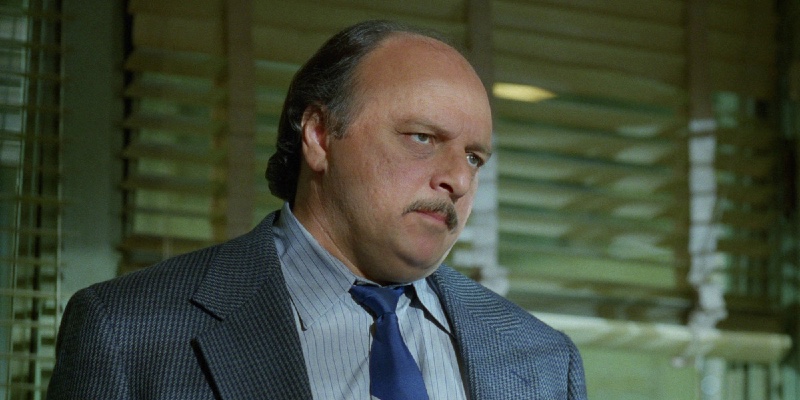
There is scene in “The Backboard Jungle,” episode ten of season three, in NYPD Blue that is unsettling even thirty years after its airdate. Detective Andy Sipowicz, played by Dennis Franz in one the most intense and complicated performances of American television, has become sober after his alcoholism nearly ended his life. He’s redeemed himself in the jaded eyes of his colleagues and formerly estranged son, and entered into a marriage with an intrepid and compassionate assistant district attorney. He and his new partner, Bobby Simone, played by Jimmy Smits, have developed a professional camaraderie that has eased into a close friendship. In the first two seasons of the program, Sipowicz has exposed himself as a racist, perpetually aggrieved at everyone from the Black street criminals who he believes assaulted his father to the “Black bosses,” like his own Lieutenant Arthur Fancy, who respects Sipowicz’s diligence and sharp investigative acumen, but considers his social ideology archaic at best. The audience, in constant amusement over Sipowicz’s bawdy and quick wit, is able to admire him as a flawed hero; a public servant striving to protect the innocent and administer justice, in spite of his bigoted beliefs.
“The Backboard Jungle” treats the audience’s delusions with the delicacy of a hammer smashing against a plate glass window.
Two people are shot dead at a community basketball game in a Black neighborhood. One of the victims was a spectator, while the other was a white woman who had stopped at a nearby intersection when the bullets flew through the air. The incident, to Sipowicz, is confirmation of racist assumptions about Black men, violence, and the dangers of any event where large groups of racial minorities assemble. It also provides supposed vindication for his suspicion of Kwasi, a civic activist who organized the game in honor of a victim of police brutality. Despite having no evidence, Sipowicz has long maintained that Kwasi, rather than working toward the goals of poverty relief, violence prevention, and social uplift, is on the take for drug runners and gang leaders.
With enough velocity to make horns seem appropriate, the two characters confront each other at the hospital, where the pair of detectives intend to interview wounded victims. In the middle of their argument, with Simone trying and failing to pull Sipowicz away, Kwasi yells, “You’re dealing with the one n***** in a thousand who knows what you can and cannot do.” Sipowicz steps closer, and whispers, “No, I’m dealing with the one n****** whose big mouth is responsible for this.” Kwasi reacts by shoving Sipowicz, who then uses the physical contact as predicate for an arrest.
In the elevator, Sipowicz, practically snarling and foaming at the mouth like a rabid dog, steps in Kwasi’s face, and says, “You know a white girl was shot, too. Her only mistake was being on Houston Street when a couple of your lowlife homies decided to act their color.” Kwasi calls him a “racist son-of-a-bitch.” Simone’s face registers a mix of shock, anger, and enough revulsion that one suspects he might vomit.
Fancy, wrestling professional turmoil and personal conflict, allows Sipowicz to keep his job, even after Kwasi complains, telling the detective, “If I move you out, my white bosses will send me a little message, giving me another one just like you, but only he won’t be able to do the job half as good.”
When Sipowicz complains about Fancy’s attitude, Simone says, voice dripping with sarcasm, “Yeah, well I guess Fancy was just acting his color.” Sipowicz replies with indignation, “So, you got a problem with me now?” “Partner, I was not comfortable with your words, and I’m not comfortable with the thoughts behind them,” Simone answers.
The episode concludes with Sipowicz humiliating himself as he tries to defend his language and hatred to his pregnant wife, who looking at him from across the bedroom with shame and disgust in her eyes, instructs him to never speak or act “that way” around their son. The hair on the side of his balding head soaked from the rain, his undershirt showing stains of sweat, he’s reduced from hero to a pathetic and contemptible figure of grotesquery. Just as his racism served a smack in the face to Kwasi, and those who respected him, it jolts the audience back into reality. Racism is not a personality quirk or mild eccentricity. It is a personal and social evil; a cause of death, destruction, ignorance, and ignominy.
One of the institutional mechanisms in place to combat racism, and mitigate the consequences of its multi-century legacy in the US, is Diversity, Equity, and Inclusion. DEI is a set of policies, ranging from support for historically Black and Hispanic-serving universities to broadening recruitment practices to ensure a wider applicant pool, currently under vicious attack from the Trump administration. Under pressure from governmental threats of taxation, regulation, and corporate sabotage, many large companies, including Target and Meta, have dropped their DEI programs. One of the most popular bromides of reactionaries hoping for the elimination of DEI is that it “reduces standards” and “makes companies weaker.”
NYPD Blue functions as a forceful rebuttal to anti-DEI mania. Without diversity and inclusion, the program would have failed to elevate the standards of dramatic television. In fact, episodes like “The Backboard Jungle” would have never existed. “The Backboard Jungle,” along with several of the other best episodes in the series, including those that take a clear-eyed look at American racism, were written by David Mills, the program’s first Black screenwriter.
After graduating from the University of Maryland in the late 1980s, Mills became a successful journalist, writing feature stories for the Wall Street Journal and Washington Post. Then, his college roommate asked him if he would like to help him write screenplays for a program he was developing for a major network. The police procedural was Homicide: Life on the Street, and the roommate was none other than David Simon. Beginning in 1993, he would write three episodes for the series. The foray into television gave him enough motivation to quit journalism, and try his hand full time in the highly competitive and often insular world of screenwriting. He submitted several episodes to the creators of NYPD Blue, but never received the much-coveted phone call.
Then, one of those creators, David Milch, gave the keynote address at a writer’s conference. When an attendee asked why his writing staff was entirely white, even when his show deals with questions of race and has Black and Latino characters, he said, “It is difficult for Black American writers to write successfully for a mass audience.” After the audience gasped, Milch grabbed a shovel and proceeded to dig deeper by asserting that the imagination of Black writers has the limitation of their racial experience, thereby preventing them from creating storylines that resonate with a sizable viewership. The comments demonstrated the classic folly of white ignorance, namely the prejudicial, often unconscious belief that anything Black (or Latino, Indigenous, or Asian) is abnormal and particular, but anything white is, automatically, universal and normal.
Milch’s brazen dismissal of Black talent provoked a massive backlash with much of Black media calling for a boycott of NYPD Blue. Rev. Jesse Jackson, at the peak of his cultural and political powers, called the president of ABC, demanding that the network make an effort at recompense after the co-creator and lead writer of their then-biggest hit program publicly levied at insult at Black people.
“One good thing” came out of the public relations nightmare, David Mills would write on his blog, “Milch hired me.” The relationship between Mills and Milch might have begun under tense circumstances, but it grew into a fruitful partnership. “He gave me a shot, I rose to the occasion, and he became a true mentor,” Mills said of his former boss.
With Mills on staff, and eventually other Black and Latino writers, NYPD Blue triumphed as not only a groundbreaking and emotionally propulsive police procedural, but a repository of social realism in a marketplace that was often superficial and frivolous. Andy Sipowicz would reach for redemption, eventually finding it in familial responsibility and professional integrity. He would disavow his past bigotry, and become a leader to all officers on staff – white, Black, Latino, straight, gay – of the “squad.” His transformation was not easy, nor was it quick. It required the trauma of losing his wife and son, the slow realization that his father’s racism rested on a foundation of lies, and that hatred trapped him within an existential torture chamber of social alienation, self-loathing, and addiction. Demanding sharp attention and viewer patience, the inward hero’s journey of Sipowicz would transpire over years of episodes, cases, personal losses and victories, large and small. Dennis Franz’s character would birth many televisual children, as Sipowicz proved that a highly flawed, even dark protagonist could keep an audience spellbound. It is easy to argue that without Sipowicz, there is no Tony Soprano, Don Draper, or Walter White.
NYPD Blue would win 20 Emmy Awards, four Golden Globes, and two Peabodys. The show was already popular, but it enlarged into the proportions of art only after Jesse Jackson’s intervention, and only after it diversified its writing staff. Most fans of NYPD Blue agree that its peak years were those of the Sipowicz-Simone duo, seasons two through episode five of season six. Mills wrote the best episodes of the series that explore the subject of racism, but proving the man who would become his mentor wrong, he also crafted the story arc involving the murder of Sipowicz’s son and his alcoholic relapse, a sequence of three episodes that fans and critics often evaluate as the series apex.
In the 1990s, Jesse Jackson consistently marshaled his power and influence to act as a roving spokesperson and leader for causes of racial equality, social justice, peace and shared prosperity. Able to insert himself into arguments erupting in the streets, corporate boardrooms, and legislative chambers, he could leverage the power of the consumer boycott or citizenry vote to repair the damage of societal racism and exploitation of the poor. His death on February 17th left the world with a profound personal absence, while measuring the loss of leadership on the national level. There is no longer a single figure who can exercise the power of Jesse Jackson in the service of edifying causes. No liberal or progressive remains whose phone call can make a corporate executive squirm. The leadership deficit is especially evident in the failure to counteract the federal assault on DEI programs – the exact kind of programs, whether official or not, that have consistently strengthened the culture within the world of art and entertainment.
David Milch would often discuss the emotional and biographical proximity between himself and his most beloved character, Andy Sipowicz. They were both alcoholics, and clearly, they both struggled with matters of race. They also both altered their identities, evolving into better versions of themselves – an evolution that was possible only with the catalyst of the company of those who were different.
In a make-believe police precinct and an actual writer’s room; in the fictional universe and real world, diversity works.

David Masciotra
David Masciotra is the author of several books, including Exurbia Now: The Battleground of American Democracy and I Am Somebody: Why Jesse Jackson Matters. He has also written for CounterPunch, Salon, and the Washington Monthly, where he is a contributing writer. His Substack is Absurdia Now.