On Slashers, Summer Flics, and Moving Beyond Typecasting
Yesterday's horror reinforced stereotypes. Today's cinema overturns them.
I saw my first slasher movie when I was about nine years old, at a school friend’s birthday party. Her parents had rented A Nightmare on Elm Street for us because that cute guy my classmates liked from 21 Jump Street was in it. (I’m dating myself here.)
A lot of horror author origin stories seem to start this way: stumbling on a slasher film at an uncommonly tender young age, which forges them into a fan for life. But Nightmare on Elm Street made the opposite impression on me. My media exposure had been extremely sheltered up to that point. My mother didn’t even let me watch cartoons, except Disney, because she thought they were too violent. So you can imagine how shocked I was by Wes Craven’s graphic set pieces: Tina writhing across the ceiling as bloody slashes cover her body; the scarlet fountain erupting from a bed; Freddy Krueger ablaze as he holds down Nancy’s mom. (My friends, by the way, were completely unfazed and more interested in the kissing scenes.) And the concept of someone who could kill you in your dreams? Someone with knife hands? Absolutely terrifying. I was afraid to sleep for weeks. Although I became a Stephen King fan when I was older, I steadfastly remained leery of slasher movies.
Fast forward over thirty years. My writing had been drifting toward horror (although writer friends have pointed out the elements were always there), and I figured I should broaden my education. Newly divorced, and finally able to watch what I wanted on TV after my young son went to bed, I cued up Halloween. Friday the 13th. The Slumber Party Massacre. Black Christmas. Prom Night. Sorority House Massacre. From there I moved on to modern slashers: Cabin in the Woods, the Evil Dead reboots, and of course, all the Scream movies. I even rewatched my old nemesis, Nightmare on Elm Street—and loved it.
It turned out in order to become a slasher fan, I only needed to watch more of them.
I have the type of brain that loves patterns. As a teenager, I imprinted on Joseph Campbell’s The Power of Myth as he validated what I’d already noticed from reading world mythology and Andrew Lang fairy tales: certain archetypes keep repeating themselves. While watching slashers, I immediately latched on to the “Final Girl”, as christened by Carol J. Clover in her 1992 film theory book Men, Women and Chain Saws. The last survivor of a slasher, usually female, who starts off quiet and unassuming, but eventually finds the agency to overcome the bad guy. (It’s perhaps not a coincidence I found this archetype appealing after making it through a divorce.)
Other slasher character tropes were apparent too, easy to spot when you grew up in the 1980s on teen movies like The Breakfast Club, Pretty in Pink, and Can’t Buy Me Love. The stereotypes act as a story shorthand. Here is the meathead jock, the hapless nerd, the promiscuous cheerleader. The audience immediately grasps how they fit into the plot and the potential conflicts they might have with others. Who is the antagonist and who is the hero? Character tropes answer that question quickly, reinforcing the story’s formula and setting up viewer expectations. Especially in slasher films, where there’s not a lot of time to get to know the cast before the blood starts spraying. We’re introduced to the good girl who’s “not like the others”, and the ill-fated friends in her orbit. Thrown into a life-or-death situation, the terror strips away the characters’ pretenses until all they’re left with is who they truly are: victims or survivors.
It turned out in order to become a slasher fan, I only needed to watch more of them.
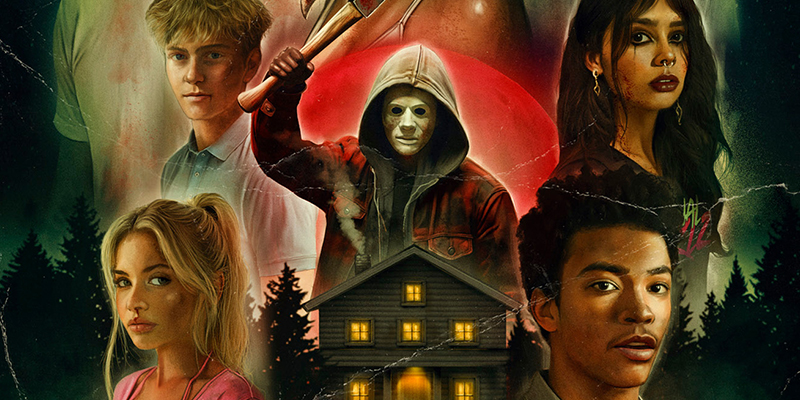
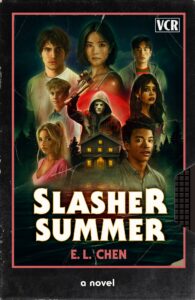
The characters in my novel Slasher Summer have been similarly pigeonholed as certain types. While part of their high school’s horror film club, they performed in raucous Rocky Horror-style showings of a cult slasher movie that had been filmed at a local cabin. How does it make you feel when an audience yells “Jock!” or “Nerd!” or “Virgin!” as you’re playing a role? What does that do to your head when people are quick to judge you from your surface traits?
Well, I know what that does to your head. As a second-generation Chinese Canadian woman, I’ve been dealing with others’ assumptions all my life. (Yes, I speak English. No, I’m only average at math.)
I suspect slashers have resurged in popularity not just due to nostalgia for the simple scares of our childhoods, but because GenX and Millennial writers and filmmakers are having conversations with them. Especially those of us who never saw ourselves reflected in the characters, or were faced with the stereotypes. As I approach a certain age and have parsed more of human behavior, I’ve started getting saltier about the unfairness when it comes to identity. I’ve started asking: Who is allowed to be themselves? And who has to code-switch or mask to fit in? And what is the psychological toll of that masking? (This last question is especially relevant if you’re neurodivergent and have to navigate a world that isn’t designed for you.)
And how do others react when you try to step out of the box they put you in?
In Slasher Summer, I used slasher character tropes to try to answer these questions by subverting and interrogating the stereotypes. For example, I made my stoner character Asian, since Asians are often portrayed as overachievers. Cheerleader Tiffany is concerned with appearances, but she’s also smart and ambitious and it’s acknowledged that cheer is a challenging sport. Other characters, like “jock” Jason and “good girl” Carrie, chafe against the expectations of how they should act. Carrie resents her Final Girl designation the most, but when a masked killer menaces her friends’ reunion, she’s forced to reconcile with it.
And that is the most terrifying threat of all. A masked man with an axe is nothing. The real horror is not being able to escape who you were in high school.
***

E.L. Chen
E. L. Chen is the author of Sweetside Motel and One of Us Is Already Dead. Her YA fantasy Summerwood/Winterwood was longlisted for the Sunburst and recommended as a Best Book for Kids and Teens by the Canadian Children’s Book Centre, and her short fiction has appeared in venues such as Strange Horizons, On Spec, and The Dark. She lives in Toronto, Canada with her son and a towering TBR pile.