

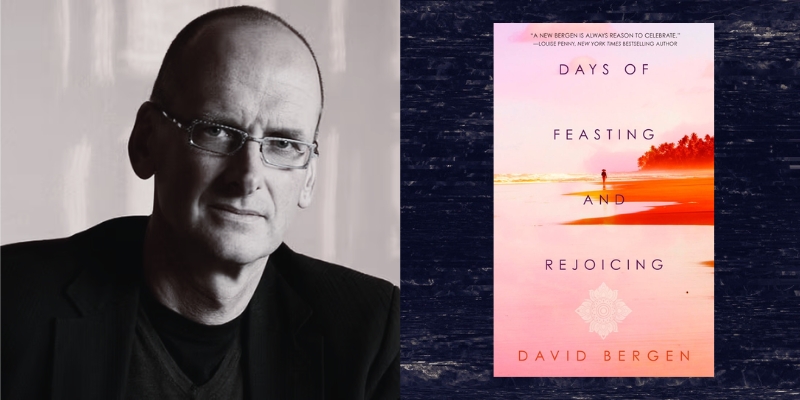
David Bergen on Patricia Highsmith, Backstories, and Why Tom Ripley's Character Works
The author of Days of Feasting and Rejoicing creates a Ripley-like "Other" in Thailand
Patricia Highsmith’s novels, specifically The Talented Mr. Ripley, Ripley Underground, and Ripley’s Game, are the holy grail of crime writing. Two more Ripley novels followed—The Boy Who followed Ripley and Ripley Under Water—but they are considered as the two youngest siblings that didn’t quite live up to their inheritance.
Having read The Talented Mr. Ripley many times (and having watched the various films and TV series), upon each reading I come away with a newfound admiration for how Highsmith takes a minor grifter like Tom, and builds him into a character who is repressed, fearful, funny, messily violent, sexually ambivalent, full of longing, and ultimately sympathetic. He is so clearly hopeful, so optimistic.
When Dickie’s father appears and offers Tom a chance to chase down Dickie in Italy, all expenses paid, it affirms Tom’s outlook: “Something always turned up. That was Tom’s philosophy.” And so the reader breathlessly follows Tom, discovering that “what turns up” is a slow burn towards fantastical violence where blunt objects such as an oar and an ashtray become instruments of death.
Critics and readers have focussed on Ripley’s latent homosexuality, and how the repression created an angry young man capable of killing Dickie Greenleaf, a blond blue-eyed young American whom Ripley might desire; a few seconds before swinging the oar, Tom thinks “he could have hit Dickie, sprung on him, or kissed him, or thrown him overboard….” However, Highsmith is more interested in the impulses at the edge of desire, in alienation, in the act of survival, and the subconscious urge to run towards an ideal.
One of the objects of Tom Ripley’s desire is wealth. Beautiful things. In the second novel of the Ripliad, Ripley Underground, Ripley lives in a villa in the south of France, is married to the striking Heloise Plisson, a woman with zero moral values, with whom he makes love once a week, and who conveniently disappears while he commits a crime, and then spices up his life by returning with new clothes. She is one more beautiful thing that whispers at the boundaries of his secret life.
Highsmith gives us little history of Tom Ripley, and so we have no sense of what “made” Tom. Another writer might introduce a traumatic childhood, or some abuse newly recalled, or the horrible evil stepmother, to justify a character who kills with robotic coldness and efficiency and then cleans up his own messes with very little emotion; a dead body is a mere object to get rid of.
Ripley knows what he has done, but he justifies each violent action as an unfortunate necessity. To create a character who has no background, no formative traits, no history, no emotional purchase, and then to make that character believable and sympathetic, is a feat.
Consider Chigurh, in No Country for Old Men, who has no apparent history or motivation for his killing, other than to get a job done, but Chigurh is like a malevolent god who metes out justice based on the flip of a coin, and there is no sympathy for him. In Ripley’s case, we feel a connection, a weird little twist of fondness for the young man who others make fun of.
The Talented Mr. Ripley is a story of movement and action. It begins with Tom Ripley looking over his shoulder avoiding a man who is following him. It ends with him picturing four Cretan policeman waiting on an imaginary pier. Will Tom always be looking over his shoulder?
Early on Tom thinks, “If there was any sensation he hated, it was that of being followed, by anybody.” And yet, his actions invite following. Tom, at the height of avoiding being caught, moves from town to town, hops from train to boat and back to train, wondering who he in fact is. Tom? Dickie? Tom?
The best narrator must convince the reader that the story being told is true and real and actually happened and that the deaths, the murders, the near misses, the lies: all of this is unavoidable. Highsmith is a master of narration. Watch Tom act. Watch him walk. Watch him dress. Watch him think. Watch him plan. Watch him kill. Watch him watching himself kill.
No mystery there. We know Tom. We cringe when he wears Dickie’s clothes, and steals Dickie’s rings, and preens in front of Dickie’s mirror. He is friendless, and hollow, and pitiable.
And still we follow him into the darkness. Highsmith woos the reader just as Ripley woos the people around him. Both are consummate narrators—come, I will tell you a story about a man named Tom. Both are great magicians of words and acts, and oh how we, the readers, fall for the trickery, the evasion, the theft of personality, the longing, the escape.
Three decades ago I lived with my wife and children in southern Thailand, close to the refugee camp where I taught English. In the evenings, in our small town, I read Highsmith while the bugs beat down and died on the pages. It was my first experience of her, and perhaps, unconsciously, in the heat of Southeast Asia, bending towards Ripley, I experienced an inkling of what would become my novel, Days of Feasting and Rejoicing. It takes place in Thailand, and the crucial setting for the novel is the house I used to live in in Phanat Nikhom.
My main character, Esther Maile, like Tom Ripley, suffers a form of “otherness,” a desire to run from herself, and she finds that other self when her roommate dies, or is perhaps drowned by Esther, and so we watch Esther become someone else. Anybody, please, but herself. It is a high form of cannibalism. Of course, when you eat the other and then run and hide, you still take yourself with you, and if you are a wanted person, it is that self and no other, that others hunt for.
***


David Bergen
David Bergen is the author of numerous acclaimed novels and short-story collections, including The Time In Between, winner of the Scotiabank Giller Prize; and Out of Mind, winner of the McNally Robinson Book of the Year Award; Away from the Dead; and Days of Feasting and Rejoicing. He lives in Winnipeg, Manitoba.